Faris Adani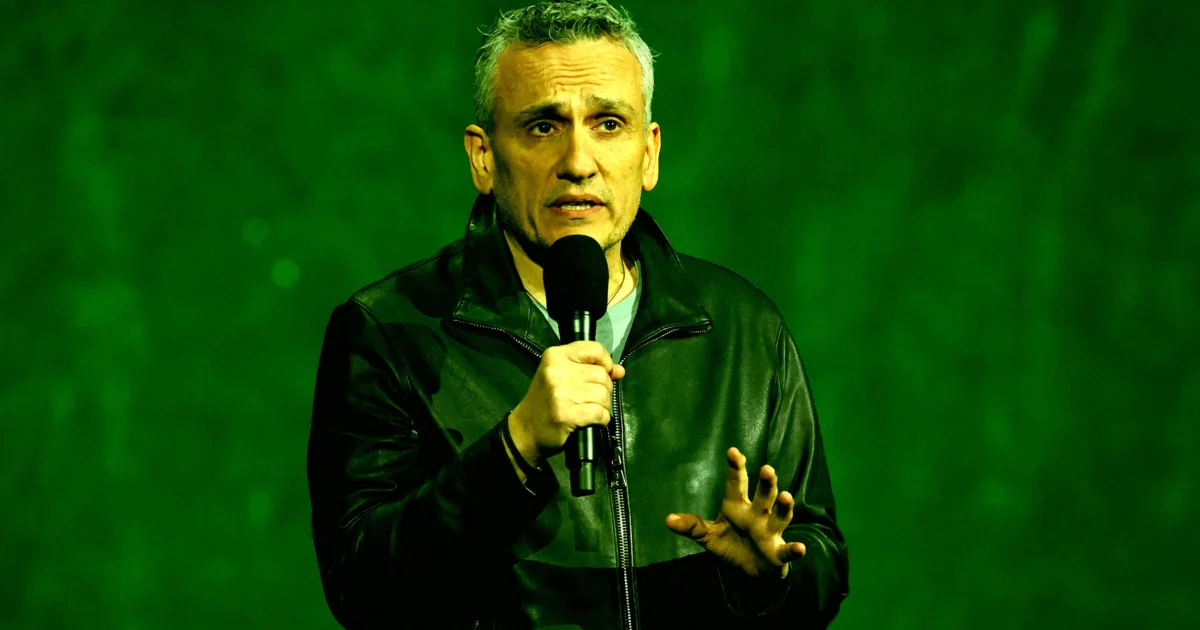
Sign up to see the future, today
Can’t-miss innovations from the bleeding edge of science and tech
Three Years Ago Today, “Avengers” Director Joe Russo Predicted There Would Be a Fully AI-Generated Movie Within Two Years.
In a striking testament to the often-overstated pace of technological advancement in the entertainment industry, exactly three years ago, acclaimed filmmaker Joe Russo, known for helming blockbusters like “Avengers: Endgame,” boldly declared in an interview with *Collider* that audiences would witness a fully AI-generated movie within a mere two years. This ambitious prognostication, made amidst a burgeoning hype cycle for artificial intelligence, has yet to materialize, serving as a poignant reminder of the chasm between speculative futurism and the complex realities of creative production. While AI continues to integrate into various facets of Hollywood, from special effects to script analysis, the vision of a complete, coherent, and critically acclaimed feature film produced solely by algorithms remains a distant horizon, far removed from the “cooked” status that some AI enthusiasts prematurely bestowed upon the industry years prior.
Russo, a prominent figure not only in filmmaking but also reportedly on the board of several AI companies, has positioned himself as a vocal proponent for generative AI, frequently advocating for its potential to revolutionize storytelling. His enthusiasm stems from a belief in the “democratization of storytelling,” arguing that AI tools could empower aspiring artists lacking the extensive resources typically required to enter the highly competitive film industry. He envisioned a future where the barriers to entry would be dramatically lowered, allowing a new generation of creators to bring their visions to life with unprecedented ease and accessibility, bypassing traditional gatekeepers and expensive production pipelines. This perspective suggests a utopian ideal where AI serves as an equalizer, leveling the playing field for creative expression.
Beyond merely aiding aspiring filmmakers, Russo’s vision extended to a deeply personalized, on-demand entertainment experience. He famously predicted a scenario where consumers could interact directly with their streaming platforms, using AI to craft bespoke cinematic content. “You could walk into your house and save the AI on your streaming platform,” Russo illustrated, “‘Hey, I want a movie starring my photoreal avatar and Marilyn Monroe’s photoreal avatar. I want it to be a rom-com because I’ve had a rough day,’ and it renders a very competent story with dialogue that mimics your voice.” This futuristic concept of hyper-personalized, algorithmically generated narratives, complete with custom casts and genres, painted a picture of entertainment as a fluid, responsive entity, tailored precisely to individual whims and moods. Such a paradigm shift would fundamentally alter the relationship between content creators and consumers, transforming passive viewing into an active, co-creative experience.
However, the reality of AI’s integration into Russo’s own filmography has offered a more ambiguous, and at times, critical, reflection of his predictions. Critics and audiences alike have observed a perceived “AI-generated” aesthetic creeping into his recent works, leading to questions about the originality and artistic depth of films like “The Gray Man” (2022) and the upcoming “The Electric State” (2025). “The Gray Man,” a massive $200 million production, was widely criticized for feeling like an anonymous assemblage of action movie tropes, a patchwork of reheated set pieces and predictable narratives that even the star power of Ryan Gosling and Chris Evans couldn’t elevate beyond generic competence. It felt less like a passion project and more like a film meticulously crafted by an algorithm designed to hit every demographic and genre beat, resulting in a product that was technically proficient but devoid of a distinct human touch or innovative spirit.
Similarly, “The Electric State,” with an even more staggering budget of $320 million, has faced accusations of embodying a “fake-movie aesthetic,” an “AI-bowdlerization” of the illustrated novel it was loosely based on. The implication is that the film’s narrative, visual style, and overall tone might have been streamlined or homogenized by a process akin to what a large language model might produce when given the prompt “make it EPIC!” This suggests a creative process driven by data-optimized formulas rather than raw, idiosyncratic artistic vision. The concern is that while AI might be capable of assembling “competent” stories, it struggles to imbue them with the unique spark, emotional resonance, or subversive originality that defines truly great human-made art.
Despite the current gap between his ambitious forecasts and the industry’s present capabilities, Joe Russo has remained an unyielding advocate for AI. Following the early 2025 release of “The Electric State,” which reportedly garnered significant negative attention for its perceived shortcomings, Russo proudly admitted to employing AI-powered voice modulation in its production. This admission, made amidst a climate of growing skepticism and concern within Hollywood regarding AI’s ethical and artistic implications, underscored his commitment to pushing the boundaries of technology in filmmaking. He further dismissed industry apprehension, asserting that AI’s limited adoption was due to people being “afraid” and simply “not understanding” the technology. This stance, however, often overlooks the deeply rooted anxieties within the creative community concerning job displacement, intellectual property rights, and the potential erosion of human artistry.
The debate surrounding AI in Hollywood is far from settled, polarizing the industry into staunch advocates and wary skeptics. The WGA (Writers Guild of America) and SAG-AFTRA (Screen Actors Guild – American Federation of Television and Radio Artists) strikes of 2023 vividly illustrated the profound fears held by creators. Writers fought for protections against AI generating scripts based on their work without fair compensation or credit, while actors sought safeguards against the unauthorized replication of their likenesses and voices, fearing a future where digital doubles could be exploited without their consent or proper remuneration. These industrial actions highlighted that the resistance to AI isn’t merely a matter of fear or misunderstanding, but a legitimate concern for economic security, artistic integrity, and human dignity in a rapidly changing technological landscape.
While Russo and other AI proponents are likely correct in their broader assertion that AI will undeniably transform the entertainment industry, the nature and pace of this transformation are proving to be far more nuanced than initially predicted. AI is already indispensable in various behind-the-scenes capacities: from sophisticated CGI and deepfake technology that can seamlessly alter performances, to AI-driven tools for pre-visualization, editing, and even marketing analysis that predicts audience preferences. It’s used to de-age actors, create complex digital environments, and streamline post-production workflows. However, these applications serve as powerful tools *assisting* human creators, rather than replacing them entirely as primary narrative engines.
The aspiration for fully AI-generated blockbusters, as envisioned by Russo, remains largely unfulfilled because current generative AI models, while impressive in their ability to produce text, images, or short video clips, still struggle with the fundamental requirements of long-form narrative coherence, emotional depth, and original artistic vision. The “AI slop” observed in some early attempts, like the AI film reportedly pulled from AMC theaters or the content from certain Chinese streaming competitors, demonstrates that quantity does not equate to quality. These early forays often lack the subtle nuances, character development, and thematic complexity that resonate with human audiences. The ability to craft a compelling, emotionally resonant story with genuine originality, one that captures the zeitgeist or pushes creative boundaries, still requires the unpredictable, intuitive, and deeply human elements of imagination, empathy, and lived experience.
Ultimately, the future of AI in filmmaking will likely be a collaborative one, where technology serves as an increasingly sophisticated paintbrush in the hands of human artists. While Joe Russo’s prediction of a fully AI-generated film within two years missed its mark, his advocacy highlights a crucial ongoing dialogue about the evolving relationship between technology and creativity. The industry will continue to grapple with how to harness AI’s power effectively and ethically, ensuring that while the tools become more advanced, the heart and soul of storytelling remain undeniably human. The challenge lies not in avoiding AI, but in integrating it in a way that amplifies human creativity rather than diminishing it, preserving the irreplaceable spark that only human ingenuity can ignite on the silver screen.
More on AI: Chinese Netflix Competitor Opens Floodgates to AI Slop