Galbot
Sign up to see the future, today
Can’t-miss innovations from the bleeding edge of science and tech
This Video of a Humanoid Robot Playing Tennis Is Extremely Impressive. The excitement surrounding recent strides in humanoid robotics is palpable, with these sophisticated machines rapidly transitioning from research labs to practical applications across diverse sectors. From the factory floor where they’re being used to assemble electric cars with unprecedented precision and efficiency, to logistics hubs where they sort packages, and even entertainment venues where they perform carefully choreographed martial arts on stage, bipedal robots are demonstrating capabilities once confined to science fiction. Their utility has even extended to grim realities, with reports of humanoid robots being sent to the frontlines of the Ukraine-Russia war, and their nascent integration into public spaces leading to humorous, albeit sometimes awkward, encounters, like getting in trouble after startling old ladies on the street.
The realm of sports has also proven to be no match for these increasingly agile automatons. We’ve witnessed them master fundamental athletic skills, from shooting hoops with surprising accuracy to engaging in live kickboxing matches that captivate crowds. Yet, a recent demonstration by Chinese AI robotics company Galbot marks a significant leap forward, showcasing a humanoid robot engaged in a veritable feat of athletic prowess: effectively playing tennis, allowing it to keep its own in a match-up against a human engineer.
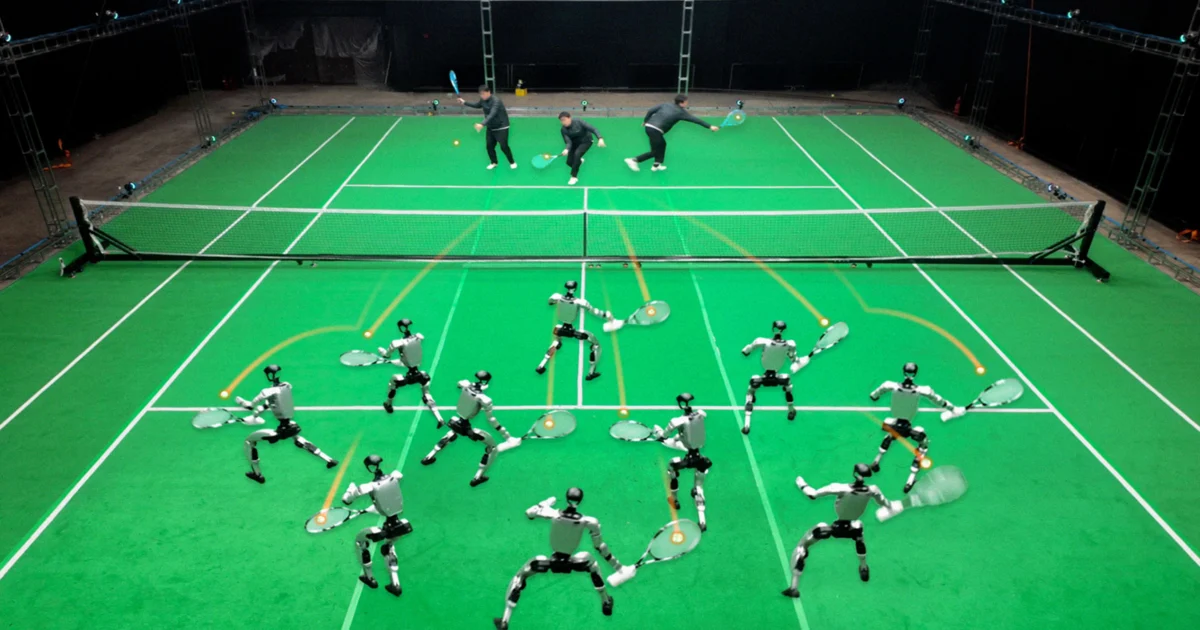
Galbot has engineered sophisticated software that enables a Galbot G1 humanoid robot (based on the Unitree G1 platform) to perform complex tennis maneuvers. A captivating video, which the company posted to social media, offers a compelling glimpse into this achievement. The white robot, strikingly human-like in its movements, holds what appears to be an unmodified tennis racket. With fluid, coordinated motion, it shuffles across the court, deftly returning the ball with remarkable consistency. This isn’t merely a static demonstration; the robot exhibits dynamic footwork and precise racket control, tracking the ball’s trajectory and positioning itself to strike with surprising accuracy.
This accomplishment stands as yet another impressive demonstration of how far robotics technology, particularly in the domain of AI-driven locomotion and manipulation, has come. The ability to engage in a sport like tennis, which demands real-time perception, predictive analytics, intricate full-body coordination, dynamic balance, and fine motor control, pushes the boundaries of what was previously thought possible for humanoid robots. While the human engineers in the video appeared to deliver relatively “lighthanded volleys,” providing a controlled environment for the robot to showcase its capabilities, the underlying technology represents a monumental step. The question of whether this robot, or its future iterations, will be able to keep up with the likes of Novak Djokovic or Serena Williams any time soon remains an open one, requiring exponential increases in power, speed, strategic intelligence, and the ability to adapt to unpredictable human opponents. However, the foundational achievement is undeniable.
Galbot, through its social media announcement, proudly proclaimed the significance of this breakthrough: “For the first time, a humanoid robot can sustain high-dynamic, long-horizon tennis rallies with millisecond-level reactions, precise ball striking, and natural whole-body motion.” This statement underscores several critical aspects of their innovation. “High-dynamic” refers to the robot’s ability to react to fast-moving objects and execute rapid, forceful movements. “Long-horizon” indicates its capacity to maintain performance over extended rallies, implying robust control and energy management. “Millisecond-level reactions” highlight the extreme computational speed required for real-time tracking and response. Perhaps most importantly, “natural whole-body motion” suggests a departure from the often jerky, mechanical movements of earlier robots, indicating a more sophisticated integration of balance, gait, and arm movements that mimic human fluidity. “This marks a leap from mechanical motion imitation to intelligent, decision-driven athletic interaction,” Galbot asserted, emphasizing the cognitive aspect of the robot’s performance over mere programmed movements.
The core of this advanced capability lies in Galbot’s innovative algorithm, dubbed LATENT, which stands for “Learning Athletic Humanoid Tennis Skills from Imperfect Human Motion Data.” This methodology addresses a common challenge in robotics: the difficulty of acquiring perfect, comprehensive datasets for complex tasks. As detailed in a yet-to-be-peer-reviewed paper, the company’s engineers devised a system that relies on “imperfect human motion data.” This data consists “only of motion fragments that capture the primitive skills used when playing tennis rather than precise and complete human-tennis motion sequences from real-world tennis matches.”
This approach is particularly ingenious because it circumvents the need for exhaustive, perfectly curated human demonstrations, which are incredibly resource-intensive to collect. Instead, by leveraging “motion fragments,” the system can glean fundamental insights into human tennis skills—such as forehand swings, backhand footwork, or serving motions—even if these fragments are incomplete or contain minor errors. The engineers found that “Our key insight is that, despite being imperfect, such quasi-realistic data still provide priors about human primitive skills in tennis scenarios.” This means that even fragmented data offers valuable foundational knowledge. Through a process of “further correction and composition,” the LATENT algorithm synthesizes these imperfect fragments into a coherent, robust policy. The result is a “humanoid policy that can consistently strike incoming balls under a wide range of conditions and return them to target locations, while preserving natural motion styles.” This ability to learn from less-than-perfect data significantly lowers the barrier to training robots for complex, dynamic tasks.
The implications of the LATENT framework extend far beyond the tennis court. The engineers argue that their system could have widespread applications, stating, “Although this work primarily focuses on the tennis return task, the proposed framework has the potential to generalize to a broader range of tasks where complete and high-quality human motion data are unavailable.” This is a crucial insight for the future of humanoid robotics. Imagine robots learning to perform intricate surgical procedures, complex manufacturing assembly, or even nuanced caregiving tasks by observing and interpreting fragmented human demonstrations, rather than requiring perfectly scripted, exhaustive training sequences. This paradigm shift could accelerate the deployment of intelligent robots in industries where data collection is challenging or where human expertise is diverse and difficult to formalize into perfect datasets.
The technical specifications of the Galbot G1, presumably based on the Unitree G1’s robust design, contribute significantly to its athletic performance. Humanoid robots require advanced actuators for powerful and precise movements, sophisticated sensor arrays for real-time environmental perception (including vision for ball tracking and proprioception for body awareness), and powerful onboard computing for rapid decision-making. The integration of these hardware components with the LATENT software allows for the “millisecond-level reactions” and “precise ball striking” that Galbot highlighted. While the video showcases controlled volleys, the inherent agility and coordination demonstrated suggest a platform capable of much more, provided further training and refinement.
Looking ahead, the development of humanoid robots capable of athletic feats like tennis opens up exciting possibilities. In sports, robots could serve as tireless, objective training partners, helping human athletes refine their technique and strategy against consistent, high-performance opponents. They could also revolutionize sports entertainment, potentially leading to new robotic sports leagues or hybrid human-robot competitions. More broadly, the ability to learn complex, dynamic tasks from imperfect data is a game-changer for industrial and service robotics. It paves the way for robots that are more adaptable, easier to train, and capable of operating in unstructured, unpredictable environments, from construction sites to homes.
Of course, significant challenges remain. To compete at a professional human level, a robot would need to master not only power and precision but also strategic thinking, stamina, adaptability to varying court conditions and opponent styles, and even the psychological aspects of competitive play. Current robots, while impressive, still require controlled environments and human supervision. Battery life, maintenance, and the sheer cost of these advanced machines are also practical considerations for widespread deployment. However, the rapid pace of innovation in AI and robotics suggests that many of these hurdles will be overcome in the coming decades.
In conclusion, Galbot’s demonstration of a humanoid robot playing tennis with such agility and precision is a testament to the synergistic advancements in robotics hardware and AI software. The LATENT algorithm, with its novel approach to learning from imperfect human motion data, represents a significant methodological breakthrough that extends far beyond the confines of a tennis court. As humanoid robots continue to evolve, blending sophisticated AI with robust physical capabilities, they are poised to redefine human-robot interaction, automate complex tasks, and potentially even elevate the future of sports. This achievement is not just about a robot playing a game; it’s a powerful indicator of the intelligent, decision-driven future that is rapidly unfolding.

Related Posts

Faris Adani
- Future Tech
- Innovation
- September 13, 2026
- 0 Comments
Amazon Unleashes AI Lip-Syncing for Dubbed Content, Igniting "Uncanny Valley" Fears and Artistic Integrity Debates
Yuganov Konstantin / Shutterstock / Futurism In a move poised to fundamentally reshape the global consumption of filmed entertainment, Amazon’s Prime Video streaming service announced this Thursday, September 10, 2026,…

- Future Tech
- Innovation
- September 12, 2026
- 0 Comments
Earth May Have Had a Larger Cousin that the Sun Devoured
A groundbreaking investigation by a team of astronomers suggests a dramatic and previously unknown chapter in the history of our solar system: the Sun may have consumed a massive, rocky…