Faris Adani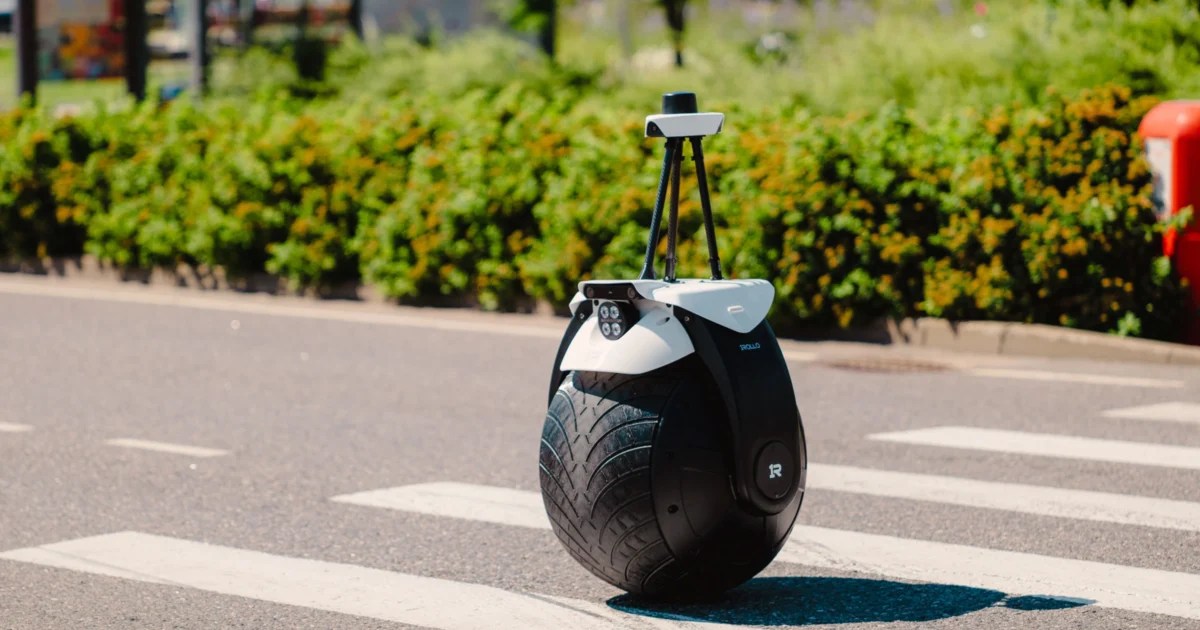
The landscape of modern policing and private security is undergoing a profound transformation, with technological innovations rapidly shifting from speculative fiction to urban reality. As North American and European law enforcement agencies increasingly invest in high-tech solutions, the public sphere is becoming a testing ground for a new generation of autonomous guardians. While much of the spotlight has fallen on intimidating "robo-dogs" from companies like Boston Dynamics or the distinctive, egg-shaped sentry-bots from Knightscope, an Estonian startup named Rollo Robotics is charting a different, arguably more provocative, course. Their latest creation, a roving sentinel dubbed "1Rollo," takes on the whimsical yet deeply unsettling form of a self-balancing, two-foot-diameter rubber kickball, a design choice that, as New Atlas aptly reports, immediately conjures images of its inevitable confrontation with an exasperated public.
The very concept of 1Rollo introduces a fascinating paradox: a sophisticated surveillance tool deliberately shaped like a children’s toy, almost inviting interaction – or, more likely, aggressive rejection. This seemingly innocuous form factor, combined with its stated mission of replacing human security personnel, positions 1Rollo squarely at the intersection of technological advancement, public privacy concerns, and the simmering discontent over expanding surveillance infrastructure. The question isn’t if this peculiar police gadget will face resistance upon live deployment on city streets, but rather how quickly it will be targeted by individuals and groups already vocal and active in their opposition to automated monitoring.
Across Europe and the United States, a growing wave of protests has manifested in direct action against perceived intrusions on privacy and civil liberties. Surveillance cameras, particularly those integrated with AI capabilities for facial recognition or predictive policing, have become tangible symbols of an encroaching surveillance state. Reports from outlets like CNN detail instances of protestors systematically cutting down or disabling "Flock" brand camera systems in the US, while Connexion France has highlighted the increasing vandalism of speed radars, often seen as impersonal tools of state control. Even camera drones, intended for broader area monitoring or search-and-rescue operations, have been targeted and destroyed. This established pattern of resistance sets a precarious precedent for any new robotic sentinel, especially one as conspicuously designed as the 1Rollo. One cannot help but envision its perfectly spherical body, presented like a challenge, being sent "to the Moon with a swift kick" by someone fed up with being watched.
At its core, the 1Rollo robot is a marvel of engineering, embodying several cutting-edge robotic principles within its unique form. The bulk of its two-foot-diameter body is comprised of a single, stable monowheel, a design that allows for exceptional agility and a relatively small footprint. Perched atop this central wheel, approximately 3.5 feet from the ground, is its primary sensory array: an AI-integrated 360-degree camera antenna. This camera system is not merely for passive observation; Rollo Robotics implies advanced onboard AI capabilities, likely including object detection, anomaly recognition, and potentially even rudimentary facial or gait analysis, enabling the bot to identify suspicious activity or track individuals within its field of view. Data collected by this omnidirectional camera is then transmitted wirelessly, presumably to a central command center or cloud-based analytics platform, allowing for real-time monitoring and threat assessment.
The company proudly declares 1Rollo as the "world’s first mono wheel robot," a claim that speaks to the novelty of its design and the sophistication of its internal mechanics. Central to its operation is a robust gyroscope-based stabilization system. Given that a monowheel inherently lacks the static stability of multi-wheeled or legged robots, these gyroscopes are crucial for maintaining balance, especially when the robot is in motion, navigating uneven terrain, or encountering external forces. This self-balancing act allows the 1Rollo to glide smoothly and maintain its upright posture, even at considerable speeds. Speaking of speed, the robot boasts an impressive top speed of 19 miles per hour, making it capable of patrolling large areas quickly and responding rapidly to incidents. Furthermore, Rollo Robotics emphasizes the robot’s rugged weatherproofing, specifically designed to withstand Estonia’s notoriously extreme winters, suggesting a robust casing and internal components capable of operating in freezing temperatures, snow, and rain.
However, the technological prowess of the 1Rollo is overshadowed by its business proposition, which, like many companies in the burgeoning AI and robotics sector, leans heavily on the promise of cost-savings. Rollo Robotics’ website boldly asserts, "Human patrol is expensive, inefficient, and now replaceable," a statement that succinctly captures the economic rationale driving much of the automation trend in security. The company highlights that there are 28.5 million frontline security workers globally and claims that the 1Rollo could deliver "labor cost reduction" of over 80 percent. This figure is derived from their assertion that three 1Rollo bots can effectively replace nine human security personnel – one robot per 24-hour shift.
This claim, however, immediately encounters a significant practical hurdle: the 1Rollo’s stated eight-hour battery life. For a robot to genuinely provide 24-hour coverage, a single unit is insufficient. A continuous operation model would necessitate a minimum of three robots per patrol area, cycling through active duty and charging. This introduces complexities related to charging infrastructure, seamless handovers between units, and the potential for downtime, which are often glossed over in marketing materials focused purely on direct labor cost reduction. While the initial investment in robotic hardware might be significant, companies like Rollo Robotics argue that the long-term operational savings on salaries, benefits, training, and human-related overheads far outweigh these costs. Yet, the true "cost" extends beyond mere dollars, touching upon the ethical implications of job displacement and the societal impact of replacing human interaction with automated surveillance.
The deliberate choice of a "kickball" aesthetic for a security robot is particularly intriguing and, from a public relations standpoint, potentially disastrous. While some might argue it’s an attempt to make the technology less intimidating, the historical context of public resistance suggests the opposite. The "soccer ball" shape, far from being endearing, could be perceived as mocking, a playful façade for a serious surveillance apparatus. It transforms a piece of technology into an irresistible target for a disgruntled individual. Unlike a static camera mounted high on a pole or a drone flying out of reach, the 1Rollo is designed for ground-level interaction, making it inherently more vulnerable to physical interference.
One can easily imagine scenarios beyond a simple kick: what about spray paint obscuring its camera lens, rendering its AI blind? What about being tipped over, rolled into a ditch, or simply stolen? While robust weatherproofing might protect against environmental elements, it offers little defense against determined human intervention. The very design that makes it agile and maneuverable also makes it perfectly suited for a swift, forceful punt – a form of protest that requires minimal effort but delivers maximum symbolic impact. This vulnerability contrasts sharply with the armored, more formidable designs of other security robots, which, while also targets, present a greater physical challenge to disable. The 1Rollo’s design seems to invite the very vandalism it’s meant to deter.
The broader implications of deploying such robots extend beyond mere cost-benefit analyses and susceptibility to vandalism. The increasing integration of autonomous robots into law enforcement and security raises fundamental questions about accountability, algorithmic bias, and the appropriate boundaries of surveillance in a democratic society. Who is responsible when an AI-powered robot makes an error in judgment, misidentifies a threat, or fails to intervene effectively? How are privacy rights protected when omnipresent, 360-degree cameras are constantly recording in public spaces? The transition from human security guards, who possess empathy and the capacity for de-escalation, to emotionless machines, however sophisticated, marks a significant shift in the nature of public safety.
The 1Rollo, with its innovative monowheel design and AI-driven surveillance capabilities, represents the bleeding edge of security technology. Yet, its peculiar, kickball-like form factor places it in a unique and precarious position. In an era where public distrust of surveillance is at an all-time high, and direct action against such technologies is increasingly common, the 1Rollo appears to be an almost perfectly designed target for disgruntled citizens. Rollo Robotics may champion the robot’s efficiency and cost-saving potential, but the long-term effectiveness of a machine so perfectly suited for a "swift kick" remains highly debatable. The future of autonomous sentinels like the 1Rollo will not only be determined by their technical specifications but also by the unpredictable and often visceral reactions of the very communities they are intended to "secure."