isnaini azizah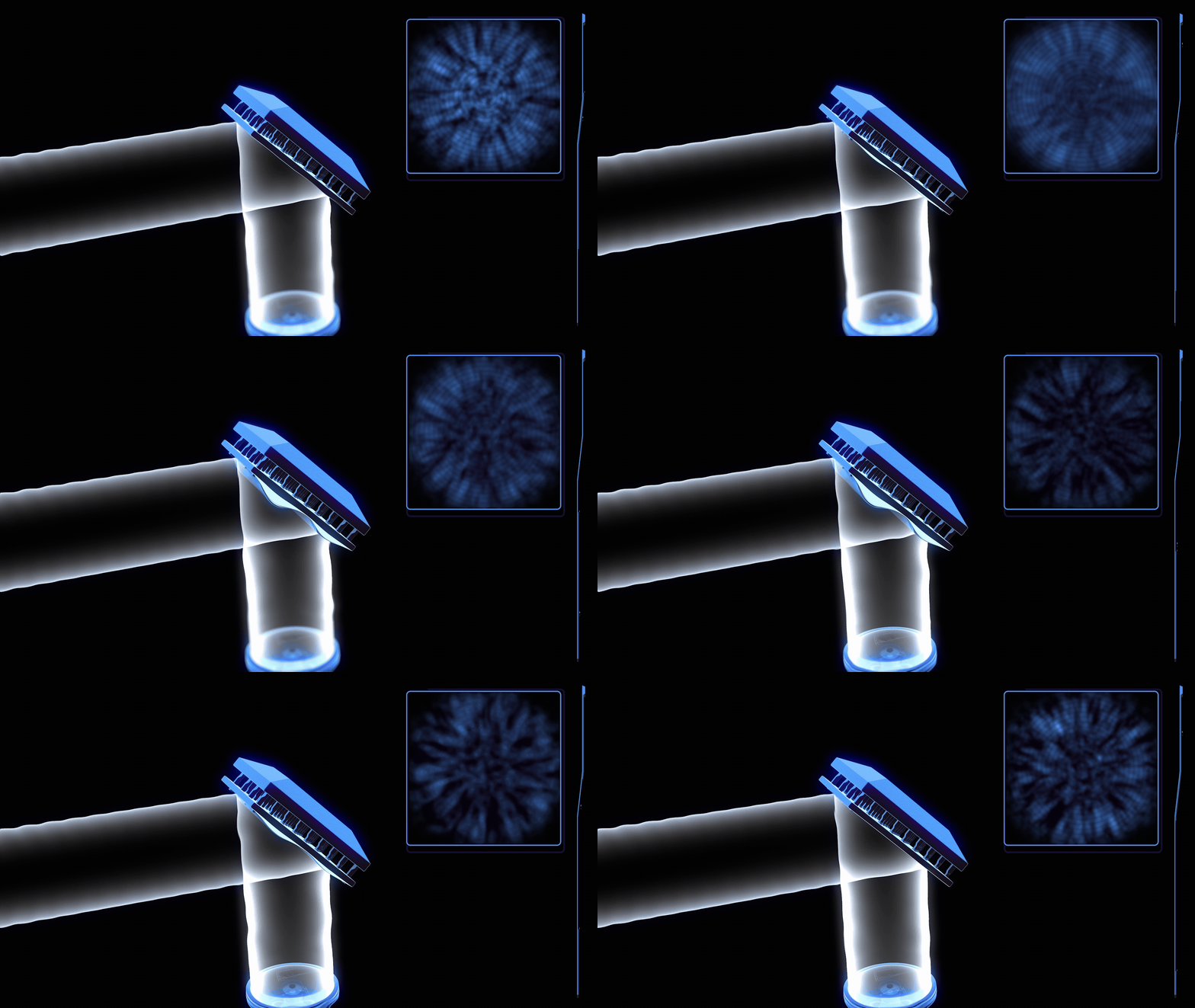
Named in honor of Nancy Grace Roman, NASA’s inaugural chief of astronomy, this revolutionary telescope boasts a formidable 300-megapixel wide-field camera. This instrument will possess the capacity to capture images approximately 100 times larger than those produced by the Hubble Space Telescope, all while maintaining a comparable level of resolution. Beyond its imaging prowess, the Roman telescope is expected to significantly advance our understanding of the universe’s most enigmatic components, dark matter and dark energy. Furthermore, it is predicted to detect around 100,000 new exoplanets – planets situated beyond our solar system whose existence is currently inferred by their subtle distortion of starlight from more distant celestial objects. Javier Viaña, a research scientist at Harvard who has had two projects selected for Roman’s highly competitive initial year of observation, eloquently compares this leap in discovery potential to transitioning from "interviewing a handful of people" to "conducting a global census."
A second camera, integrated with the novel coronagraph, will meticulously block a star’s intense light to facilitate observations of individual stellar systems. This advanced instrument will grant astronomers an unparalleled view of the cosmic environments surrounding stars, allowing them to discern smaller, dimmer, and more closely orbiting exoplanets. "It’s giving us the ability to see planets that we haven’t been able to physically see before," stated Creager, highlighting the transformative potential of this technology.
The Anatomy of a Vanishing Trick
While coronagraphs have been deployed in space before, including on the Hubble and James Webb Space Telescopes, their effectiveness has been limited by their static nature. These earlier systems employed fixed components to obscure a star’s blinding light, a method akin to shielding one’s eyes from a flashlight while searching for a firefly in darkness. Despite blocking the main light source, stray glare, originating from light seeping around machinery or scattering off minute imperfections in mirrors and coatings, can still obscure faint planetary signals. This scattered light can not only hide exoplanets but also generate false positives that mimic their presence.
In contrast, Roman’s coronagraph represents a significant departure by incorporating an "active wavefront control" technique, a capability never before implemented in space telescopes. Before each observation, the instrument will meticulously measure this residual light and actively work to suppress it. This sophisticated process is made possible by the telescope’s inclusion of two deformable mirrors. Each mirror features a 48-by-48 array of actuators – minute pistons – positioned beneath a thin, pliable glass surface. By applying precise electrical voltages, these actuators can contract, subtly pulling their respective mirror segments backward. This intricate manipulation, described as "thousands of microscopic fingers delicately sculpting a surface," allows for unparalleled control over the mirror’s shape.
The deformations achieved are remarkably subtle. Each mirror segment can adjust by up to 0.5 micrometers, a dimension roughly equivalent to one-fourth the size of an E. coli bacterium. Moreover, these adjustments can be made in increments as small as approximately 10 picometers, a scale about one-tenth the diameter of a hydrogen atom, according to Ilya Poberezhskiy, the instrument’s project systems engineer at JPL.
These actuators enable the mirrors to generate an "active wavefront." By precisely positioning each component, the system can effectively cancel out incoming waves of unwanted light, functioning much like noise-canceling headphones, but for photons instead of sound. Poberezhskiy explained that this "canceled-out" light creates a "doughnut-shaped region around the star where we suppress starlight and where we’re hoping to see exoplanets." Compared to existing space-based coronagraphs, Roman’s system is projected to enhance exoplanet detection sensitivity against stellar glare by a factor of up to 1,000, unveiling planets that were previously too faint to observe.
In addition to its deformable mirrors, Roman, like Hubble and JWST, utilizes masks – patterned plates strategically placed in the light path to block photons. One particularly innovative component within Roman’s mask repertoire is "silicon grass." This dense array of microscopic spikes on certain masks, when employed in specific configurations, acts as a photon trap. Light entering this dense forest of spikes bounces repeatedly between the blades, becoming absorbed rather than reflecting back towards the detector. "Once the light gets into there, it never gets out," Poberezhskiy emphasized, illustrating the efficacy of this light-trapping mechanism. The synergistic interplay between the deformable mirrors and these specialized masks creates a series of carefully orchestrated optical gates and barriers, ensuring that as much preserved planetary light as possible is guided towards the final detector.
Alien Jupiters
This elaborate instrumental setup heralds a new era in the direct imaging of exoplanets. Historically, the vast majority of exoplanets captured in direct images have been massive, young gas giants, starkly different from the planets in our solar system. These "oversize youngsters" often possess several times the mass of Jupiter, still radiating residual heat from their formation, and orbit their stars at distances hundreds of times greater than Earth’s orbital radius from the Sun. Their relative ease of detection stems from their inherent brightness in infrared light, a consequence of their size, warmth, and significant distance from their parent stars, placing them far from the star’s blinding glare.
The Roman telescope, however, is poised to achieve a significant breakthrough: the direct imaging of a true "Jupiter analogue." This would be a planet comparable in mass to Jupiter, orbiting a sun-like star at a distance only a few times greater than Earth’s orbital distance from the Sun. Unlike the "hot Jupiters" detectable today, this newly imaged planet would be a mature gas giant, similar to our own Jupiter. Instead of radiating intense heat from its formation, it would primarily reflect its parent star’s light after billions of years of cooling. Astronomers have previously inferred the existence of such planets by observing the subtle gravitational "wobble" they induce in their host stars. Roman’s coronagraph, however, will directly capture the light reflected from the planet itself. Meredith MacGregor, a professor of astronomy at Johns Hopkins who has also secured an observing program for Roman, underscored the profound significance of this capability: "We’re not looking at the star. We’re not looking at the effect of the planet on the star. We are actually looking at the planet, and that is super powerful."
Once this revolutionary instrument becomes operational, the onus will fall upon scientists to harness its capabilities. MacGregor expressed a mixture of anticipation and awe, stating, "I’m honestly a little terrified about how we’re all going to deal with it, because I think it’s just so much data. I think people will legitimately still be working on Roman data for decades."
While the prospect of a high-resolution, 4K image of an alien Jupiter is still some years away, Roman’s coronagraph will still provide invaluable insights. The telescope may not resolve such a planet into a distinct sphere, but rather depict it as a "smattering of pixels." Nonetheless, this limited resolution will be sufficient. MacGregor explained that by analyzing the light across various wavelengths reflected by these pixels, astronomers can glean crucial information about the planet’s atmospheric chemistry. "You’re taking something that’s a point of light and turning it into an actual world," she remarked, emphasizing the potential for such atmospheric data to reveal information about the planet’s surface and, consequently, its "possibility of life being on that planet."
During its initial observational campaigns, scientists and engineers will meticulously assess the instrument’s performance. They will verify their ability to precisely center a star within the coronagraph’s masks, fine-tune the deformable mirrors to sculpt the "dark doughnut" region, and maintain these delicate adjustments as the spacecraft navigates through space and experiences temperature fluctuations. The data gathered from these early observations will be instrumental in informing NASA’s ambitious Habitable Worlds Observatory, a future endeavor envisioned by many exoplanet astronomers. This proposed observatory aims to achieve the extraordinary feat of separating the light of an Earth-like planet from the overwhelming glare of a sun-like star, which can be over 10 billion times brighter.
Creager, who has been involved with the instrument’s development since 2018, expressed profound pride in the achievement. "Not too many people get to say, ‘I built something and it’s taking a picture of a planet that’s at a star that’s 50 light-years away or 100 light-years away,’" he mused. He envisions the collective pride his team will feel upon receiving the first image: "Yes, we did that." While the depicted planet might appear as merely a minuscule dot, the true triumph of the Roman telescope will reside in the profound darkness that has been meticulously engineered around it, a testament to human ingenuity and our insatiable quest to understand our place in the cosmos.