Imroatul Nasiyah
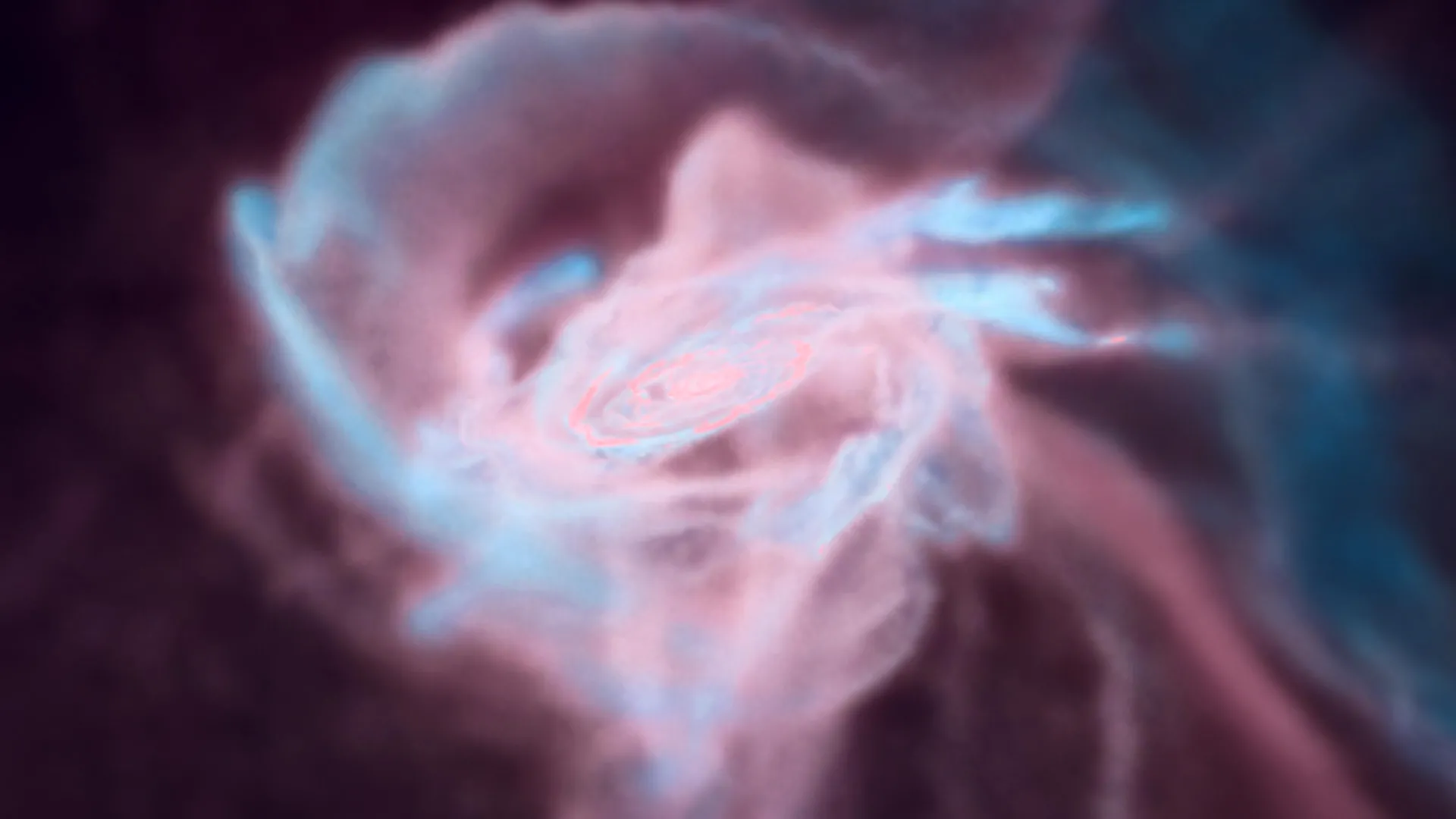
Among the myriad of cosmic revelations delivered by the James Webb Space Telescope (JWST), one of the most enigmatic and persistently intriguing has been the discovery of a substantial population of diminutive, intensely red celestial bodies. These objects, colloquially termed "Little Red Dots" (LRDs), have defied straightforward classification, their true nature remaining a tantalizing enigma for astronomers. However, a groundbreaking new suite of simulations, meticulously crafted and executed on Japan’s formidable ATERUI III supercomputer, has now presented a compelling hypothesis: these peculiar LRDs may, in fact, represent black holes undergoing exceptionally rapid growth, thriving in the unique and now-vanished conditions of the primordial Universe.
This revolutionary proposition does not hinge on the invocation of exotic physics or improbable cosmic coincidences. Instead, the sophisticated simulations suggest that the LRDs could naturally emerge from the specific environmental dynamics that characterized the nascent cosmos. In this ancient epoch, black holes were afforded opportunities to accrete matter and expand their mass at rates that are simply unattainable in the Universe we observe today. This insight offers a potential resolution to a long-standing astrophysical puzzle concerning the unexpectedly massive black holes found at the very dawn of cosmic history.
The research, spearheaded by the astute astrophysicist Sunmyon Chon from the Max Planck Institute for Astrophysics, represents a significant leap forward in our understanding of early cosmic evolution. The team harnessed the unparalleled computational power of the ATERUI III supercomputer, situated at the National Astronomical Observatory of Japan, to undertake some of the most detailed and high-resolution cosmological simulations ever attempted for the early Universe. This endeavor was not a trivial undertaking; it demanded a progressive zoom-in approach, commencing with the grand scale of a nascent galaxy and progressively narrowing its focus to increasingly smaller, more granular regions. Ultimately, the simulations delved into the intricate physics governing individual clouds of gas, a task that necessitated the cutting-edge, high-resolution computing capabilities that ATERUI III so effectively provides.
The simulations yielded a remarkable insight into the conditions that prevailed in the early Universe. They indicate that intense far-ultraviolet (FUV) radiation, emanating from nearby galaxies in this dynamic period, could act as a potent inhibitor of conventional star formation within certain gas clouds. Instead of fragmenting into a multitude of smaller stellar bodies, as would typically occur, these gas clouds were predisposed to undergo a catastrophic gravitational collapse, coalescing into a single, colossal supermassive star. It is the subsequent, inevitable collapse of these gargantuan stellar entities that, according to the model, births a "black hole seed" – a nascent black hole poised for prodigious growth.
Once these primordial black hole seeds were established, the simulations revealed a critical subsequent phase: their encapsulation by exceptionally dense and voluminous disks of gas. These gas-rich environments proved to be extraordinarily effective at trapping radiation, creating a hyper-efficient feeding ground for the nascent black holes. This process allowed them to consume surrounding matter at rates far exceeding anything observable in the modern Universe. Under these exceptionally favorable circumstances, the simulations demonstrated that these black holes could expand their mass by dozens of times faster than is presently possible, a rate that until now had been largely theoretical.
Crucially, the predicted physical characteristics of these simulated, rapidly growing black holes align with striking fidelity to the observed properties of the Little Red Dots (LRDs) detected by the JWST. This remarkable concordance strongly suggests that these mysterious red objects are not merely an anomaly but may, in fact, represent a crucial observational signature of this early epoch of hyper-accelerated black hole growth.
The existence of supermassive black holes in the early Universe has been a persistent thorn in the side of astrophysical models for decades. Astronomers have grappled with the perplexing question of how these colossal objects, some boasting masses millions or even billions of times that of our Sun, could have formed and matured so rapidly, appearing in the cosmic record less than 600 million years after the Big Bang. The very existence of such massive entities at such an early stage challenged prevailing theories of black hole formation and growth.
The JWST was anticipated to be a game-changer in this regard, its unprecedented sensitivity allowing it to detect fainter and more distant galaxies than any previous telescope. This capability is vital because observing extremely distant objects is tantamount to looking back in time. Light, traveling at a finite speed, takes time to traverse the vast cosmic distances. A galaxy observed at a distance of 11 billion light-years, for instance, is seen as it was 11 billion years ago. Similarly, a galaxy 12 billion light-years away presents an image from 12 billion years in the past. By peering further into the cosmic past than ever before, the JWST promised an unparalleled vista of the young Universe, potentially offering clues to this black hole conundrum.
However, rather than immediately resolving the mystery of early black hole formation, the JWST unveiled something entirely unexpected: a significant abundance of these small, intensely red objects – the LRDs. Their ubiquity and distinct spectral signature hinted at a phenomenon yet to be fully understood. The new simulations from Chon’s team now propose that these LRDs might indeed be the very missing piece of this intricate cosmic puzzle.
According to the proposed model, the environmental conditions necessary for the formation and subsequent rapid accretion of these black holes were not rare or peculiar. Instead, they arose naturally from the prevailing dynamics of the early Universe. This means that no extraordinary physical laws or highly improbable celestial alignments are required to explain their existence. This naturalistic explanation also offers a plausible reason for the observed prevalence of LRDs in JWST observations; if they are a natural consequence of early cosmic conditions, they would naturally be expected to be common.
As the JWST continues its observational mission, undoubtedly uncovering more LRDs and pushing the boundaries of our cosmic vision, and as future generations of telescopes delve even deeper into the archives of cosmic history, this newly proposed model is poised to provide astronomers with an invaluable theoretical framework. This framework will be instrumental in comprehending the formative processes, the explosive growth, and the profound influence of some of the Universe’s earliest black holes, shedding light on how they not only existed but actively shaped the grand narrative of cosmic evolution itself. The Little Red Dots, once a perplexing enigma, may well be the Rosetta Stone for understanding the genesis of the most massive structures in the Universe.