Faris Adani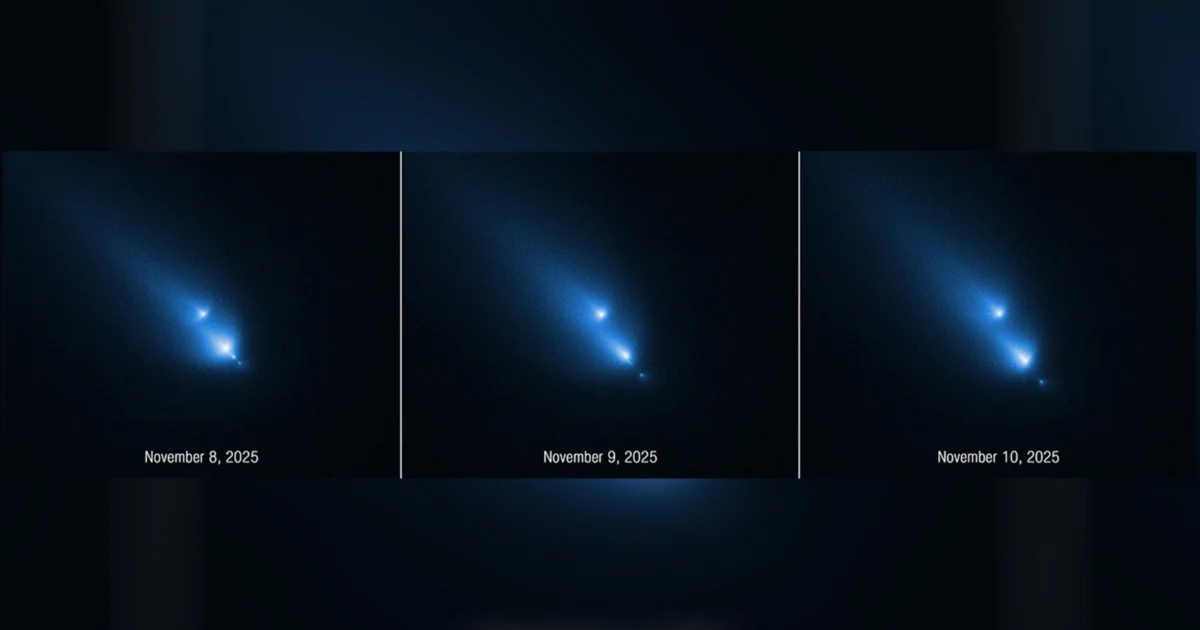
Lady Fortune indeed smiled upon astronomers who, in a stroke of serendipitous timing, directed the venerable Hubble Space Telescope towards a comet traversing our solar system, only to witness the icy wanderer dramatically disintegrate before their very eyes, an extraordinary event that has offered an unparalleled window into the fundamental processes governing these primordial celestial bodies. "Sometimes the best science happens by accident," remarked John Noonan, a research physicist at Auburn University in Alabama and a key co-author of the groundbreaking study published in the prestigious journal Icarus, detailing this remarkable discovery. His sentiment perfectly encapsulates the unexpected bounty of scientific data gleaned from what began as a mere contingency plan. The original observational target for the Hubble program had become unfeasible, prompting the team to scramble for an alternative. "We had to find a new target," Noonan explained, recalling the pivotal moment. "And right when we observed it, it happened to break apart, which is the slimmest of slim chances." This fortuitous alignment of circumstances transformed a routine observation into a high-stakes cosmic drama, providing astronomers with an unprecedented, front-row seat to a cometary demise.
The comet in question, officially designated C/2025 K1 (ATLAS), is a native "snowball" of our solar system, distinct from the more widely publicized interstellar visitor, 3/I ATLAS, which had previously captured headlines. C/2025 K1 had recently completed its closest approach to the Sun, a point in its orbit known as perihelion, on October 8, 2025. During this fiery embrace, the comet ventured within a mere one-third of Earth’s distance from our star, subjecting its icy nucleus to intense solar heating and radiation. It was in the aftermath of this solar scorching, between November 8 and November 20, 2025, that the Hubble Space Telescope meticulously captured its unraveling. When Noonan meticulously reviewed the Hubble observations, a startling revelation emerged: instead of the expected single cometary nucleus, the images clearly displayed a quartet of distinct comets. C/2025 K1 had splintered into four separate fragments, each proudly sporting its own nascent coma – the characteristic fuzzy cloud of gas and dust that envelops a comet’s solid core. This immediate, high-resolution view of a cometary breakup provided an invaluable "before and after" snapshot, offering critical insights into the forces at play.
Comets are often described as "dirty snowballs" or "cosmic time capsules," pristine remnants from the very dawn of our solar system, roughly 4.6 billion years ago. They are composed of a mixture of ice (primarily water ice, but also frozen carbon dioxide, carbon monoxide, methane, and ammonia) and dust, rock, and organic compounds. As these icy wanderers approach the Sun, the solar radiation causes the volatile ices to sublimate – transform directly from solid to gas – forming the extensive coma and the iconic tails that make comets such spectacular celestial sights. However, this process of sublimation can also exert immense stress on the comet’s nucleus. The sudden release of gas can create jets, which in turn can cause the comet to spin rapidly, leading to rotational forces that can tear it apart. Thermal stress from differential heating across the nucleus, or even the tidal forces from a close pass by a massive body (though not the primary cause in this instance), can also contribute to fragmentation. The observation of C/2025 K1’s breakup immediately after perihelion strongly suggests that the intense heating it experienced was the primary trigger, causing internal pressures to exceed the structural integrity of the nucleus.
The Hubble Space Telescope, a joint project of NASA and ESA, proved to be an indispensable tool for this discovery. Launched in 1990, Hubble has revolutionized our understanding of the universe, providing breathtaking images and crucial spectroscopic data across a broad spectrum of light, from ultraviolet to visible and near-infrared. Its position above Earth’s obscuring atmosphere grants it unparalleled clarity and resolution, enabling it to discern fine details that are impossible to observe from ground-based telescopes. In the case of C/2025 K1, Hubble’s keen vision was critical for resolving the individual fragments and their distinct comas, a feat that would have been exceedingly difficult, if not impossible, for most other observatories. Even as discussions occasionally arise about Hubble’s eventual "death spiral" or its planned decommissioning, this event serves as a powerful testament to its enduring scientific prowess and its continued capacity to deliver groundbreaking observations, even in its later years of operation. The image processing, expertly handled by Joseph DePasquale of STScI, from the raw data provided by NASA and ESA, further enhanced the clarity of the fragmented comet.
The most profound scientific advantage of this serendipitous observation lies in the "pristine" nature of the sample. As Principal Investigator Dennis Bodewits, also a physics professor at Auburn University, eloquently articulated, "They’ve been heated; they’ve been irradiated by the sun and by cosmic rays. So, when looking at a comet’s composition, the question we always have is, ‘Is this a primitive property or is this due to evolution?’" Typically, by the time astronomers observe a comet’s breakup, weeks or even months have passed since the event. During this extended period, the exposed surfaces of the fragments continue to be altered by solar radiation, outgassing, and other environmental factors, making it challenging to differentiate between the comet’s original, primordial composition and changes induced by its journey through the inner solar system. However, C/2025 K1 was captured by Hubble mere days after its fragmentation. "Never before has Hubble caught a fragmenting comet this close to when it actually fell apart. Most of the time, it’s a few weeks to a month later. And in this case, we were able to see it just days after," Noonan emphasized.
This unprecedented proximity to the moment of rupture provides an invaluable opportunity to study the comet’s interior almost immediately after it has been exposed. This "pristine" glimpse allows scientists to infer the comet’s true, unadulterated composition, providing a more accurate snapshot of the materials present in the early solar nebula from which our planetary system formed. Specifically, astronomers can now analyze the individual comas of the four fragments, using spectroscopic techniques to identify the specific gas species being emitted. This data will reveal the relative abundances of various ices and volatile compounds, offering direct clues about the chemical conditions of the protoplanetary disk. Furthermore, by observing the rate at which gas and dust are ejected from these freshly exposed surfaces, researchers can gain a deeper understanding of the physics of outgassing and the formation of the coma. "This is telling us something very important about the physics of what’s happening at the comet’s surface. We may be seeing the timescale it takes to form a substantial dust layer that can then be ejected by the gas," Noonan added, highlighting the opportunity to study the very mechanisms that govern a comet’s activity. The rapid formation and ejection of dust layers are critical processes that influence a comet’s brightness, tail morphology, and overall evolution.
The implications of this discovery extend far beyond the immediate study of C/2025 K1. Comets are widely considered to be the most primitive and unaltered objects in our solar system, preserving the original chemical signature of the cloud of gas and dust that collapsed to form the Sun and its planets. By analyzing their composition, scientists can reconstruct the conditions of the early solar system, including temperature, pressure, and the distribution of elements and molecules. This knowledge is crucial for understanding the processes that led to the formation of planets, including Earth. Comets are also theorized to have played a significant role in delivering water and complex organic molecules to the early Earth, potentially contributing to the genesis of life. A more accurate understanding of cometary composition, obtained from "pristine" samples like those offered by C/2025 K1’s breakup, strengthens or refines these theories, shedding light on the extraterrestrial origins of life’s building blocks. Moreover, insights gained from studying these local "home-grown" comets can inform our understanding of exoplanetary systems, allowing us to draw parallels and make predictions about the composition and evolution of other cosmic neighborhoods.
While the dramatic fragmentation has already occurred, the work for astronomers is far from over. The research team is now diligently engaged in the meticulous process of analyzing the wealth of data captured by Hubble. This involves not only identifying the various gas readings from the comas but also tracking the trajectories of the individual fragments, studying their brightness changes, and modeling the forces that led to the breakup. The fragmented remains of C/2025 K1 are now approximately 250 million miles from our planet, continuing their journey through the outer reaches of the solar system. Astronomers, in the meantime, are figuratively trying to piece together the cosmic puzzle, extracting every possible shred of information from this extraordinary event. The detailed spectroscopic data will allow them to create a chemical fingerprint of the comet’s interior, providing invaluable baseline information for future missions that might one day sample cometary material directly. This unexpected cosmic spectacle underscores the dynamic and unpredictable nature of our solar system, reminding us that even after decades of exploration, there are still profound secrets waiting to be unveiled by a combination of skilled observation, advanced technology, and a little bit of cosmic luck. The ongoing analysis promises to enrich our understanding of these ancient ice worlds and, by extension, the very origins of our solar system.