Faris Adani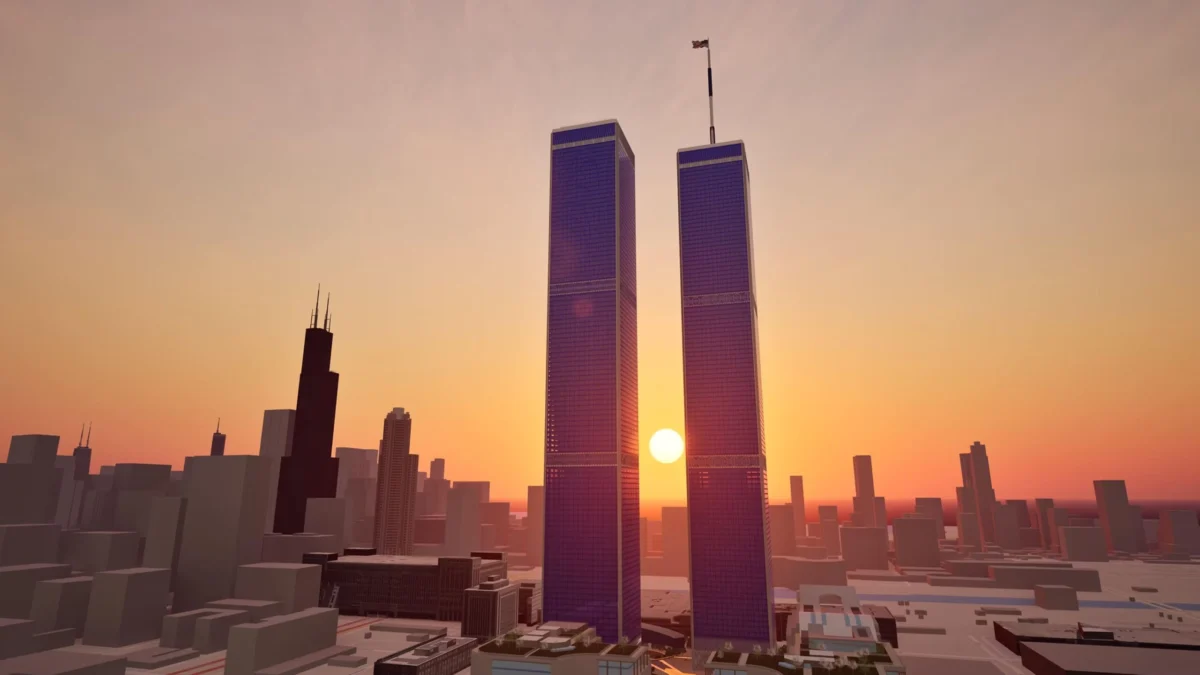
After their grisly destruction in a terror attack in 2001 – and the chaotic and deadly wars that followed – it can be hard to remember that the World Trade Center’s Twin Towers, originally completed in 1973, were architecturally controversial for their impact on the Manhattan skyline. Yet, for many, they became an indelible symbol of American ingenuity and economic might. Now, an audacious and long-shot effort seeks to resurrect this iconic silhouette, not in New York, but in an unlikely locale: Chicago, where they would be reborn as massive data centers and sprawling scientific laboratories, replete with cutting-edge defensive capabilities.
Behind this monumental campaign is Raphael Chryslar, a figure whose personal journey and professional aspirations make him an intriguing proponent for such a grand vision. Currently residing in Hatfield, England, Chryslar was merely a toddler when the original Twin Towers tragically collapsed. This temporal distance, however, has only fueled a profound fascination and reverence for the structures. Trained in aerospace engineering – a discipline demanding precision, innovation, and an eye for the future – Chryslar is a self-described author, photographer, entrepreneur, and aspiring architect and astronaut. His dedication to the original World Trade Center is not merely academic; he has gone so far as to get a tribute to the towers tattooed on his arm, a permanent testament to his emotional connection to their legacy and loss.
Chryslar’s ambitious undertaking, dubbed the World Tech Center (WTC), envisions a sprawling 35-acre campus in the heart of Chicago’s downtown, featuring nine distinct buildings. The centerpiece, of course, would be the new Twin Towers, reconceptualized for the 21st century. These structures would not merely be replicas but vastly upgraded iterations, designed to be “substantially safer than their predecessors” and embody a new era of resilience and technological advancement. The proposed enhancements are comprehensive and deeply rooted in lessons learned from past tragedies and future threats.
Central to their structural integrity would be a meter-thick central core crafted from ultra-high-performance concrete. This material, far exceeding conventional concrete in strength and durability, would provide unparalleled blast resistance, fire protection, and seismic stability, forming an impenetrable spine for each tower. The steel I-beams, a critical component in the original design, would be reimagined with advanced fireproofing techniques, likely involving intumescent coatings that expand when exposed to heat, insulating the steel and preventing structural failure during extreme temperatures. To combat the dynamic forces of nature and potential impacts, each tower would incorporate advanced tuned mass dampers, massive pendulums each filled with 1,000 tonnes of water. These sophisticated systems would counteract building sway caused by high winds or seismic activity, ensuring occupant comfort and structural integrity.
Fire suppression would be revolutionized with foam fire-suppression systems, a significant upgrade from traditional water sprinklers, particularly effective in environments with sensitive electronics and data. Evacuation would be safer through pressurized stairwells, designed to prevent smoke ingress, creating clear and breathable escape routes. A dedicated, on-site fire department would ensure immediate, specialized response capabilities, familiar with the unique complexities of the WTC campus. Looking further into the future, the design includes a firefighting drone launch pad, allowing for rapid aerial assessment and targeted suppression in hard-to-reach areas.
Perhaps the most sci-fi improvement, and certainly the most attention-grabbing, would be an “aerial threat detection and neutralization system.” Chryslar’s World Tech Center website describes this system as comprising a sophisticated radar network, radio, and communications sensors to identify and track airborne anomalies. As a "last resort," the system would be equipped with either anti-aircraft surface-to-air missiles or a multi-megawatt laser defense weapon. This visionary, albeit controversial, defensive posture highlights a commitment to protecting critical infrastructure against evolving threats, from drone attacks to more conventional aerial dangers. A multi-megawatt laser defense system, while still largely in the realm of advanced research, represents the pinnacle of directed energy weapon technology, capable of intercepting and neutralizing fast-moving targets with extreme precision. Its inclusion underscores the project’s futuristic and security-first philosophy.
Far from workaday office buildings, Chryslar envisions the towers reimagined as sprawling STEM laboratories and data strongholds. The north tower, dedicated to technology, would house all manner of computing laboratories, vast data centers, and lecture rooms, designed to attract a new generation of innovators, from software engineers and AI developers to cybersecurity experts and video game designers. It would serve as a vertical tech campus, fostering collaboration and groundbreaking research in artificial intelligence, quantum computing, virtual reality, and advanced robotics.
The south tower, meanwhile, would host the science compliment, complete with more traditional laboratories, university offices, and state-of-the-art research and development cleanrooms. This tower would become a hub for biotechnology, materials science, advanced physics, environmental research, and space exploration technologies, drawing top-tier scientific talent and fostering interdisciplinary breakthroughs. The proximity of these two towers would create a synergistic environment, promoting cross-pollination between scientific discovery and technological application.
Beyond the Twin Towers themselves, the fully realized infrastructure project would encompass a diverse ecosystem of facilities. This includes a physics and engineering mega facility, potentially exploring areas from fusion energy to particle accelerators; a chemistry and biological sciences lab, featuring advanced bio-containment levels and penthouse suites for leading researchers, suggesting a blend of cutting-edge science with luxurious amenities for top talent. A performing arts center would provide a crucial cultural balance, offering spaces for creativity and public engagement. A massive atrium would serve as a central gathering space, an architectural marvel connecting various parts of the campus and fostering community interaction.
One particularly exciting detail is the inclusion of a 10-story NASA workshop, suggesting a potential partnership with the space agency and a focus on aerospace innovation and public outreach, perhaps even hosting exhibitions or educational programs. A major 4-star hotel would accommodate visiting scientists, engineers, conference attendees, and families. And, last but not least, a sprawling subterranean shopping mall inspired by Stanley Kubrick’s iconic film “2001: A Space Odyssey” would offer a unique retail and leisure experience, integrating seamlessly with the overall futuristic aesthetic and creating a self-contained, vibrant urban environment.
Chryslar’s vision is not just about concrete and steel; it’s a profound statement. “Our vision reincarnates that American symbol of peace and strength that was wrongfully taken from us nearly 25 years ago, and with it thousands of innocent lives,” his WTC website proudly declares. “Their families and the wider community cry out to restore and heal. This is what America rightfully deserves. We shall no longer be afraid.” This powerful rhetoric underscores the project’s ambition to transform a symbol of tragedy into a beacon of resilience, innovation, and national pride. The choice of Chicago, a city renowned for its architectural heritage and status as a major technological and scientific hub, further strengthens this narrative, positioning the new WTC as a testament to American forward-thinking.
How far this landmark plan gets remains to be seen. Chryslar lays out a long-reaching eight-part strategy, which targets an opening in the year 2050. This multi-decade timeline suggests a meticulously planned process, likely involving extensive feasibility studies, international architectural design competitions, monumental funding rounds from both public and private sectors, complex land acquisition, rigorous environmental impact assessments, and sustained community outreach to garner support. In an email, Chryslar told Futurism that the project is currently in “phase 2,” gathering community feedback and building a coalition ahead of formal organization. This early stage focuses on generating public interest, securing initial endorsements, and forming a core team to propel the initiative forward. More details are promised in the months ahead; for now, Raphael Chryslar is just getting warmed up, embarking on a journey to transform a dream of remembrance and technological supremacy into a tangible reality. This audacious blend of memorialization, cutting-edge engineering, and futuristic vision presents a compelling narrative for a world constantly seeking to build a stronger, safer, and more innovative tomorrow.