Pradipta eManuel
The consumer data broker Radaris.com, long notorious for its defiance of personal information removal requests, has faced significant repercussions after a lawsuit alleged violations of a New Jersey privacy law. The law, Daniel’s Law, specifically protects state law enforcement officials, government personnel, judges, and their families by mandating the removal of their data from commercial data brokers and imposing hefty fines for non-compliance. In a decisive ruling, a judge ordered the transfer of Radaris.com and over a dozen other associated data broker domains to the plaintiffs, Atlas Data Privacy Corp., due to Radaris’s persistent evasiveness and misrepresentations.
The legal battle commenced in February 2024 when Atlas Data Privacy Corp. initiated legal proceedings against Radaris, targeting its alleged breaches of Daniel’s Law. This New Jersey statute, inspired by a judge’s personal tragedy, empowers protected individuals to demand complete data erasure and levies a $1,000 fine per violation against non-compliant companies. Shortly after the lawsuit was filed, KrebsOnSecurity published an in-depth investigation into the Radaris co-founders, Russian-born brothers Igor and Dmitry Lubarsky (also known as Lybarsky), who operate a sprawling network of people-search services and Russian language dating sites from Massachusetts. Their attorneys initially threatened defamation lawsuits and vehemently denied the reporting, claiming the true owners were Ukrainians.
However, KrebsOnSecurity stood by its reporting, further detailing how the Lubarsky brothers allegedly operated Radaris and other data broker entities using a fictitious CEO, "Gary Norden." Their attorney, Val Gurvits of the Boston Law Group, eventually admitted that the pseudonym was indeed fabricated and that the company had used it in press releases to solicit investment. Radaris’s legal team attempted to delay proceedings and obscure ownership, claiming Atlas had not served the true operators. In response, Atlas refiled and expanded the lawsuit in June 2025, targeting a broader range of Radaris-affiliated data brokers for Daniel’s Law violations.
Matt Adkisson, president and CEO of Atlas, described Radaris’s strategy as a "tried-and-true playbook" of delaying tactics and obfuscation regarding their origin and ownership. He characterized this period as an "island-hopping phase," marked by constantly changing privacy policies and the appearance of new entities from jurisdictions like the Marshall Islands, the British Virgin Islands, and Seychelles. Adkisson likened their defense to a "shell game," where entities claiming to operate domains were discarded as judgments neared, while new entities emerged to shield the actual owners from responsibility. In one instance, Atlas discovered that a newly formed entity in the Marshall Islands, claimed by Radaris to be managing the company, did not yet exist.
This pattern of evasion was not new. In a 2017 class action lawsuit, Radaris similarly lost a $7.5 million default judgment due to a lack of court appearance. While the court ordered the transfer of radaris.com from the registry Verisign to the plaintiffs, the domain transfer was halted on appeal by Mr. Gurvits, who argued the lawsuit had not named the actual owner, Cyprus-based Bitseller Expert Limited. The judge allowed the plaintiffs to refile, after which the operator of Radaris shifted to Andtop Company, an entity incorporated in the Marshall Islands in October 2020. The plaintiffs, seemingly exhausted by the procedural complexities, did not refile at that time.

Raj Parikh, a partner at PEM Law representing Atlas, noted that Radaris’s historical strategy of "attrition" had worked for a decade, with opposing counsel often tiring of the games and withdrawing. However, Atlas was committed to eliminating the threat Radaris posed to New Jersey law enforcement and public officials, regardless of the resources required. On August 26, the New Jersey judge found the defendants had ample opportunity to defend themselves and failed to do so. Mr. Gurvits stated the case was assigned to another attorney, Victor Worms, who asserted the default judgment was void because Radaris.com is not a legal entity and vowed to appeal the domain transfer as an unconstitutional forfeiture.
Currently, radaris.com no longer offers detailed personal dossiers. Instead, it redirects to a notice from Atlas detailing the court-ordered domain transfer and linking to KrebsOnSecurity’s previous reporting. Atlas has reportedly amassed over 10,000 emails and documents during the litigation, which they claim corroborate KrebsOnSecurity’s findings about the ownership and operation of Radaris and its affiliated companies. These documents allegedly reveal that nominal entities such as Radaris America, Inc., Bitseller Expert Limited, and several others are centrally administered by a small group from shared mailboxes, payment systems, and virtual office addresses, all operating under the difive.com mail domain and its successors.
The emails reportedly indicate that Radaris.com generates approximately $42,000 per month, while Veripages.com earns around $45,000 monthly through a partnership with the Lifetime Value Company, which owns brands like PeopleLooker and NumberGuru. Furthermore, the Radaris family of websites allegedly earns up to $25,000 monthly from a partnership with Onerep, a company that purports to help individuals remove their data from people-search sites. This partnership is particularly noteworthy, as Onerep’s Belarusian founder was previously exposed by KrebsOnSecurity for operating numerous people-search sites himself, effectively perpetuating the very problem he claimed to solve.
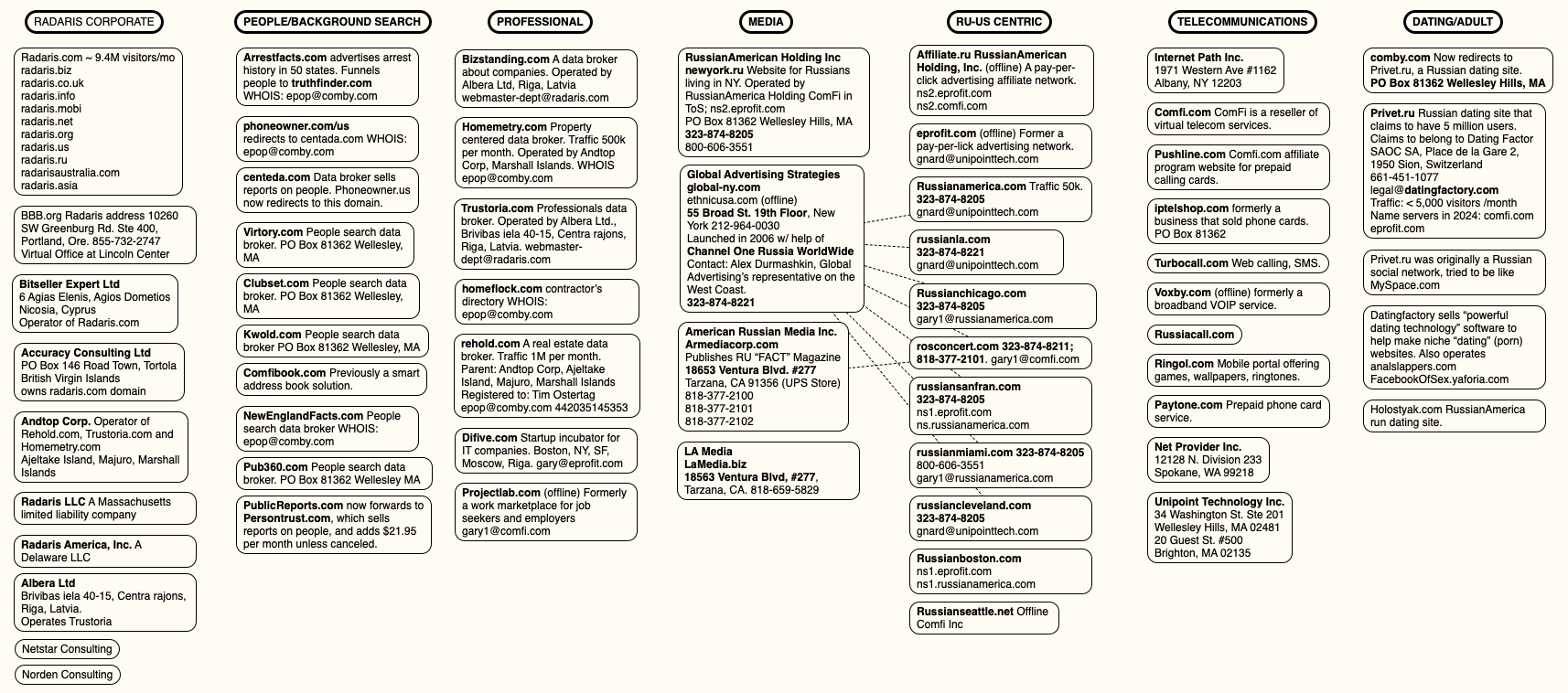
To date, the New Jersey court has transferred 14 domain names from the Radaris group to Atlas. While Radaris.com now serves as a notification page, the Radaris companies still face potential fines of $1,000 per violation of Daniel’s Law. The broader data broker industry is actively challenging Daniel’s Law, with many of the approximately 150 firms sued by Atlas having moved their cases to federal court, arguing the statute is overly broad and violates the First Amendment. The Third Circuit Court of Appeals is expected to rule on this constitutional challenge, with an appeal to the Supreme Court anticipated regardless of the outcome.
Meanwhile, at least 14 other states have enacted laws similar to Daniel’s Law, though a federal district court in August 2025 ruled West Virginia’s version facially unconstitutional under the First Amendment. Privacy expert Justin Sherman, author of the forthcoming book "The Middlemen," highlighted the intense lobbying efforts by various tech industries—including social media, big tech, cryptocurrency, and AI proponents—against comprehensive federal data privacy legislation. Sherman argued that without meaningful federal laws, people-search companies will continue to thrive, especially since many state privacy laws exempt commonly available public or government records like voter registries, property filings, and criminal records.
Sherman drew a parallel to the recent IDScan.net breach, which exposed the driver’s license information of over 153 million Americans, emphasizing the lack of federal law restricting how companies collect, use, or retain such data, even for age verification purposes. He concluded that despite numerous "wake-up calls," the absence of comprehensive federal privacy law stems not from a lack of awareness but from a deliberate resistance to enacting meaningful protections, with those who claim otherwise being either misinformed or self-deceptive.