Pradipta eManuel
The consumer data broker Radaris.com, notorious for its persistent refusal to honor requests for personal information removal, has faced significant repercussions following a lawsuit that alleged violations of a New Jersey privacy law. This statute imposes substantial fines on data brokers that disseminate personal information concerning state law enforcement officials. After repeated evasiveness and obfuscation by Radaris’s legal representatives, a judge ordered the transfer of radaris.com and over a dozen other data broker domains to the plaintiffs. This dramatic development, detailed by KrebsOnSecurity, marks a pivotal moment in the ongoing battle for consumer data privacy against aggressive data aggregation firms.
The legal action commenced in February 2024 when Atlas Data Privacy Corp. filed a lawsuit against Radaris. Atlas is actively pursuing data brokers accused of breaching Daniel’s Law, a New Jersey statute designed to protect the privacy of state law enforcement, government personnel, judges, and their families. The law mandates the complete removal of their personal information from commercial data broker and people-search services, with penalties of $1,000 per violation for non-compliant companies.
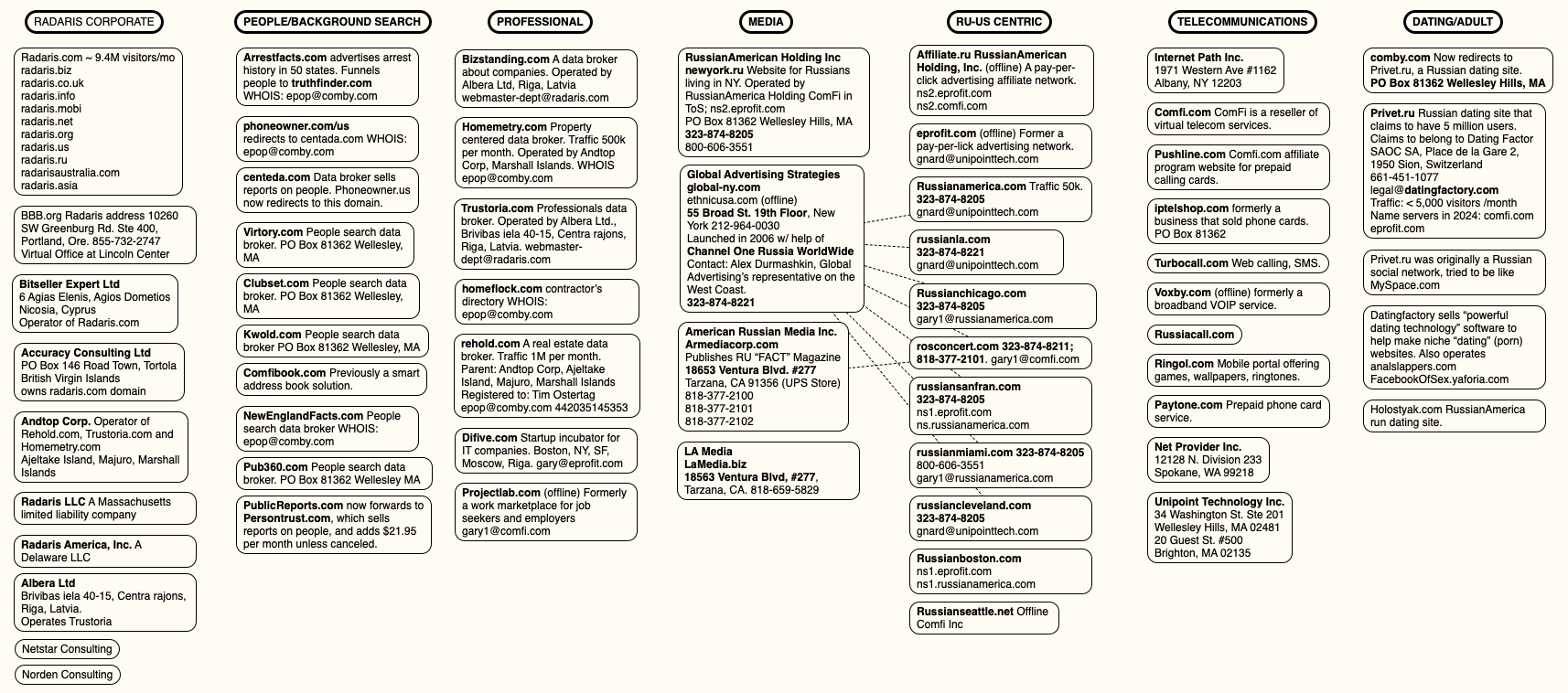
Shortly after Atlas initiated legal proceedings, KrebsOnSecurity published an in-depth investigation into the co-founders of Radaris: Russian-born brothers Igor and Dmitry Lubarsky, also known as Lybarsky. Operating from Massachusetts, the Lubarsky brothers managed a complex network of people-search companies, alongside Russian language dating services and affiliate marketing programs. Their legal team responded with threats of a defamation lawsuit if the report was not retracted and an apology issued, vehemently denying its accuracy and claiming the true owners were Ukrainians residing in Ukraine.
Undeterred, KrebsOnSecurity reinforced its reporting, providing evidence that the Lubarsky brothers had built and operated Radaris and other data broker entities using a fabricated CEO. Their follow-up exposé revealed that Radaris’s attorney, Val Gurvits of the Boston Law Group, admitted to the use of a pseudonym, "Gary Norden," and acknowledged that Radaris had issued multiple press releases quoting this fictitious CEO to solicit investments.
Radaris’s legal team attempted to delay court proceedings, only appearing at the last minute to contest what was effectively a predetermined default judgment in favor of the plaintiffs. They argued that Atlas had failed to serve the actual owners and operators of Radaris and its associated companies. In response, Atlas refiled an expanded lawsuit in June 2025, significantly increasing the number of Radaris-affiliated data brokers accused of violating Daniel’s Law. Matt Adkisson, president and CEO of Atlas, described Radaris’s strategy as a familiar playbook: delaying tactics, obfuscating the company’s true origin, and constantly shifting ownership structures.
Adkisson characterized this period as an "island-hopping phase," where privacy policies were frequently altered, and new entities emerged from jurisdictions like the Marshall Islands, the British Virgin Islands, and Seychelles. He likened the defense’s approach to a "shell game," where entities claiming to operate domains would be presented as the proper parties to sue, only to be discarded as a judgment neared, with new entities taking their place while the lawyers argued the original owners shouldn’t be held responsible. Atlas even hired an investigator in the Marshall Islands after Radaris updated its terms of service to claim management by a company there, only to discover that the purported new entity did not yet exist.
The case of Val Gurvits representing Radaris in a 2017 class-action lawsuit that Radaris lost due to non-contestation further illustrates the company’s pattern of engagement. When plaintiffs sought to collect a $7.5 million default judgment, the court ordered Verisign to transfer the radaris.com domain. Gurvits appealed, asserting that the lawsuit had not named the actual domain owner, Cyprus-based Bitseller Expert Limited, thereby violating their due process rights. The judge initially sided with Radaris, halting the domain transfer and allowing plaintiffs to refile. Subsequently, Radaris’s operator changed from Bitseller to Andtop Company, an entity formed in the Marshall Islands in October 2020, at which point the plaintiffs did not refile.
Raj Parikh, a partner at PEM Law and a lead attorney for Atlas in Daniel’s Law litigation, noted that Radaris’s past success stemmed from plaintiffs tiring of the procedural games and abandoning their cases. He acknowledged the difficulty of recovering funds from foreign entities but stressed Atlas’s commitment to eliminating the threat Radaris posed to New Jersey law enforcement and public officials.
On August 26, the judge in the New Jersey case ruled that the defendants had ample opportunities to defend themselves but failed to do so. Gurvits declined to comment, stating the case was handled by another attorney, Victor Worms. Worms, however, asserted that the court transferred Radaris.com as part of a default judgment against Radaris.com, which he argued is not a legal entity and therefore cannot be sued. He stated their intention to file a motion to vacate the judgment and pursue appeals, viewing the domain transfer as an unconstitutional forfeiture.

While radaris.com still appears in online searches for U.S. residents, it no longer offers detailed personal dossiers. The homepage now displays a notice from Atlas detailing the court-ordered domain transfer and links to previous KrebsOnSecurity reporting.
Atlas has secured over 10,000 emails and documents during litigation, which they claim corroborate KrebsOnSecurity’s reporting on Radaris’s ownership and operations. These emails reportedly demonstrate that various nominal entities, including Radaris America, Inc., Bitseller Expert Limited, and others, are all managed by a small group of individuals using shared mailboxes, payment methods, and virtual office addresses. The evidence suggests a unified operation run from the difive.com mail domain and its successors.
Financial details gleaned from these emails indicate that radaris.com generates approximately $42,000 monthly, while Veripages.com earns around $45,000 monthly through a partnership with Lifetime Value Company, which owns brands like PeopleLooker and PeopleSmart. Furthermore, the Radaris network reportedly earns up to $25,000 monthly from its partnership with Onerep, a company that itself was revealed by KrebsOnSecurity to be founded by an individual who had launched and operated dozens of people-search sites.
In total, the New Jersey court has transferred 14 domain names from the Radaris group of companies to Atlas. Radaris.com now redirects to a notification of this court-ordered transfer.
Looking ahead, the Radaris companies could still face significant fines under Daniel’s Law. However, the broader landscape sees Daniel’s Law facing constitutional challenges from approximately 150 other consumer data broker firms also being sued by Atlas. Over 70 of these lawsuits have been moved to federal court, where the data broker industry is challenging the New Jersey statute as overly broad and a violation of the First Amendment. The Third Circuit Court of Appeals has yet to rule, and the case is widely expected to reach the Supreme Court.
Despite these challenges, at least 14 other states have enacted laws similar to New Jersey’s Daniel’s Law, with more considering such measures. However, West Virginia’s version of Daniel’s Law was recently declared unconstitutional by a federal district court.
Privacy expert Justin Sherman, author of the forthcoming book "The Middlemen," highlights the intense lobbying efforts by the technology industry against stricter U.S. data privacy laws. He notes that powerful industries, including social media, big tech, cryptocurrency, and AI proponents, are actively working to prevent comprehensive data privacy legislation, often framing such regulations as detrimental to the economy.
Sherman argues that people-search companies will continue to thrive unless Congress enacts meaningful, 21st-century consumer privacy and data protection laws. He points out that most state privacy laws exempt publicly accessible government records, such as voting registries, property filings, and criminal records, which are heavily utilized by data brokers.
The lack of federal law governing the use and sharing of data collected for age verification, for example, has contributed to breaches like the one at IDScan.net, which exposed the driver’s license information of over 153 million Americans. Sherman concludes that while the public’s desire for broad privacy protections is clear, the lack of federal action is not due to a lack of awareness but rather a failure to enact necessary legislation, despite numerous "wake-up calls."