Faris Adani
CCTV
Sign up to see the future, today
Can’t-miss innovations from the bleeding edge of science and tech
Chinese Taikonauts Achieve ‘Bumper Crop’ of Space Tomatoes Aboard Tiangong Station, Advancing Deep Space Sustenance.
In a significant stride for long-duration space missions and the future of extraterrestrial habitation, taikonauts aboard China’s Tiangong space station have successfully harvested a robust crop of “space tomatoes.” This achievement underscores the growing capabilities of the Tiangong outpost, which, despite being a fraction of the size of the International Space Station (ISS), has proven to be an invaluable platform for groundbreaking research over its five years of operation. The successful cultivation of these vibrant yellow and red cherry tomatoes marks another milestone in humanity’s quest to make living in space more sustainable and self-sufficient.
The Tiangong space station, a marvel of Chinese engineering, is configured in a distinctive T-shape, comprising three primary modules: the Tianhe core module, and the Wentian and Mengtian lab modules. This orbital outpost is designed to comfortably house up to six taikonauts, providing them with advanced living quarters and two state-of-the-art laboratory environments for a diverse array of scientific experiments. Beyond its current configuration, Tiangong’s capabilities are set to expand further with the anticipated launch of the Xuntian space telescope, a Hubble-class instrument designed to orbit in close proximity to the station, allowing for potential servicing and refueling. This integration highlights China’s ambitious vision for a comprehensive and enduring presence in low-Earth orbit.
Central to the recent agricultural success is Tiangong’s innovative aeroponic cultivation system. Unlike traditional soil-based farming or even hydroponics, which submerges roots in nutrient-rich water, aeroponics nourishes plants by misting their roots with a fine aerosol of water and dissolved nutrients. This method dramatically reduces the amount of water required, a critical advantage in the resource-constrained environment of space. The system on Tiangong is housed within a specially designed, box-like growing environment. Footage released by state media, including CCTV, shows small vines laden with tomatoes, their roots visible through transparent windows, meticulously monitored as they absorb the nutrient mist. A full-spectrum LED panel provides the precise light conditions necessary for photosynthesis and optimal plant growth, simulating Earth’s sunlight in the vacuum of space. This closed-loop system not only conserves water but also minimizes waste and maximizes nutrient delivery, making it an ideal candidate for future extraterrestrial habitats.
The harvest of these “bumper crop” tomatoes, as reported by state-run news network *Global Times*, represents more than just a fresh meal for the taikonauts. It’s a tangible demonstration of advanced life support systems functioning effectively in microgravity. The visual evidence, showing presumably hungry astronauts proudly displaying their cultivated produce, underscores the psychological as well as nutritional benefits of such endeavors. Fresh food, grown within sight, can significantly boost morale and provide a comforting connection to Earth for crew members on long missions, combating the monotony and isolation of space travel.
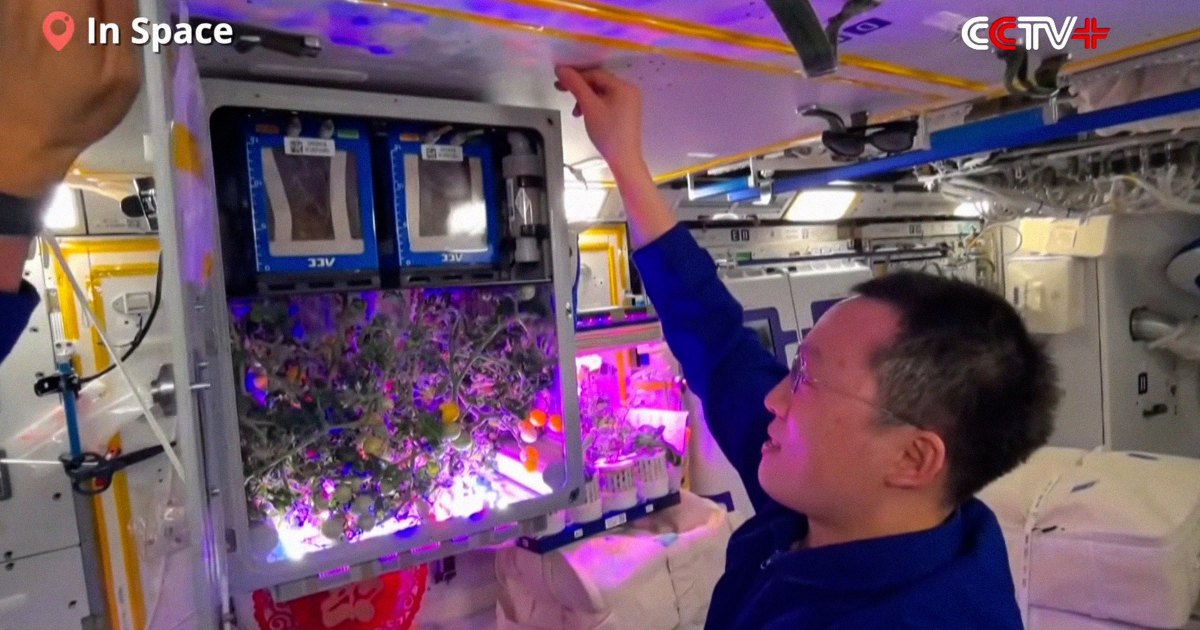
The Chinese space program’s ambitions for space agriculture extend far beyond tomatoes. Following this successful harvest, the crew is slated to experiment with growing other essential crops, including wheat, carrots, and various medicinal plants. These subsequent experiments aim to further investigate the versatility and efficiency of the space cultivation system, providing critical data on how different plant species adapt to microgravity, altered light cycles, and controlled atmospheric conditions. The ultimate goal is to develop a comprehensive space-based food production system that can support human exploration far beyond Earth’s immediate vicinity, enabling truly long-duration missions to the Moon, Mars, and beyond, where resupply missions would be infrequent and costly.
China’s advancements in space agriculture complement similar efforts by other space agencies, most notably NASA on the International Space Station. For many years, NASA astronauts have also been engaged in cultivating various plants, including different varieties of lettuce, peppers, and radishes, using systems like Veggie and the Advanced Plant Habitat (APH). Their research focuses on understanding the genetic elements of plants that allow them to adapt and survive spaceflight, optimizing growth parameters, and assessing the nutritional value of space-grown produce. These parallel experiments by different nations contribute to a global pool of knowledge, accelerating the development of sustainable off-world living.
Beyond the tangible benefits of fresh food, the psychological upsides of gardening in space are widely acknowledged. As NASA highlighted in a 2023 update, the act of tending to living plants, watching them grow, and ultimately harvesting their fruits, offers profound psychological advantages. It can significantly boost crew morale, reduce stress, and provide a sense of purpose and connection to natural life cycles, which are often absent in the sterile, high-tech environment of a spacecraft. This “green therapy” can lead to an overall increased quality of life for astronauts, making long missions more bearable and enjoyable.
The practical implications for future space exploration are immense. Reliable food production systems are a cornerstone of any truly self-sufficient extraterrestrial habitat. Imagine a future Moon base or a Mars colony where fresh vegetables are a regular part of the diet, reducing the logistical burden and cost of launching provisions from Earth. This not only makes such missions more feasible but also enhances the health and well-being of the pioneering astronauts and settlers. Space-grown produce could provide essential vitamins and antioxidants that are often degraded in pre-packaged, long-shelf-life space foods, contributing to better physical health during extended stays off-world.
In a moment of lightheartedness that captured the public’s imagination, the bountiful harvests on the International Space Station even led to a culinary mystery that was solved in late 2023. NASA astronaut Frank Rubio, who had spent a record-breaking 371 days in space, was initially “accused” of eating a rogue tomato that went missing for nearly a year. The tomato was part of an experiment testing hydroponic and aeroponic techniques, much like those now being used on Tiangong. The disappearance of the small, cherry-sized fruit became a running joke among the crew and back on Earth.
The mystery was finally resolved when, after Rubio had returned to Earth, fellow NASA astronaut Jasmin Moghbeli announced during a December 2023 live stream, “Our good friend Frank Rubio, who headed home [already], has been blamed for quite a while for eating the tomato. But we can exonerate him. We found the tomato.” The discovery of the desiccated, but intact, remains of the tomato in a crevice on the ISS not only cleared Rubio’s name but also provided an amusing anecdote illustrating the challenges and quirks of living in a microgravity environment. At the time of its initial harvest, NASA had hailed the crop as yielding the first-ever tomatoes grown in space and eaten by humans, underscoring the significance of even small-scale space agriculture experiments. This humorous incident highlighted the human element of space exploration and the close-knit community of astronauts.
The successful tomato harvest on China’s Tiangong space station is more than just an agricultural feat; it is a testament to humanity’s ingenuity and determination to expand its presence beyond Earth. By mastering the art of growing food in space, both China and other spacefaring nations are laying the groundwork for sustainable human outposts on the Moon, Mars, and perhaps even farther into the cosmos. These “space tomatoes” represent a small but crucial step towards a future where astronauts can truly live off the land – or rather, off the specially designed cultivation systems – of their new orbital and planetary homes.
More on tomatoes: NASA Proudly Shows Off Desiccated Tomatoes Lost in Space Station Crevice