anjir abdul
The overwhelming force behind Monday’s Bitcoin ETF recovery was BlackRock’s iShares Bitcoin Trust ETF (IBIT), which alone captured an astounding $205.9 million in net inflows. This figure represents approximately 95% of the total daily inflows into the entire spot Bitcoin ETF category, according to analytics from Farside Investors, solidifying BlackRock’s dominant position in the nascent but rapidly expanding institutional crypto investment space. BlackRock, a global investment management powerhouse with trillions of dollars under management, has quickly established IBIT as a frontrunner since its launch in January, leveraging its immense brand recognition, distribution network, and institutional trust to attract substantial capital. The company’s entry into the Bitcoin ETF market was widely seen as a major legitimizing factor for the asset class, providing a regulated, accessible, and familiar investment vehicle for traditional finance participants who might otherwise shy away from direct cryptocurrency ownership. The consistent performance and strong inflows into IBIT underscore the strategic importance of BlackRock’s role in bridging the gap between traditional finance and the digital asset economy, setting a benchmark for other institutional players.
While BlackRock led the charge, other prominent fund providers also contributed to the positive momentum. Fidelity’s Wise Origin Bitcoin Fund (FBTC) secured a respectable $6.9 million in inflows, further cementing its position as a strong contender in the market. The Bitwise Bitcoin ETF (BITB) added $4.3 million, indicating continued interest in its offerings. Notably, Morgan Stanley’s Bitcoin Trust attracted $3.6 million, signaling a growing appetite from one of Wall Street’s venerable institutions. Grayscale’s Bitcoin Mini Trust, a newer offering designed to provide a lower-fee alternative to its flagship Grayscale Bitcoin Trust (GBTC), also performed strongly, attracting $9.4 million. This is particularly significant given that GBTC, which converted from a trust to an ETF, has experienced substantial outflows since its conversion, as investors sought lower-fee alternatives offered by competitors or even the Mini Trust itself. The ability of the Grayscale Mini Trust to attract capital suggests a strategic move by Grayscale to retain a share of the market by offering more competitive fee structures.

Conversely, VanEck’s Bitcoin ETF (HODL) was the sole fund to record withdrawals on Monday, posting $13.4 million in net outflows. This could be attributed to various factors, including profit-taking by early investors, rebalancing of portfolios, or reallocation of capital to other more dominant or newly favored Bitcoin ETFs. The remaining spot Bitcoin ETFs reported no significant flows, indicating a consolidation of investor interest around a few key players, particularly BlackRock and Fidelity, who have emerged as market leaders in terms of consistent inflows and asset accumulation. The overall picture, however, remains overwhelmingly positive, with the category demonstrating its ability to quickly recover from temporary dips and continue its trajectory of attracting significant institutional capital. This resilience highlights the fundamental shift in how traditional finance views Bitcoin – no longer a niche, speculative asset, but a legitimate component of diversified investment portfolios.
The enthusiasm for digital asset ETFs extended well beyond Bitcoin, with altcoin funds displaying remarkable strength and consistency. Spot Ether ETFs, in particular, continued their impressive run, attracting $87.7 million on Monday and marking their 11th consecutive trading session of inflows. This sustained interest in Ether ETFs comes on the heels of significant regulatory developments, including the US Securities and Exchange Commission’s (SEC) approval of 19b-4 forms for several spot Ether ETFs, paving the way for their eventual launch. This regulatory clarity has injected new confidence into the market, suggesting that Ether, the native cryptocurrency of the Ethereum blockchain, is increasingly viewed as a viable institutional asset, following in Bitcoin’s footsteps. BlackRock’s iShares Ethereum Trust ETF (ETHA) led these inflows with $59.9 million, mirroring its dominance in the Bitcoin ETF space. Grayscale’s Ethereum Mini Trust also attracted substantial capital with $13.5 million, and Fidelity’s Ethereum Fund brought in $9.3 million, indicating broad-based institutional interest across different providers. The consistent inflows into Ether ETFs reflect growing recognition of Ethereum’s pivotal role in the broader decentralized finance (DeFi) ecosystem, non-fungible tokens (NFTs), and decentralized applications (DApps), positioning it as a foundational layer for the future of Web3.
Beyond the two largest cryptocurrencies, other altcoins are also carving out their niche in the institutional investment landscape. XRP ETFs extended their positive run to 10 consecutive sessions, accumulating $5.64 million in net inflows, according to SoSoValue. This sustained interest is particularly noteworthy given the ongoing regulatory uncertainties surrounding XRP, specifically the long-standing legal battle between Ripple (the company behind XRP) and the US SEC. Despite these legal headwinds, the consistent inflows since August 18 suggest that a segment of institutional investors sees long-term value in XRP, potentially due to its utility in cross-border payments and its established network. The continued positive sentiment for XRP ETFs underscores investor belief in its underlying technology and potential, regardless of the regulatory challenges it faces in the US.
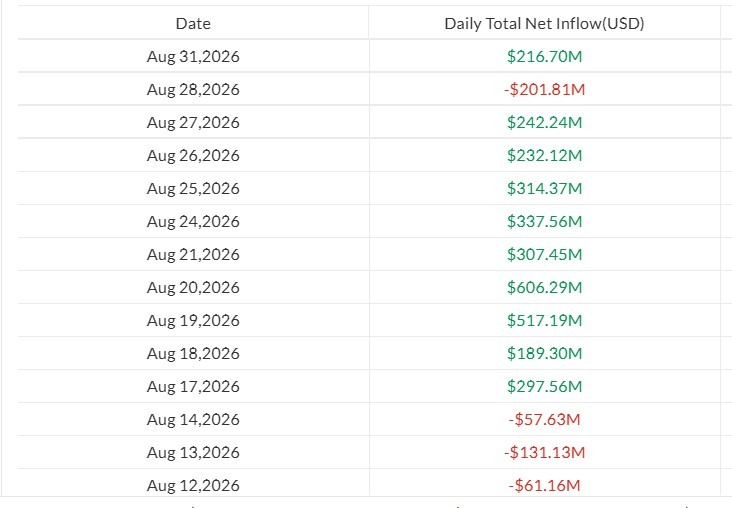
Solana ETFs also maintained their impressive streak, posting a 10th consecutive positive session. However, daily inflows for Solana funds experienced a slowdown on Monday, registering $925,010, a significant drop from the $18.1 million recorded on Friday. While this figure represents the weakest inflow during its current positive run, the fact that capital continues to flow in for ten straight sessions is a strong indicator of sustained investor confidence in Solana. Solana has emerged as a formidable competitor to Ethereum, often dubbed an "Ethereum killer" due to its high transaction throughput and low fees, making it attractive for various decentralized applications and NFT projects. The institutional interest in Solana ETFs reflects the broader trend of investors looking beyond Bitcoin and Ethereum to high-performance alternative blockchains with strong ecosystems and growth potential. This diversification of institutional interest across various altcoins highlights a maturing crypto market where investors are increasingly comfortable allocating capital to a broader range of digital assets based on their unique technological propositions and market positions.
The overall market sentiment remains highly bullish, fueled by these sustained institutional inflows and a broader positive outlook for the crypto sector. The recovery in Bitcoin’s price to nearly $78,700, coupled with the consistent capital flow into altcoin ETFs, paints a picture of a market gaining momentum. Institutional adoption, particularly through regulated ETF products, is crucial for the long-term maturation and stability of the cryptocurrency market. It provides a more accessible and compliant entry point for traditional investors, asset managers, and even corporate treasuries looking to diversify their portfolios. The recent Bitcoin halving event, which reduces the supply of new Bitcoin, combined with strong demand from ETFs, has created a compelling supply-demand dynamic that many analysts believe will continue to drive price appreciation. Moreover, the macro environment, with evolving interest rate policies and global economic shifts, also plays a role in making uncorrelated assets like Bitcoin and other cryptocurrencies attractive. As regulatory frameworks continue to evolve and more sophisticated financial products emerge, the trend of institutional capital flowing into digital assets is expected to strengthen, paving the way for a more integrated and robust crypto economy. The consistent performance of BlackRock, Fidelity, and other major players in attracting and managing these funds solidifies the growing legitimacy and investment appeal of digital assets for a global audience.
This article is produced in accordance with Cointelegraph’s Editorial Policy and is intended for informational purposes only. It does not constitute investment advice or recommendations. All investments and trades carry risk; readers are encouraged to conduct independent research.