
 anjir abdul

The audacious assault, which commenced precisely at 8:04 pm UTC on a Thursday, saw perpetrators, widely linked to the notorious North Korean hacking syndicate Lazarus Group, launch an immediate and aggressive campaign to convert their freshly stolen digital assets. Their primary objective was a high-stakes race against time: transforming ‘freezable’ stablecoins like USDT and USDC into ‘unfreezable’ decentralized cryptocurrencies such as Bitcoin (BTC) and Ether (ETH) before centralized authorities could intervene.
This lightning-fast strategy was evident almost immediately. CertiK engineer Dickson Wu’s diligent tracing revealed that a staggering $500 million in USDT was funneled to a single address. Within less than an hour, by 8:59 pm UTC, a substantial portion—$325 million—had already been liquidated through market makers for ETH. This rapid conversion underscored the hackers’ sophisticated planning and the urgency of their operation, as they knew they were up against some of the most formidable gatekeepers in the crypto world. Stablecoin behemoths like Tether and Circle, crucial to the global crypto economy, had already begun blacklisting addresses associated with the theft, initiating a desperate tug-of-war for control over the stolen funds.
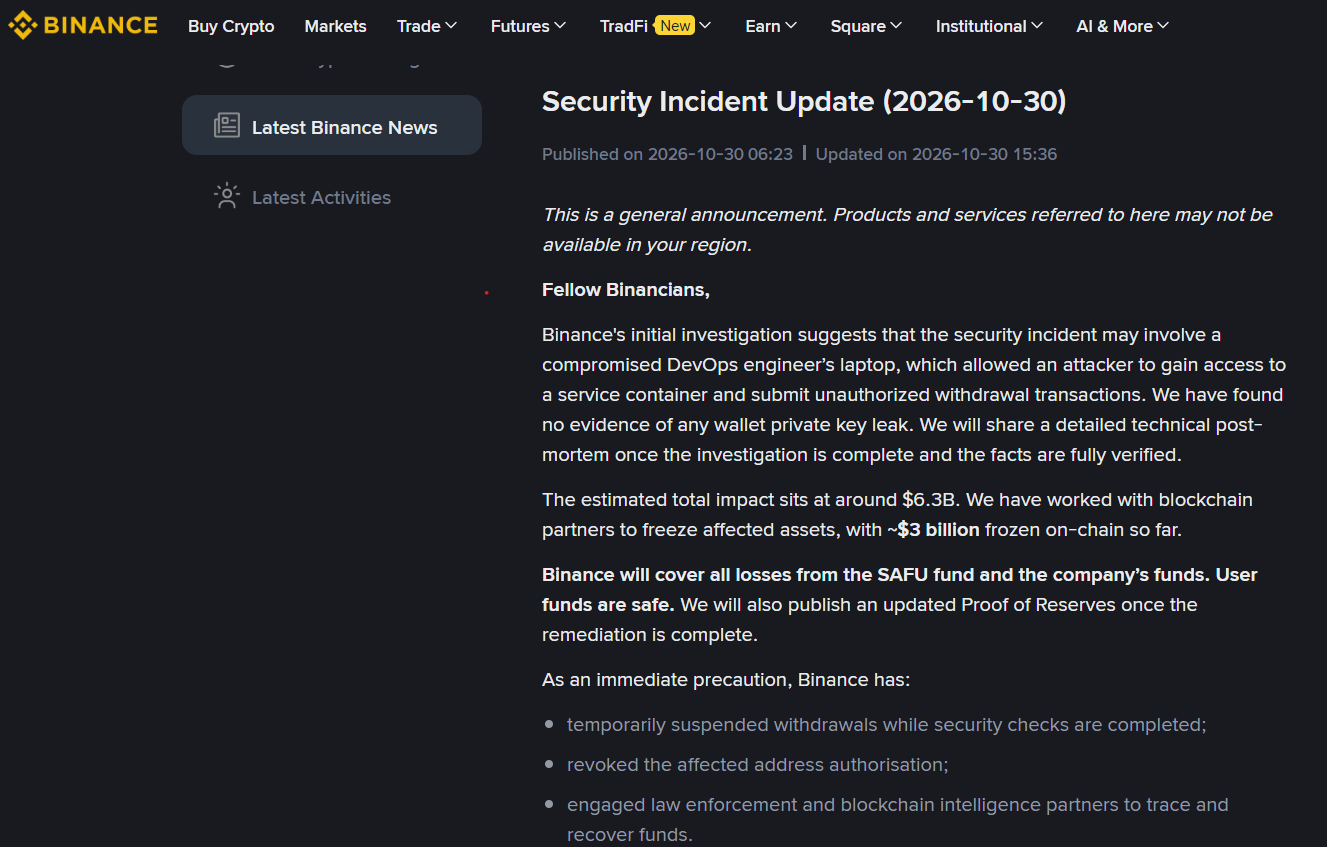
Binance, the world’s largest cryptocurrency exchange, confirmed on Friday that approximately $3 billion of the pilfered assets had been successfully frozen on-chain, a significant achievement given the total estimated $6.3 billion taken. The exchange immediately activated its robust security protocols, announcing its collaboration with international law enforcement agencies, including the FBI, as well as token issuers and leading blockchain analytics firms, in a comprehensive effort to trace and recover additional funds.
The sheer scale of the theft is staggering, even by the volatile standards of the cryptocurrency market. If the $6.3 billion figure holds, it dwarfs every previous crypto heist, making the $625 million Ronin Bridge exploit or the $100 million Harmony Bridge hack pale in comparison. However, with nearly half of the assets already immobilized, a critical question emerged: how much of the remaining stolen crypto could the perpetrators realistically spend or launder?
The Crypto with an "Off Switch": Centralized Countermeasures
The ability to freeze assets lies at the heart of the ongoing battle. Unlike Bitcoin or Ether, which operate on decentralized networks without a central authority capable of pausing transactions or blacklisting addresses, stablecoins like Tether’s USDT and Circle’s USDC are issued by centralized entities. This inherent centralization grants their issuers the power to freeze tokens held at specific addresses, effectively rendering them unusable to malicious actors.
This crucial distinction allowed for an incredibly swift response. Tether, the largest stablecoin issuer, moved with unparalleled speed, freezing a total of around $1.567 billion in USDT. The first major freeze occurred a mere 37 minutes after the stolen funds first landed in the attacker’s primary Ethereum wallet, demonstrating a highly responsive security infrastructure. Circle followed suit just three minutes later, immobilizing approximately $823 million in USDC. Other issuers, including Ripple and World Liberty Financial, quickly joined the coordinated effort, blacklisting associated wallets.
The power to immobilize crypto is not exclusive to stablecoins. Even some decentralized protocols, despite lacking central issuers, took decisive action. Arbitrum, a prominent Layer 2 scaling solution for Ethereum, saw its Security Council intervene. It moved approximately $30.5 million in ARB and ETH into an intermediary frozen wallet, ensuring these funds could only be moved following further action by the council or a vote by the Arbitrum DAO governance. This demonstrated a nuanced approach to decentralization, where governance mechanisms could be leveraged for emergency responses.

However, a critical distinction remains: frozen funds do not automatically equate to recovered funds. While immobilizing assets effectively prevents suspected attackers from spending them, it does not automatically return them to Binance or the affected users. The frozen funds remain in the blacklisted wallets, awaiting a legal or technical process for their rightful return, which can often be complex and time-consuming.
The Aave Complication: A Decentralized Lending Dilemma
The decentralized lending protocol Aave introduced another layer of complexity to the recovery efforts. In a rapid sequence between 8:58 pm and 9:01 pm UTC, a wallet linked to the attackers deposited $60 million in USDT into Aave V3 on Ethereum. They then immediately borrowed $44.6 million of wrapped Ether (WETH), executing this maneuver approximately 40 minutes before the first major stablecoin freeze took effect.
LlamaRisk, an Aave risk service provider, later reported that the attacker’s position held around $59.9 million in USDT collateral against $43.8 million in debt. Crucially, Aave confirmed that this position remained overcollateralized, meaning the value of the collateral exceeded the value of the borrowed assets, thus not immediately jeopardizing the protocol’s suppliers.
The challenge arose because the USDT had already been deposited into Aave’s lending pool. As Aave Chan Initiative founder Marc Zeller explained, blacklisting the attacker’s wallet could not automatically retrieve the collateral held within the protocol. "USDT is real money backed by dollars, and the position is criminal but overcollateralized in the eyes of the protocol," Zeller clarified. The funds were locked within a smart contract interaction that honored the terms of the loan, regardless of the illicit origin of the collateral. To mitigate potential risks and prevent further malicious activity, Aave temporarily froze markets across its V3 and V4 deployments. While existing users could still withdraw funds, repay loans, and liquidate positions, new deposits and borrowings were halted. Aave later lifted its precautionary freeze, confirming that its contracts were unaffected and all positions remained overcollateralized, a testament to the protocol’s design resilience even under extreme pressure. "Just another day in crypto," Zeller quipped, highlighting the inherent volatility and rapid problem-solving culture of the decentralized finance space.
The Architects of Chaos: The North Korean Connection
The attribution of the hack to North Korea’s Lazarus Group added a chilling dimension to the incident. This state-sponsored cybercrime organization has become synonymous with some of the largest and most sophisticated cryptocurrency heists in recent years, including the $625 million Ronin Bridge hack in March and the $100 million Harmony Bridge exploit in June. Their primary motivation is believed to be funding North Korea’s illicit weapons programs, making these hacks acts of state-sponsored financial terrorism.
Lazarus Group’s modus operandi typically involves highly elaborate social engineering schemes, exploiting vulnerabilities in cross-chain bridges, or compromising private keys through phishing attacks. Their sophisticated tactics, coupled with a relentless pursuit of anonymity, make tracking and recovering funds an arduous task for even the most advanced blockchain forensics experts and law enforcement agencies. The speed and precision with which they executed the Binance hack’s initial conversion phase were hallmarks of their operational prowess, underscoring their capabilities.
The Chase: Blockchain Analytics and Law Enforcement
The coordinated response from the crypto industry and law enforcement was unprecedented. Firms like CertiK and Elliptic played a pivotal role, leveraging their advanced blockchain analytics tools to trace the flow of stolen funds across various networks and protocols. These companies use sophisticated algorithms and vast databases of known addresses to identify suspicious transactions, link them to known entities, and map out the entire illicit money trail. Their work provided critical intelligence that enabled stablecoin issuers to act swiftly and precisely.
Binance’s collaboration with the FBI and other international agencies underscores the global nature of this challenge. Recovering funds from state-sponsored actors like Lazarus Group is notoriously difficult. These groups often employ advanced laundering techniques, including mixing services, chain hopping (moving funds between different blockchains), and utilizing obscure exchanges, to obscure their tracks. International cooperation is essential, but jurisdictional complexities and the inherent pseudo-anonymity of cryptocurrency transactions present significant hurdles.
Frozen vs. Recovered: A Critical Distinction
Elliptic, a leading blockchain analytics firm, estimated that by 7:00 am UTC on Friday, approximately $2.84 billion had been frozen. This meant that while a significant portion of the stolen funds was no longer accessible to the attackers, they still controlled around $3.33 billion in assets that issuers could not immobilize.
The stark reality is that Bitcoin and Ether, being truly decentralized, lack the "off switch" available to stablecoins. Once stolen assets are successfully converted into these native cryptocurrencies, restricting transactions becomes significantly harder, and freezing them in the traditional sense is almost impossible. This explains the hackers’ frantic race to convert, understanding that BTC and ETH offer a higher degree of anonymity and resistance to centralized control, making them ideal for long-term retention and eventual laundering.
Binance, however, has pledged to cover all losses incurred by its users, drawing upon its Secure Asset Fund for Users (SAFU) and additional company funds. The SAFU fund, established in 2018, is an emergency insurance fund designed to protect user assets in extreme cases of security breaches. According to a recent update from Binance CEO Richard Teng, the exchange is already actively "recovering stolen assets for users." This commitment is crucial for maintaining user trust and confidence in the wake of such a colossal security incident.
Broader Implications and The Future of Security
The Binance hack, irrespective of the final recoverable amount, will undoubtedly have far-reaching implications for the cryptocurrency ecosystem. It reignites debates about the balance between decentralization and security, highlighting the vulnerabilities that can arise at the intersection of centralized services and decentralized protocols, particularly cross-chain bridges. It also underscores the persistent threat posed by state-sponsored hacking groups and the critical need for enhanced security measures across all layers of the crypto infrastructure.
For investors, such events can erode confidence, potentially leading to increased regulatory scrutiny and demands for stricter oversight. The coordinated response by stablecoin issuers, while effective in limiting the damage, also serves as a stark reminder of the centralized control points within the broader crypto market. As the industry continues to mature, the lessons learned from this unprecedented hack will undoubtedly drive innovation in security, bridge design, and collaborative defense mechanisms, shaping the future landscape of digital asset safety. The race to recover the remaining billions will continue, a testament to the ongoing cat-and-mouse game between sophisticated attackers and the global forces striving to protect the integrity of the crypto world.