Faris Adani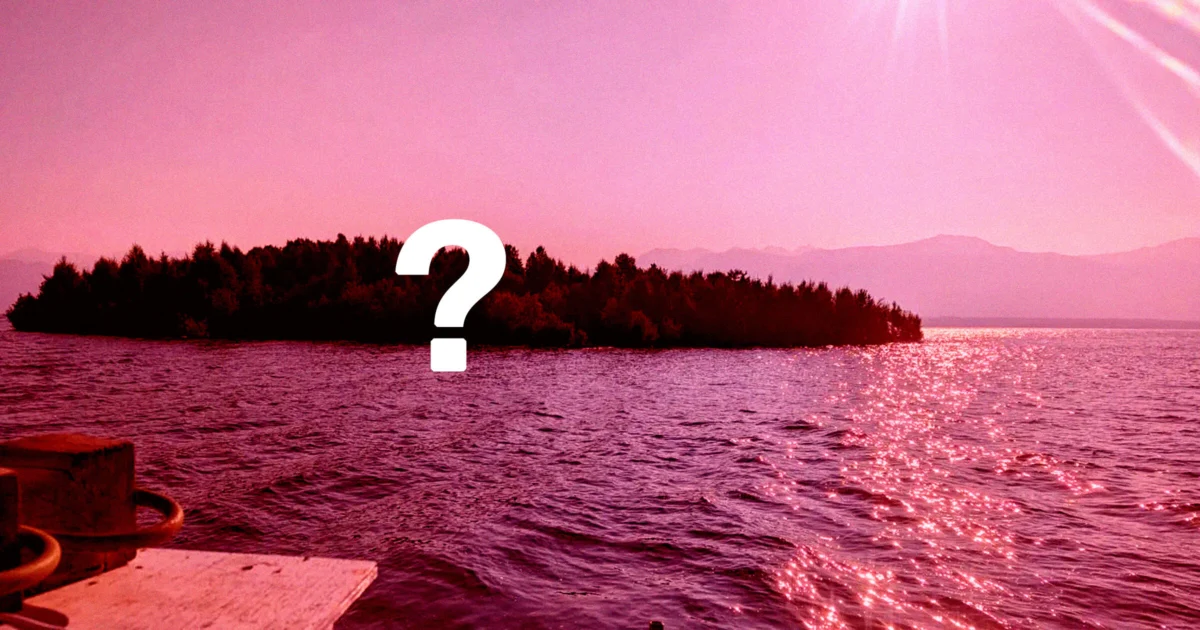
In a startling incident that initially baffled authorities and sparked widespread skepticism, a substantial island, densely covered with fully-grown trees, inexplicably materialized in the vast expanse of Williston Lake in northern British Columbia. The sheer suddenness and unusual nature of its appearance were so profound that when a local boater, Rocky Avery, posted compelling video footage of the new landmass on social media, incredulous officials at first dismissed it as a sophisticated fabrication, suspecting it to be the product of advanced artificial intelligence. The notion of an entire, forested island simply appearing out of thin air seemed to defy natural laws, pushing the boundaries of what was considered plausible in the digital age.
However, the extraordinary event was no digital hoax. Subsequent satellite imagery of Williston Lake, Canada’s largest body of freshwater and a massive artificial reservoir, provided undeniable confirmation: the nearly two-and-a-half-acre island was undeniably real, a verdant enigma floating on the lake’s surface. This revelation only deepened the mystery, transforming initial disbelief into profound scientific curiosity and wonder. Bob Gammer, a spokesman for BC Hydro, the government-owned utility responsible for operating the colossal reservoir, articulated the unprecedented nature of the situation. "This is a first for us, for this reservoir," Gammer told the New York Times, highlighting the rarity of such a phenomenon within their operational history. Speaking further to The Guardian, he added, "In the days of AI, you really needed another form of verification or evidence like a corroborating eyewitness account. And soon, we got that."
Williston Lake itself is a testament to human engineering and environmental transformation. Created in 1968 by the construction of the W.A.C. Bennett Dam on the Peace River, it is one of the largest reservoirs in the world by volume, inundating vast tracts of land, including forests and valleys, to generate hydroelectric power. This immense man-made body of water, stretching over 250 kilometers in length with a shoreline exceeding 1,600 kilometers, is characterized by its deep, often fluctuating water levels and the remnants of its past — submerged forests and vast quantities of woody debris from the cleared land. The very nature of its creation, involving the flooding of established ecosystems, laid the groundwork for unusual geological and ecological events. The lake’s dynamic environment, subject to significant changes in water levels due to power generation and seasonal variations, plays a crucial role in understanding phenomena like the appearance of a floating island.
The newly discovered island was observed floating roughly 60 miles west of the reservoir’s colossal W.A.C. Bennett Dam, a significant distance that underscored its migratory potential. BC Hydro’s experts quickly moved to formulate a plausible scientific explanation for its sudden emergence. Their leading hypothesis suggests that the island is essentially a massive chunk of the reservoir’s shoreline that detached due to a confluence of factors, primarily influenced by unusually high water levels—the highest recorded in 14 years. Over an extended period, perhaps several years, logs, woody debris, and other organic matter could have accumulated in a sheltered bay or cove along the reservoir’s edge. This accumulation, often forming a dense, intertwined mat, would have become a substrate for vegetation. Over time, trees, some already fully grown, would have taken root within this organic raft, their root systems further binding the material together and forming a surprisingly stable, buoyant structure.
Gammer elaborated on this mechanism, explaining how such a mass could break free. "We could easily see that a mass of woody debris with live vegetation on top of it rises up, floats and breaks free from the shoreline," he told the NYT. The elevated water levels would have provided the necessary buoyancy to lift this entire forested raft from its grounded position. Once detached, the powerful winds prevalent across the expansive Williston Lake would have acted as a natural propulsion system, carrying the colossal raft out into open water, transforming it into a veritable naval expedition of trees. This phenomenon, while rare on such a scale and with mature trees, is not entirely unknown globally. Natural floating islands, often referred to as "sudd" in places like the Nile River or as "tussocks" in other wetlands, are formed by similar processes of vegetation and organic matter binding together, eventually becoming buoyant and drifting. The Williston Lake event, however, stood out due to the sheer size of the "island" and the maturity of its arboreal inhabitants.
Just as scientific and public curiosity peaked, and experts began to fully comprehend the mechanics behind this remarkable new island, it unveiled another astonishing trick: it vanished. Sometime around August 5, the entire forested landmass disappeared from its known location, leaving behind only open water. The news, reported by Scientific American, sent a fresh wave of bewilderment through observers. Was it a fleeting illusion? Had it sunk? The mystery deepened significantly. Then, with an equally dramatic flair, fresh satellite imagery captured on August 15 confirmed its reappearance. But it wasn’t in the same spot. The wandering island had reappeared some 20 miles northwest of its initial sighting, now conspicuously hugging a different stretch of shoreline.
The dramatic disappearance and reappearance, coupled with its migratory journey, naturally led to speculative questions, some playfully wondering if the island could "swink" (swim and sink), "swim," or even "turn invisible." While such fantastical notions captured the public imagination, the most plausible scientific explanation points to the island temporarily drifting to a shore where its forested mass blended seamlessly with the existing coastline. From a distance or even from satellite perspectives, it could have been indistinguishable from the permanent landmass, effectively "hiding" in plain sight. Strong winds, fluctuating water currents, or a combination of both could then have dislodged it once more, sending it back out into the open water to resume its slow, deliberate voyage across the reservoir. This dynamic behavior underscores the transient nature of such geological curiosities and the powerful, unseen forces at play in large aquatic environments.
The Williston Lake floating island, with its dramatic appearance, disappearance, and reappearance, serves as a powerful reminder of the dynamic and often unpredictable nature of our planet, even in seemingly stable, man-made environments. While primarily a marvel of natural processes, such events can also carry broader implications. Ecologically, a large floating island can create a temporary, mobile habitat for various species, potentially transporting flora and fauna across vast distances. For a large reservoir like Williston Lake, while likely not posing a significant navigational hazard due to its slow movement and vastness, such a substantial floating object does warrant monitoring by BC Hydro, particularly concerning its proximity to dam infrastructure or recreational areas. The incident has undoubtedly spurred greater interest in the hydrogeology of large reservoirs and the potential for similar, previously unobserved phenomena. As monitoring continues, the story of Williston Lake’s wandering island remains a fascinating blend of scientific intrigue, natural wonder, and a compelling illustration of how our world can still surprise us, even in an age where seemingly everything is cataloged and understood.