anjir abdul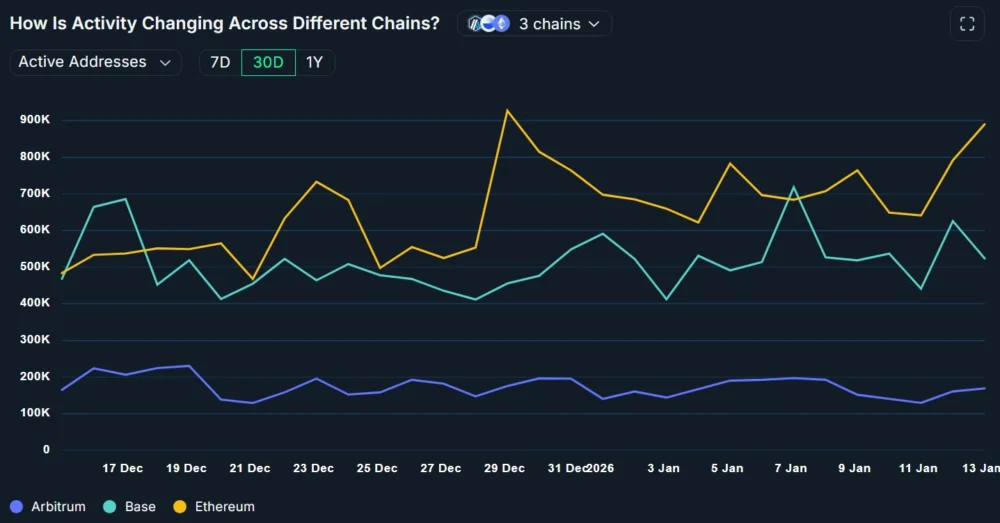
Active users on the core Ethereum network have recently surpassed those on prominent Layer 2 (L2) scaling solutions such as Base, Arbitrum, and Optimism, signaling a significant shift in the blockchain landscape as long-term development strategies for the Layer 1 (L1) begin to yield substantial results. This milestone underscores Ethereum’s renewed vitality and growing utility, driven by a series of crucial upgrades that have dramatically reduced transaction costs and enhanced network capacity.
According to comprehensive data from Nansen, the number of active addresses on the Ethereum mainnet exceeded an impressive 791,000 on a recent Monday. This figure places Ethereum comfortably ahead of its major L2 counterparts, which have traditionally been the go-to for users seeking lower fees and faster transactions. The resurgence of L1 activity is particularly noteworthy given the narrative of L2s as the primary scaling solution for Ethereum. This growth is not merely an isolated event but a culmination of persistent efforts by the Ethereum developer community to future-proof the network.
Perhaps even more striking than the increase in active users is the drastic reduction in daily average transaction costs. On the same Monday, the average fee for a transaction on Ethereum plummeted to a mere $0.15. This stands in stark contrast to just one year prior, when the average transaction fee hovered around $11. Looking further back, the period from late 2021 to mid-2022, characterized by the explosion of decentralized finance (DeFi) and the peak of the non-fungible token (NFT) craze, saw users reporting gas fees upwards of $200 for a single transaction, leading to widespread frustration and raising serious questions about Ethereum’s scalability and usability.

These remarkable metrics—surging active users and plummeting fees—are not accidental. Over the last year, the number of active addresses on the Ethereum network has surged by 71%, climbing from approximately 460,000 accounts recorded a year ago to the current 791,000. This organic growth is a testament to the network’s increasing appeal and functionality. Moreover, daily transactions on Ethereum have consistently been hitting all-time highs, indicating a robust and expanding utility. On a recent Tuesday, the Ethereum blockchain processed an astonishing 2.1 million transactions, maintaining an average fee of just $0.15. This unprecedented combination of high transaction volume and ultra-low costs directly addresses the very challenges that propelled the rise of L2s in the first place.
The emergence and rapid adoption of L2 networks in 2023, with major players like Coinbase launching their own solutions such as Base (which opened its mainnet to users in August 2023), were largely a response to Ethereum’s prior scalability limitations. These L2s offered a temporary reprieve from high gas fees by batching transactions off-chain and then submitting a single proof to the Ethereum mainnet. While L2s continue to play a crucial role in the Ethereum ecosystem, the recent improvements on L1 suggest that the base layer itself is becoming increasingly competitive and viable for a broader range of applications.
Two major upgrades to Ethereum in 2025 were pivotal in achieving these improvements. In May 2025, the Pectra upgrade significantly increased the capacity of "blobs"—a specialized data type designed to store transaction data more efficiently for rollups. By providing more blob space, Pectra enabled rollups to post their transaction data to the L1 at a much lower cost, a saving that could then be passed on to users in the form of reduced fees. This was a critical step in making L2s cheaper to operate, which in turn indirectly benefited L1 users by creating more overall network capacity.
Building on Pectra’s success, the Fusaka upgrade, activated on December 3, 2025, further enhanced blob capacity. More importantly, Fusaka introduced Peer Data Availability Sampling (PDAS). This innovative mechanism allows Ethereum validators to verify the availability of blob data without needing to download entire blobs. Instead, validators can use small, random samples to confirm data availability, dramatically reducing the computational and storage burden on individual nodes. This architectural improvement is crucial for scaling the network while maintaining decentralization and security.

Beyond lower fees and increased active addresses, developers are also showing a renewed preference for Ethereum as a settlement layer. According to Token Terminal, the number of new smart contracts created and published on Ethereum reached an all-time high of 8.7 million in the fourth quarter of 2025. This metric is a powerful indicator of future network activity and developer confidence, suggesting a vibrant ecosystem increasingly choosing Ethereum’s robust foundation for deployment.
This resurgence of Ethereum’s L1 utility comes at a time of intensified competition among various Layer 1 blockchains, including powerhouses like Tron, Solana, and BNB Chain. These alternative L1s have gained traction largely due to their high transaction throughput and popularity for retail users and memecoin activities. While they boast impressive transaction per second (TPS) figures and active addresses, Ethereum’s strategic upgrades are positioning it to directly challenge these competitors by offering a more scalable and cost-effective L1 experience without compromising on its foundational principles of decentralization and security.
As the blockchain race heats up, Ethereum developers are actively pursuing strategies to "future-proof" the network, ensuring its longevity and resilience. A key philosophical underpinning of this vision was articulated by Ethereum co-founder Vitalik Buterin. On Monday, Buterin stated on X (formerly Twitter) that the network must evolve to a point where its core developers can eventually "walk away." He emphasized that building robust applications is "not possible on a base layer which itself depends on ongoing updates from a vendor in order to continue being usable." For Ethereum to truly endure for "100 years," Buterin asserted that it must pass the "walkaway test," embodying the traits of decentralization and self-sufficiency that it strives for in its applications.
Buterin outlined several key factors to achieve this ambitious goal, pushing Ethereum towards a state where its value proposition does not strictly depend on any features not already enshrined in the protocol. These include:

- Statelessness: Reducing the amount of historical data nodes need to store, making them lighter and easier to run.
- Enshrined Proposer-Builder Separation (PBS): A mechanism to mitigate censorship and centralizing tendencies in block production.
- L1 Light Client Sync: Enabling easier and more secure verification of the chain by resource-constrained devices.
- ZK-EVMs (Zero-Knowledge Ethereum Virtual Machines): Integrating ZK-proofs directly into the EVM to enhance scalability and privacy.
- Single-Slot Finality: Achieving transaction finality within a single block, drastically speeding up confirmation times.
Buterin stressed that developers should aim to "tick off at least one of these boxes, and ideally multiple," every year. This ongoing, methodical approach to core protocol development is what underpins the current success and future ambitions of Ethereum.
Looking ahead, major transformative changes are slated for Ethereum in 2026. The eagerly anticipated Glamsterdam fork is poised to introduce "perfect parallel processing" to the network. This revolutionary feature will allow multiple transactions to be processed simultaneously, dramatically increasing transaction bandwidth and throughput. Concurrently, Glamsterdam will significantly increase the gas limit from its current 60 million to an unprecedented 200 million, while also implementing further increases to blob size. Perfect parallel processing, by optimizing how transactions are executed, is expected to allow for larger block sizes without necessarily increasing gas limits proportionally, thus maintaining efficiency and affordability. The combined effect of these upgrades is projected to boost Ethereum’s throughput to an impressive 10,000 transactions per second (TPS), a figure that would make it highly competitive with even the fastest L1s.
As Ethereum continues to execute its ambitious roadmap of network upgrades, the accumulating data unequivocally demonstrates increasing activity and utility on its L1. The strategic investments in scalability and efficiency are now paying tangible dividends, manifest in soaring user numbers and minimal transaction costs. This sustained momentum suggests that the vision of a robust, scalable, and self-sufficient Ethereum—a network developers can eventually "walk away from"—is steadily becoming a reality, laying a bulletproof foundation upon which future generations of decentralized applications can confidently build.