anjir abdul
Researchers at the Bank for International Settlements (BIS), often dubbed the "central bank for central banks" due to its role in fostering international monetary and financial cooperation, have unveiled a significant revelation regarding the measurement of economic activity within the cryptocurrency ecosystem, particularly highlighting a major gap in how Bitcoin’s onchain transfer values are estimated. Their latest working paper, titled "Hidden complexity: Measuring stablecoin, crypto, and decentralised finance ecosystems," reveals that estimates of Bitcoin onchain transfer values can diverge by as much as sixfold, depending critically on the methodologies employed for measuring these transactions. This profound discrepancy does not pertain to trading volumes on centralized crypto exchanges but specifically to the movement of value directly on the Bitcoin blockchain, challenging the long-held assumption of straightforward and universally understood metrics within the digital asset space.
The core of this sixfold variation lies in the fundamental design of Bitcoin’s transaction structure, particularly its reliance on the Unspent Transaction Output (UTXO) model. Unlike traditional banking systems where balances are directly debited and credited, Bitcoin transactions operate by consuming entire unspent transaction outputs (UTXOs) and generating new ones. When a user wishes to spend a certain amount of Bitcoin from a larger UTXO, the entire UTXO must be spent. This typically results in two new outputs: one representing the intended payment to the recipient, and another, known as a "change output," returning the remaining unspent funds back to an address controlled by the original sender. The BIS researchers found that the gap in transfer estimates largely reflects how these change outputs, and other similar transfers back to the sender, are treated. Some measurement methods might count all outputs generated by a transaction, including the change output, as a transfer of value. However, from an economic perspective, the change output merely represents funds being returned to the original party, not a genuine transfer of economic value to a distinct recipient. Consequently, including these change outputs inflates the perceived transaction volume, leading to a substantial overestimation of the actual economic throughput or transfer activity on the network. This nuance is crucial because it suggests that raw onchain data, while transparent, requires sophisticated interpretation to accurately reflect genuine economic activity, rather than simply programmatic movements of funds within a user’s own control.
The measurement problem extends beyond just transaction values, also impacting the perceived market capitalization of Bitcoin. The BIS study indicates that the conventional measure of market capitalization, calculated by multiplying the total circulating supply by the current market price, has at times been as much as four times higher than "realized capitalization." Realized capitalization offers a more nuanced perspective by valuing each unit of Bitcoin (or any cryptocurrency) at the price it was last moved onchain. This method effectively filters out coins that have been lost or are held in long-term inactive wallets, providing a potentially more accurate reflection of the capital actively invested in the network and held by participants. The substantial difference between these two capitalization metrics suggests that the conventional measure might significantly overstate the actual market size and the amount of capital actively circulating within the ecosystem, potentially misleading investors and analysts about the true scale and liquidity of the asset. As the researchers aptly put it, "Metrics such as transaction volumes, market capitalisation and total value locked often suggest a degree of accuracy that is not supported by the nature of the underlying data."

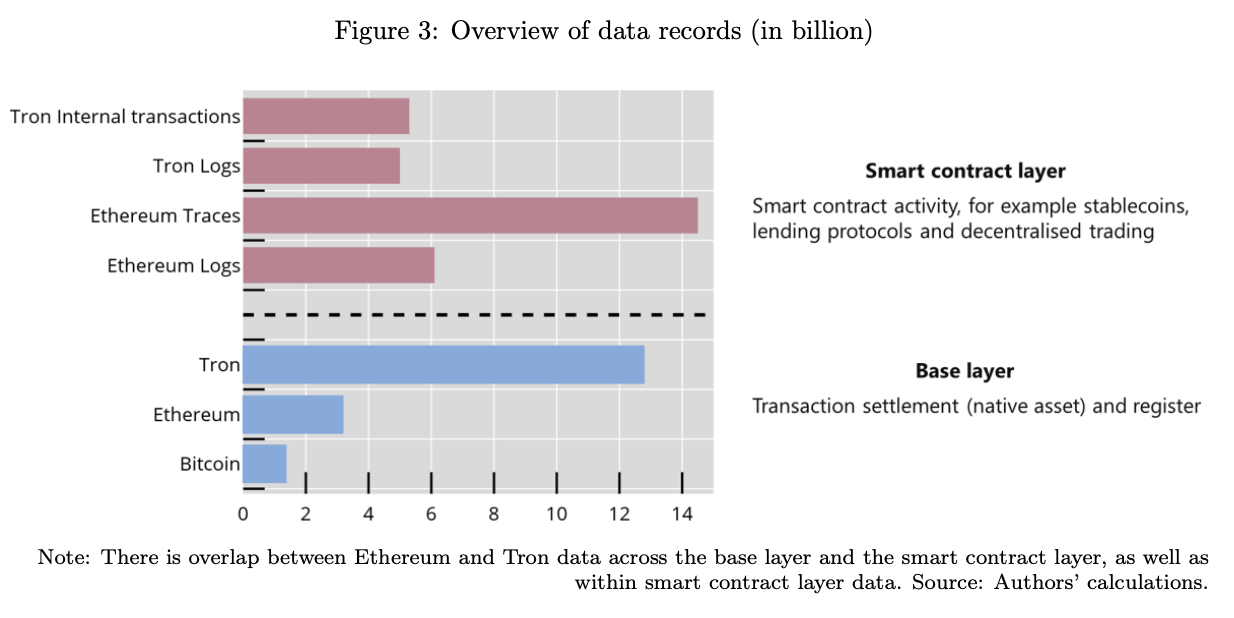
The comprehensive study, which meticulously analyzed over 100 billion blockchain records spanning Bitcoin, Ethereum, and Tron, reveals that similar measurement challenges are pervasive across the broader cryptocurrency ecosystem. This isn’t an isolated issue specific to Bitcoin but a systemic complexity inherent in interpreting blockchain data for economic analysis.
Ethereum, with its more complex and programmable architecture, presented its own unique set of measurement hurdles, primarily due to the proliferation and diverse functionalities of smart contracts. Out of approximately 67.5 million active smart contracts examined on the Ethereum network, a staggering 54 million, or nearly 80%, could not be meaningfully categorized using the classifications established in the study. This inability to classify the vast majority of smart contracts highlights a profound challenge in understanding their purpose, activity, and economic impact. Smart contracts can perform a myriad of functions, from simple token transfers to complex decentralized finance (DeFi) protocols, gaming logic, or even dormant placeholder contracts. Without a clear understanding of what these contracts are doing, it becomes exceedingly difficult to accurately measure the true economic activity, innovation, or risk associated with the Ethereum network, underscoring the "hidden complexity" mentioned in the paper’s title.
Interpreting stablecoin activity, which forms a critical bridge between traditional finance and the crypto world, presents yet another layer of complexity. The BIS researchers observed that the same stablecoin asset, such as Tether (USDT), can serve dramatically different purposes depending on the blockchain it resides on. For instance, USDT deployed on the Ethereum blockchain was found to be more intimately linked with DeFi activities, including lending, borrowing, and decentralized exchange trading. In stark contrast, USDT on the Tron blockchain appeared to be predominantly associated with payment-like transactions, remittances, and store-of-value purposes, reflecting different user bases and regional preferences. This functional divergence was particularly evident in smart contract holdings: the share of USDT held by smart contracts on Ethereum exceeded 20% in 2022, while on Tron, this figure hovered around a mere 1%. The researchers warned that simply aggregating USDT activity across different blockchains without accounting for these distinct use cases can conflate disparate types of economic activity, thereby obscuring a clear understanding of how stablecoins are actually being utilized and their true economic significance. This has critical implications for regulators seeking to understand the systemic risks posed by stablecoins and policymakers aiming to formulate appropriate regulatory frameworks.
The overarching conclusion drawn by the BIS researchers is a critical one: onchain indicators, despite their apparent transparency, should be universally treated as "noisy approximations rather than direct measures of economic activity." This caveat is vital for investors, analysts, journalists, and regulators alike, emphasizing the need for a more sophisticated and discerning approach to interpreting blockchain data. Blindly relying on raw transaction counts or unadjusted market capitalization figures can lead to significant misinterpretations of market trends, investment opportunities, and the overall health and scale of the crypto economy. The paper serves as a potent reminder that while blockchains provide an unprecedented level of data accessibility, extracting meaningful economic insights from this raw data is a complex analytical challenge that requires careful methodology and a deep understanding of the underlying protocols.
Crucially, the industry itself is not entirely unaware of these challenges, and some leading analytics providers are already working to distinguish between raw blockchain activity and adjusted measures designed to more accurately represent economic activity. A prime example is Visa’s Onchain Analytics dashboard, powered by data from Allium Labs. This platform explicitly displays both total and "adjusted" stablecoin transaction volumes. Visa’s adjusted methodology aims to meticulously filter out potential distortions arising from various forms of non-economic activity, including high-frequency trading algorithms, automated bot activities, bridge routing mechanisms (where assets move between different blockchains), and internal exchange operations (such as rebalancing hot and cold wallets). The stark difference between these figures is compelling: the dashboard recently showed $6.4 trillion in total stablecoin transaction volume across tracked networks over the past 30 days, compared to a significantly lower $313.1 billion in adjusted volume. This demonstrates a nearly 20-fold difference, even more pronounced than the sixfold gap identified for Bitcoin, underscoring the massive overestimation that can occur when raw data is not carefully parsed. Such initiatives by industry players like Visa highlight a growing recognition of the need for more refined and economically meaningful metrics, moving towards a more mature and data-driven understanding of the crypto landscape.
In conclusion, the BIS working paper serves as a seminal contribution to the ongoing effort to accurately quantify and understand the crypto ecosystem. It meticulously dissects the inherent complexities in measuring onchain activity, from Bitcoin’s UTXO model and its impact on transfer estimates to Ethereum’s vast, often uncategorized smart contract landscape, and the diverse, context-dependent use cases of stablecoins across different blockchains. The paper’s call to treat onchain indicators as "noisy approximations" rather than direct economic measures is a crucial directive for all stakeholders. As the digital asset space continues to evolve and integrate with traditional finance, the development and adoption of standardized, economically sound measurement methodologies will be paramount for fostering transparency, enabling informed decision-making, and facilitating robust regulatory oversight. The work by institutions like the BIS, coupled with innovative solutions from industry leaders such as Visa and Allium Labs, marks a vital step towards demystifying the "hidden complexity" of the crypto world and building a more accurate, reliable framework for its analysis.