Imroatul Nasiyah
Future quantum computers and expansive quantum networks may hinge on the ability to forge robust connections between widely separated modules through distributed entanglement. Historically, establishing these crucial quantum links has demanded intricate, active control and a constant barrage of repeated measurements. However, physicists at the Institute of Science and Technology Austria (ISTA) have unveiled a paradigm shift: a fully autonomous alternative powered by a novel "quantum bath" meticulously engineered from correlated particles of light. This groundbreaking achievement, detailed in the prestigious journal Physical Review X, not only validates a theoretical prediction from over two decades ago but also lays a fresh foundation for the practical realization of advanced quantum technologies.
Entanglement, a cornerstone of quantum mechanics, describes an uncanny correlation between particles or systems that transcends the explanations offered by classical physics. The ability to engineer entanglement between physically separated qubits, the fundamental units of quantum information, is paramount for scaling up quantum computers and constructing robust quantum networks capable of transmitting quantum information across vast distances. Prior to this breakthrough, researchers typically employed one of two main strategies to achieve this distant entanglement. The first involved the active and precise manipulation of a single photon, sent from one qubit to another. The second strategy entailed each qubit emitting its own photon, with the hope that a subsequent process of matching these emitted photons would successfully generate entanglement between the two original qubits. This second approach, recognizing the profound implications of entangled photon pairs, was notably acknowledged with the 2022 Nobel Prize in Physics. Yet, even with this recognition, the process remained intrinsically reliant on iterative measurements and post-selection, a statistically driven approach that did not always guarantee the successful creation of entanglement.
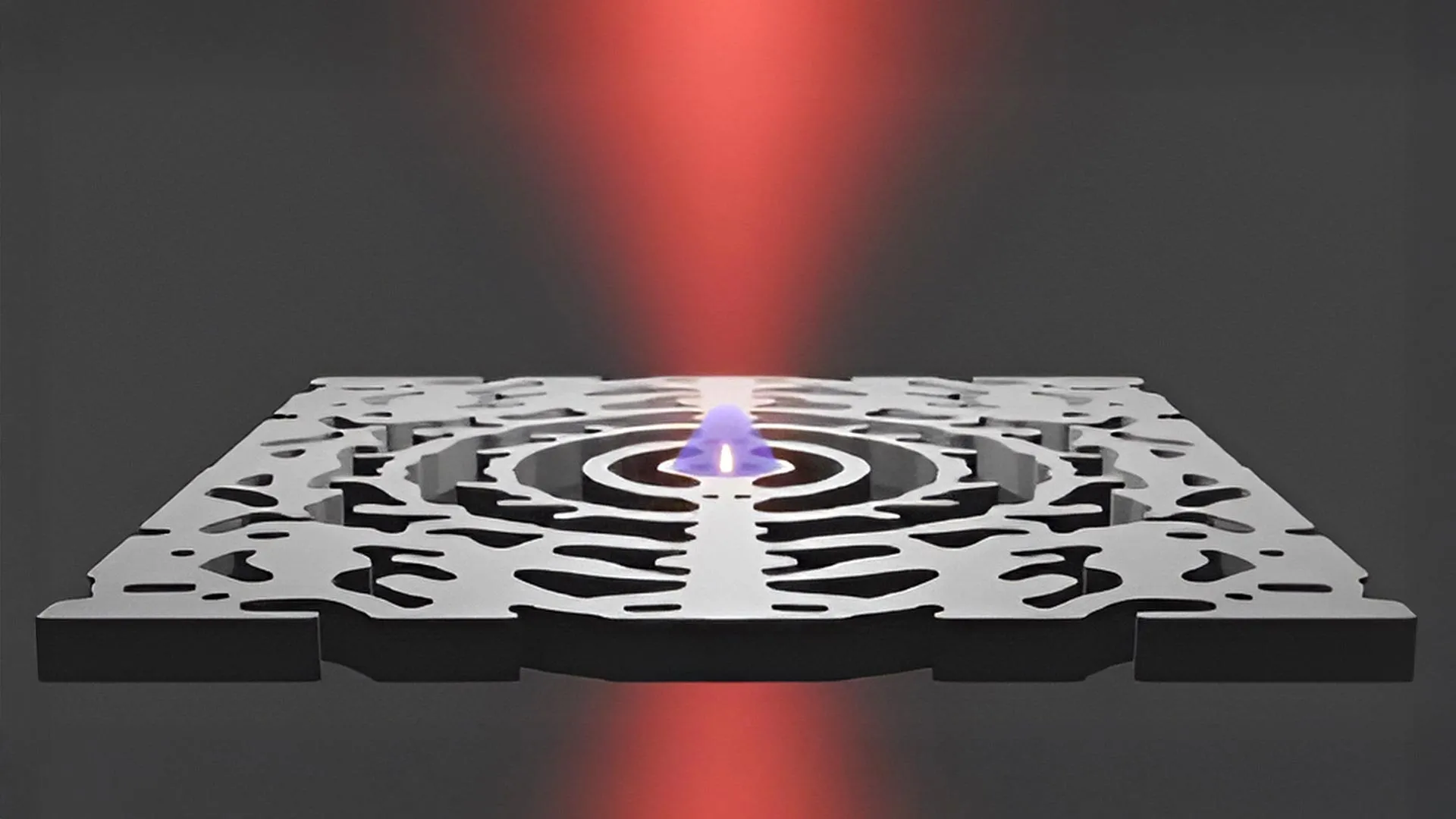
The innovative solution presented by PhD student Alejandro Andrés-Juanes and Professor Johannes Fink at ISTA, in collaboration with international partners, sidesteps these limitations. Their system ingeniously harnesses a "quantum bath" that acts as a self-synchronizing mechanism, automatically aligning distant qubits into a state of entanglement. In a pioneering prototype, the ISTA team utilized a shared source of correlated light particles to entangle two spatially separated qubits, thereby transforming a theoretical concept, conceived over twenty years ago, into a tangible experimental reality.
This new approach to generating entanglement is particularly significant because it bridges the gap between readily available forms of entanglement and those essential for practical quantum applications. Quantum entanglement manifests in various forms. Continuous-variable (CV) entangled states, for instance, are relatively accessible and can be produced efficiently. These can be conceptually likened to a pendulum, where both its position and momentum undergo continuous changes. However, many of the most powerful and useful quantum technologies, such as advanced quantum computing processors and secure quantum communication protocols, rely on "discrete-variable" (DV) systems. These DV systems utilize ‘all-or-nothing’ forms of entanglement, perfectly suited for stationary qubits. The core challenge for the ISTA team was to elegantly connect the easily generated CV entanglement with the discrete forms required for these high-impact applications.
"In this work, we aimed to overcome this mismatch between the readily available and the practically useful forms of entanglement," explains Andrés-Juanes. "By stabilizing the entangled states remotely, our approach is fully autonomous and requires no active control or measurement." This autonomy is a game-changer, promising to simplify the complex operational requirements that have thus far hampered the widespread adoption of quantum technologies.
The persistent challenge in quantum computing and networking lies in maintaining both entanglement and quantum coherence, the delicate quantum states that enable computation and communication. The ISTA researchers ingeniously addressed this by tasking the qubits’ surrounding environment – the "quantum bath" itself – with the responsibility of both generating and stabilizing entanglement.
"In our method, the quantum bath — meaning the qubits’ environment — is the source of entanglement," states Fink. "It creates a new ground state through a continuous stream of correlated photons. This way, the entangled qubit state is stabilized, even beyond the qubits’ own ‘lifetime’, and remains always available as a resource for further quantum processing. This makes the approach conceptually significant." The implication here is profound: the entangled state, once established, persists and is readily accessible for use whenever needed, unlike transient forms of entanglement that must be exploited within their fleeting existence.
To facilitate the coupling of the qubits with this entangled photon source, the researchers strategically employed microwave photons. These low-energy particles of light are exceptionally well-suited for manipulating quantum information and are already integral to the leading superconducting-qubit technologies. Optical photons, on the other hand, play a different but equally crucial role, commonly utilized in optics and atomic physics. They are also anticipated to be vital for transmitting quantum information between geographically dispersed quantum computers via fiber optic cables, an area of active research within Fink’s group at ISTA.
A critical step in validating their success was the ability to confirm that the two qubits were indeed synchronized within the quantum bath. For this, the researchers turned to quantum tomography, a sophisticated technique that reconstructs the properties of a quantum system by analyzing its behavior across a multitude of different "slices" or measurement outcomes.
"Qubits can be in a superposition of states, but all these states collapse when we measure them, leaving us with a 0 or 1 state," explains Andrés-Juanes. Quantum tomography provides a way to circumvent this inherent measurement problem by allowing researchers to perform very brief measurements – on the order of 20 to 80 nanoseconds – and then extrapolate from these observations to infer the qubits’ underlying, pre-measurement states. A nanosecond, for context, is one billionth of a second.
The successful entangling of two isolated qubits through a quantum bath marks a significant milestone, transforming a long-standing theoretical proposal into a functional laboratory prototype. "We present a relatively simple method that could be scaled up to synchronize multiple distant qubits," notes Andrés-Juanes, hinting at the scalability of their approach.
While this new method holds immense promise, it is important to acknowledge that it is not yet as efficient as techniques that involve direct, active control of qubit states. "Our method currently transfers about 10% of the bath’s available entanglement," the researchers report. They suggest that the lengthy time it took to experimentally realize the concept – over two decades – might be attributed to the original theory being developed under idealized conditions that are notoriously difficult to replicate in practice.
"Our experiments helped us reveal several factors that may have prevented scientists from designing a functional quantum bath using a single source of correlated photons for distributed entanglement," Fink elaborates. The insights gained from their experimental work are invaluable for future research and development in this domain.
The prototype developed at ISTA is poised to unlock new avenues for quantum-optics experiments and could significantly contribute to ongoing efforts to expand the capabilities of quantum processors. Ultimately, this breakthrough brings us closer to achieving fault-tolerant quantum computation, a critical goal for unlocking the full potential of quantum computing for scientific discovery and technological innovation. The "quantum bath" approach represents a pivotal step towards making the intricate world of quantum entanglement more accessible, reliable, and ultimately, automatable.