anjir abdul
The cryptocurrency market experienced a sharp downturn on Friday, as an unexpectedly robust U.S. labor market report dramatically shifted sentiment regarding the Federal Reserve’s upcoming monetary policy decisions. Bitcoin (BTC), the world’s largest cryptocurrency, bore the brunt of this shift, plummeting from a high of $81,300 to local lows of $78,600 almost immediately following the announcement, settling around $79,500 at the time of writing. This volatility underscores the continued sensitivity of digital assets to macroeconomic indicators, particularly those influencing interest rate expectations.
Labor Market Exceeds Expectations, Rattling Markets
The catalyst for this market reaction was the latest nonfarm payrolls data, which revealed a substantial increase of 162,000 jobs in the U.S. economy for August. This figure far surpassed economists’ consensus expectations, which had hovered around a more modest 56,000 new jobs. The "threefold" beat indicated a labor market significantly stronger than anticipated, defying predictions of a cooling economy. A strong jobs report, while seemingly positive for the economy, often signals to central banks that inflationary pressures might persist or even accelerate, thereby increasing the likelihood of tighter monetary policy, such as interest rate hikes or a prolonged period of higher rates. For risk assets like Bitcoin, higher interest rates make borrowing more expensive, reduce liquidity in the financial system, and make less risky investments (like government bonds) more attractive by offering better yields, thus diminishing the appeal of speculative assets.
The weight of recent economic data has been particularly heavy, given the highly divided rate outlooks preceding the pivotal Federal Open Market Committee (FOMC) meeting scheduled for September 15-16. Traditionally, expectations ahead of FOMC meetings were often "well-anchored" due to clearer forward guidance from previous Federal Reserve chairs. However, under the current Chair, Kevin Warsh, the market has grappled with a perceived lack of explicit forward guidance. This ambiguity, coupled with the potential for dissenting voices within the committee, has injected an unprecedented level of uncertainty into monetary policy predictions.
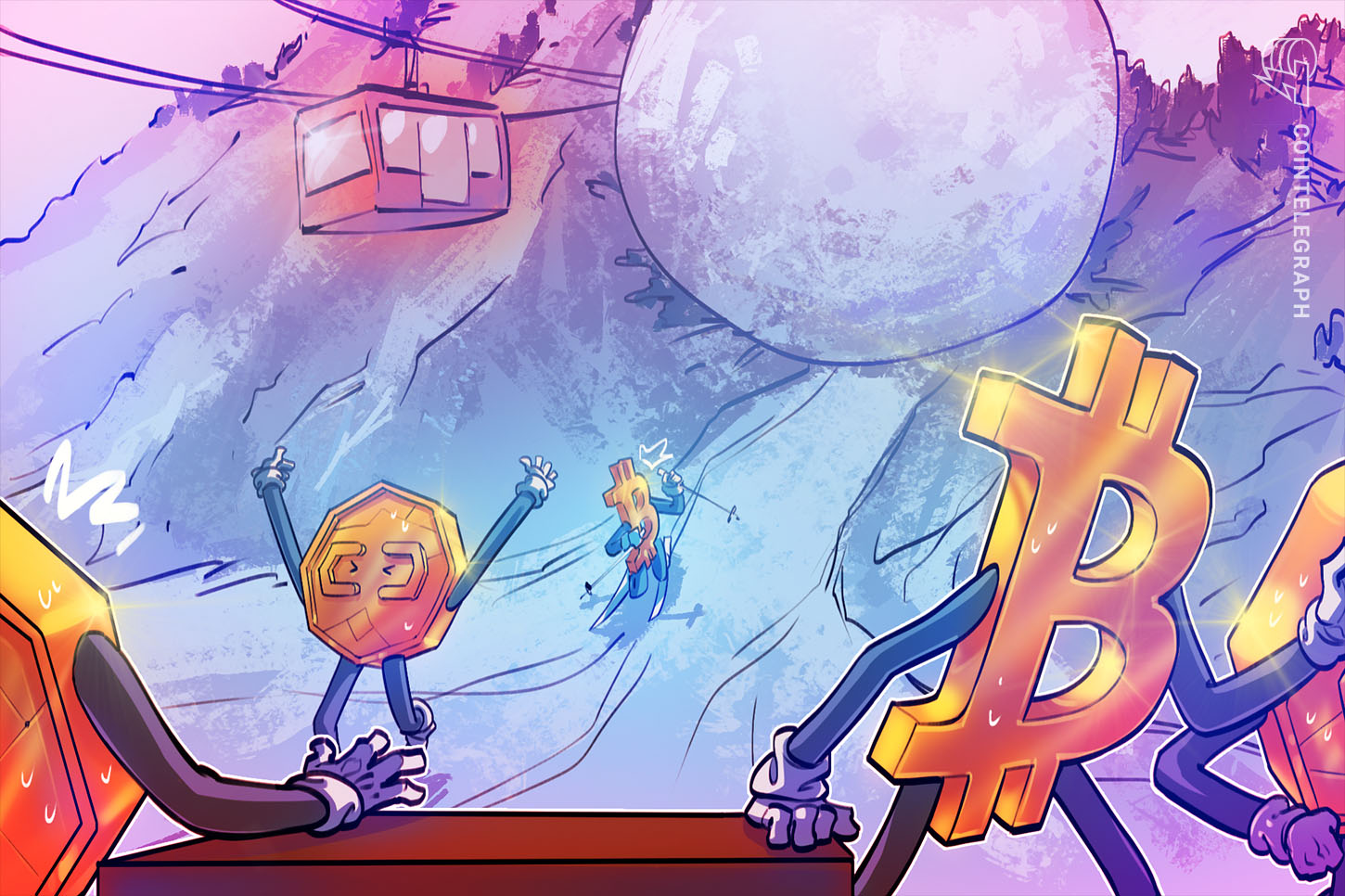
Just a day prior, Federal Reserve Governor Christopher Waller had hinted at a preference for a rate pause, contingent on forthcoming inflation data. This statement had initially swung Polymarket probabilities, a popular platform for predicting real-world events, to a 60% chance in favor of a pause and only 40% for a 25-basis-point interest rate hike (a basis point is one-hundredth of a percentage point). However, Friday’s surprisingly robust labor market data swiftly reversed this sentiment, driving the implied probabilities back to an even 50/50 split. This rapid recalibration reflects the market’s interpretation that the strong jobs growth could compel the Fed to maintain a hawkish stance to combat potential inflation, making a rate hike or at least a sustained period of higher rates more probable. The accompanying image, Implied Probabilities for the Sep. 16 FOMC rate decision, clearly illustrates this dramatic shift in market expectations.
The strong labor market data also elicited a swift response from former U.S. President Donald Trump, who immediately escalated his demands for rate cuts. In a post on his social media platform, Truth Social, Trump stated, "The Fed Board, with its great new leader, must get smart – BE PATRIOTS for a change." He continued, emphasizing his long-held view that, "High interest rates put the U.S.A. at a very unfair disadvantage, and I won’t allow that to happen!" Trump’s remarks underscore the political pressure often exerted on the nominally independent central bank. During his presidency, Trump frequently criticized then-Chair Jerome Powell for not cutting rates more aggressively. His recent comments mark a significant shift, as he had largely refrained from publicly admonishing Warsh on monetary policy until this latest jobs report. This renewed pressure highlights the complex interplay between economic data, central bank policy, and political discourse.
Blake2b Version of Bitcoin Emerges Amid Decentralization Debate
Beyond the macroeconomic turbulence, the Bitcoin ecosystem itself has been grappling with internal debates regarding its fundamental architecture, particularly concerning mining centralization. A recent development saw the emergence of a new, distinct version of Bitcoin, leveraging the Blake2b proof-of-work algorithm, which has now attracted its first albeit thin liquidity.
This saga traces back to August 7, when the BIP-110 soft fork was activated. BIP-110 (Bitcoin Improvement Proposal 110) aimed to introduce specific changes to the Bitcoin protocol, likely related to block size or other technical enhancements intended to improve scalability or efficiency. As a User-Activated Soft Fork (UASF), it sought to implement these changes through a bottom-up approach, relying on users and node operators to enforce the new rules, rather than waiting for miners to signal support. However, upon activation, the Bitcoin network briefly split into two competing chains: one adhering to BIP-110’s new rules and another continuing under the existing protocol. The BIP-110 side largely stalled and failed to gain traction because a critical mass of miners did not dedicate sufficient computing power (hashrate) to extend that chain. This lack of miner support effectively rendered the BIP-110 chain dormant.
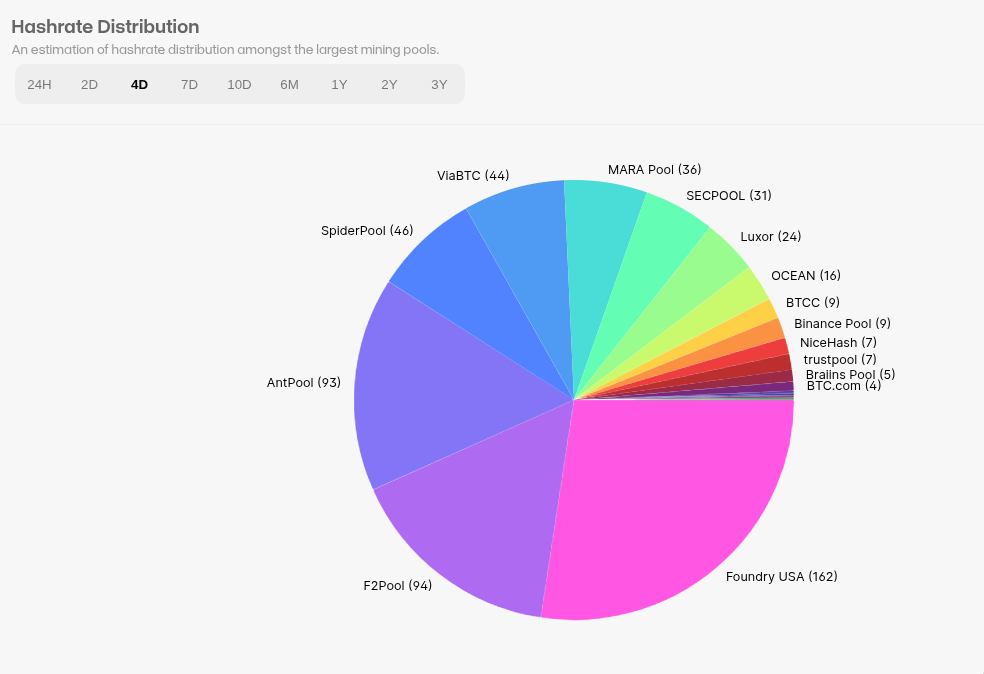
Supporters of BIP-110 interpreted the miners’ refusal to follow the UASF as compelling evidence that Bitcoin’s mining layer has become excessively centralized. The core of this criticism lies in the observation that a very small number of large mining pools now control the vast majority of Bitcoin’s hashrate. As depicted in the Bitcoin Network Hashrate Distribution chart from Blockchain.com, this concentration of power means that a handful of entities exert significant influence over which chain is extended, which transactions are included in blocks, and ultimately, the future direction of the network. This centralization contradicts Bitcoin’s foundational ethos of decentralization and censorship resistance. The criticism was further sharpened by the absence of an organized counter-effort from the Bitcoin Core development side, such as a User-Rejected Soft Fork (URSF), which would have explicitly signaled community disapproval of BIP-110.
In response to this perceived centralization and the failure of the original BIP-110 chain, a determined subset of its supporters, notably led by the prominent and often controversial Bitcoin developer LukeDashjr, decided to pursue an alternative path. Their solution involved continuing the BIP-110 chain but with a fundamental change to its proof-of-work (PoW) algorithm. On August 30, a corresponding hard fork was initiated, transitioning the mining algorithm from SHA-256 (the original Bitcoin PoW) to Blake2b. The rationale behind this change was to allow for a new, more decentralized set of miners to emerge. SHA-256 mining is dominated by highly specialized and expensive Application-Specific Integrated Circuits (ASICs), which consolidate power in the hands of a few manufacturers and large mining farms. By switching to Blake2b, the aim is to foster GPU-based mining or other forms of mining that are more accessible to individuals, thereby distributing hashrate more broadly and reducing the influence of large, centralized mining entities. This new Blake2b chain also leverages "DATUM gateway technology," which is intended to further facilitate decentralized mining operations by providing tools and infrastructure for a wider range of participants.
A significant aspect of this hard fork is its implication for existing Bitcoin holders. Any address that held SHA-256 Bitcoin before August 7 (and potentially some time after, depending on the exact snapshot taken) will automatically hold an equivalent amount on this new Blake2b version of Bitcoin. This is akin to a "fork drop" or "airdrop," where existing holders receive coins on a new chain. This means that individuals who were holding Bitcoin (BTC) now also possess an equal amount of what could be referred to as "Bitcoin Blake2b" (BTCB2).
The practical reality for this new fork is still nascent. So far, the only exchange listing Blake2b Bitcoin (BTCB2) is Neoxa. While liquidity remains quite thin, BTCB2 coins are currently trading at approximately $350 against USDC, with a 1.1% spread. The accompanying image, BTCB2/USDC orderbook, provides a snapshot of the limited trading activity on the Neoxa Exchange. The establishment of initial liquidity, even if minimal, is a crucial first step for any new cryptocurrency. However, the long-term viability and adoption of this Blake2b version of Bitcoin will depend on its ability to attract more users, developers, miners, and further exchange listings, as well as prove its claim of superior decentralization. This fork represents a bold experiment stemming from deep-seated philosophical disagreements within the Bitcoin community, echoing past splits like Bitcoin Cash (BCH) and Bitcoin SV (BSV), all driven by differing visions for Bitcoin’s future.
This article is produced in accordance with Cointelegraph’s Editorial Policy and is intended for informational purposes only. It does not constitute investment advice or recommendations. All investments and trades carry risk; readers are encouraged to conduct independent research.