anjir abdul
The European Union’s landmark Markets in Crypto Assets (MiCA) regulation, initially hailed as a pioneering framework for digital assets, deliberately sidestepped the intricate world of crypto lending within its original rulebook. However, the rapidly evolving landscape of decentralized finance (DeFi) has prompted Brussels to reconsider, initiating a targeted consultation to explore whether these sophisticated, often opaque, financial mechanisms should now be brought under its regulatory umbrella. This move signals a pivotal moment for the future of DeFi in the EU, particularly for the burgeoning sector of "lending vaults" that funnel billions into on-chain credit markets, challenging traditional notions of finance and regulation.
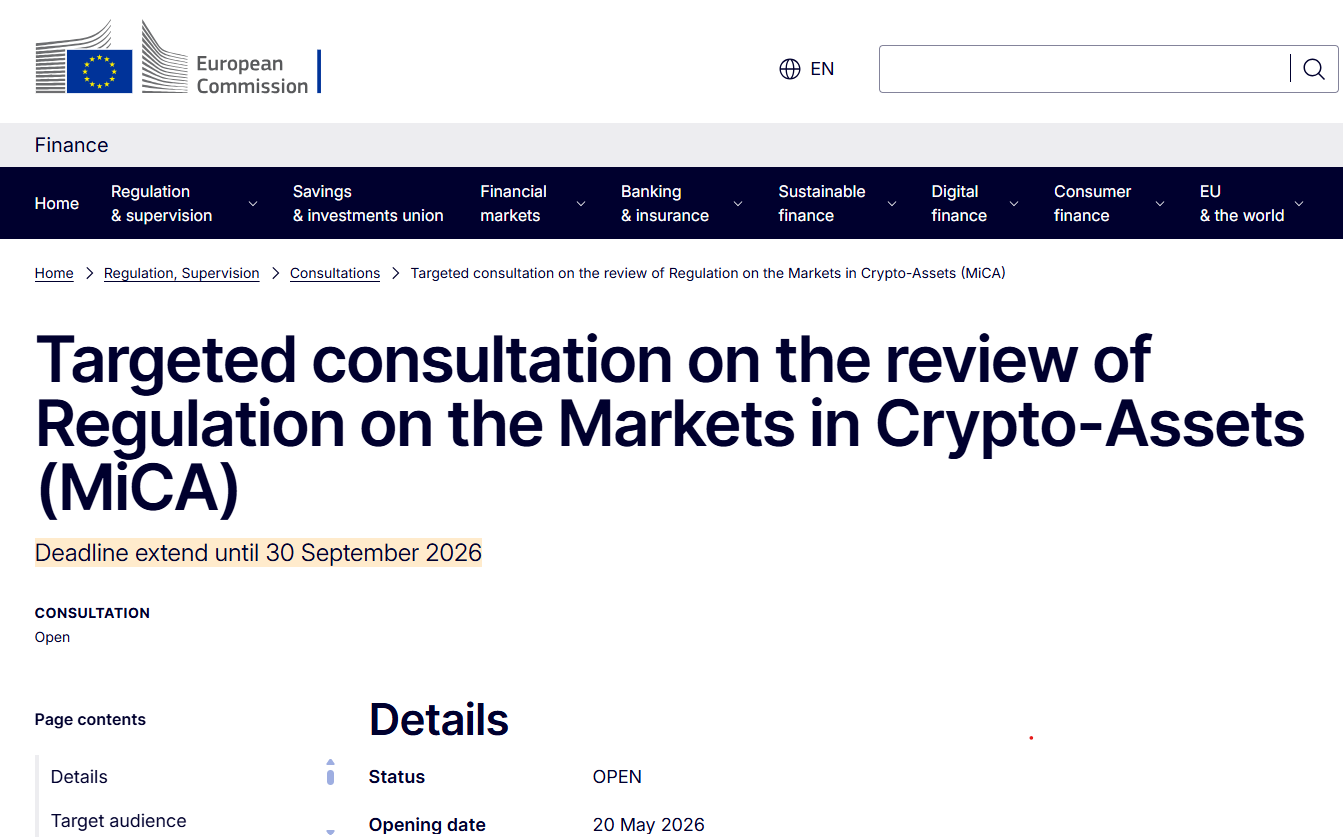
On May 20, 2026, the European Commission formally invited stakeholders to provide their insights on crucial areas deliberately excluded from the initial MiCA framework. Among these, decentralized finance and the multifaceted operations of crypto lending and borrowing stand out as primary subjects of scrutiny. The consultation reflects a growing recognition that while MiCA established clear rules for crypto-asset service providers (CASPs) and stablecoins, it left a significant gap regarding innovative DeFi protocols that replicate, and often enhance, traditional financial services in a peer-to-peer, automated fashion. The core challenge lies not just in regulating these activities, but in understanding their fundamental nature and how they deviate from conventional financial constructs.
At the heart of this regulatory conundrum are lending vaults. These automated, smart-contract-driven pools of capital allow users to deposit crypto assets, which are then algorithmically lent out to borrowers, generating yields for depositors. Unlike traditional banks or even centralized crypto lenders, these vaults operate with varying degrees of decentralization, often lacking a single, identifiable legal entity responsible for their operations. Their legal status currently hinges on non-binding interpretations that suggest they fall outside the scope of MiCA and existing EU fund rules, a position that is becoming increasingly tenuous as their economic significance grows.

Yuriy Brisov, an esteemed EU digital assets lawyer and partner at Digital & Analogue Partners, underscores the prevailing ambiguity. "EU law has no category called a ‘vault.’ A lawyer therefore defines it the way a regulator would qualify it: by function, not by label." This statement encapsulates the fundamental difficulty regulators face. They cannot simply apply existing definitions designed for centralized financial intermediaries to systems where responsibilities are distributed across smart contracts, governance tokens, and multiple, often anonymous, participants. The economic function of lending is undeniably present, yet the structural characteristics that typically trigger regulatory oversight are fragmented or entirely absent.
This functional distribution presents myriad regulatory problems. While vaults perform the economic functions of lending, the mechanisms for doing so are spread across immutable smart contracts and a network of participants, rather than residing within a single corporate entity. This makes it exceedingly difficult to identify a "service provider" in the traditional sense, or to pinpoint a responsible party for compliance, risk management, or consumer protection. If Brussels determines that lending activities within DeFi should indeed fall within the regulatory perimeter, the implications for the very architecture of decentralized finance, and for the developers, DAO members, and liquidity providers behind these vaults, would be profound.
The decentralized lending protocol Morpho offers a compelling case study that illuminates the practical complexities of this regulatory challenge. Its innovative Vault V2 architecture meticulously divides responsibilities among distinct roles: an owner, a curator, an allocator, and a sentinel. The curator is tasked with configuring strategy and risk parameters, while the allocator executes asset allocations, and the sentinel is vested with powers to mitigate risk. While none of these roles neatly map onto the provision of a regulated lending service under MiCA, their existence highlights the inherent difficulty in identifying a singular "provider" in a system designed for distributed governance and automated execution. For instance, the curator might influence strategy, but is that equivalent to managing a fund? The allocator executes trades, but are they an investment manager? The answers are far from clear.
Jonathan Galea, a partner at Cahill Gordon & Reindel, has delved into this intricate issue, publishing a client update that meticulously analyzes the position of lending vaults under EU financial regulation. His analysis explores the complex interplay between vault structures and existing frameworks, including MiCA, stablecoin regulations, and broader European fund law (such as AIFMD or UCITS, which govern investment funds). Galea cautions policymakers against viewing all lending vaults as a monolithic category, emphasizing their diverse functions. "Lending vaults solve more practical problems than they create," he tells Magazine, referring to their role in aggregating fragmented liquidity for lending markets. He contrasts these with other types of vaults that might primarily engage in buying and selling crypto assets, arguing they should be treated distinctly. "Bring ‘DeFi lending’ into the perimeter as a single label, and structures that deserve opposite answers risk ending up captured together." This warning underscores the critical need for a nuanced, function-specific approach to avoid inadvertently stifling innovation or misapplying inappropriate regulatory burdens. A broad-brush approach could lead to regulatory arbitrage or drive legitimate innovation outside the EU.
A key provision in MiCA currently excludes crypto-asset services provided in a "fully decentralized manner." However, the regulation can still apply where only a portion of an activity is performed in a decentralized way. This creates a spectrum of decentralization, making it challenging to draw a clear line. Galea argues that making decentralization the sole dividing line could unfairly penalize newer protocols. "Decentralization is a spectrum and a function of time: a test built on it would penalize newer, more novel protocols while entrenching mature incumbents that have had years to distribute control." This highlights that decentralization is not a static state but an ongoing process, often achieved gradually as protocols mature and control is progressively relinquished.
Brisov suggests a more structurally focused approach. "The safer ground is structural: there is no undertaking, no appointed manager, the holder has a direct coded claim on the pool, and the user can exit before any parameter change takes effect." This perspective shifts the focus from identifying a central entity to analyzing the intrinsic design of the protocol and the rights and control afforded to its users. If Brussels determines that lending and borrowing activities warrant regulation, Brisov advocates for explicitly adding them to the list of regulated crypto-asset services, rather than attempting to broaden the definition of an existing crypto-asset service provider, which could lead to conceptual inconsistencies and unintended consequences.
Michael Egorov, the founder of Curve Finance, a prominent DeFi protocol, emphasizes the need for a distinct regulatory framework. "If DeFi lending is ever brought into the scope of regulation, it should be treated completely differently. DeFi doesn’t need some of the safeguards which traditional lending requires, and yet, at the same time, it may need others." He points out that the transparent, overcollateralized, and auditable nature of many DeFi lending protocols inherently offers safeguards not present in traditional finance, such as real-time risk monitoring and automated liquidation mechanisms. However, DeFi also introduces unique risks like smart contract vulnerabilities, oracle manipulation, and governance attacks. Egorov stresses that regulation must be approached "really carefully" to avoid imposing rules that are either redundant or impossible for truly decentralized protocols to comply with due to their architectural design. A dedicated, bespoke framework, he suggests, could enhance safety and broaden access to DeFi lending without stifling its innovative spirit.
The Commission’s targeted consultation, which closes on September 30, marks a critical juncture. The outcome will largely determine whether lending vaults continue to operate outside MiCA’s direct purview or become subject to a new, potentially custom-tailored regulatory framework. For Brussels, the challenge extends beyond a simple "to regulate or not to regulate" decision. It involves the far more intricate task of crafting rules that can effectively distinguish between the myriad forms of on-chain lending, account for varying degrees of decentralization, and accurately identify the individuals or entities (if any) that genuinely exercise control over these complex, automated financial systems. The regulatory decisions made now will not only shape the future of DeFi within the EU but could also set a precedent for how jurisdictions worldwide approach the regulation of this rapidly evolving and transformative sector. The balancing act between fostering innovation, protecting consumers, and maintaining financial stability has never been more delicate or more vital.