anjir abdul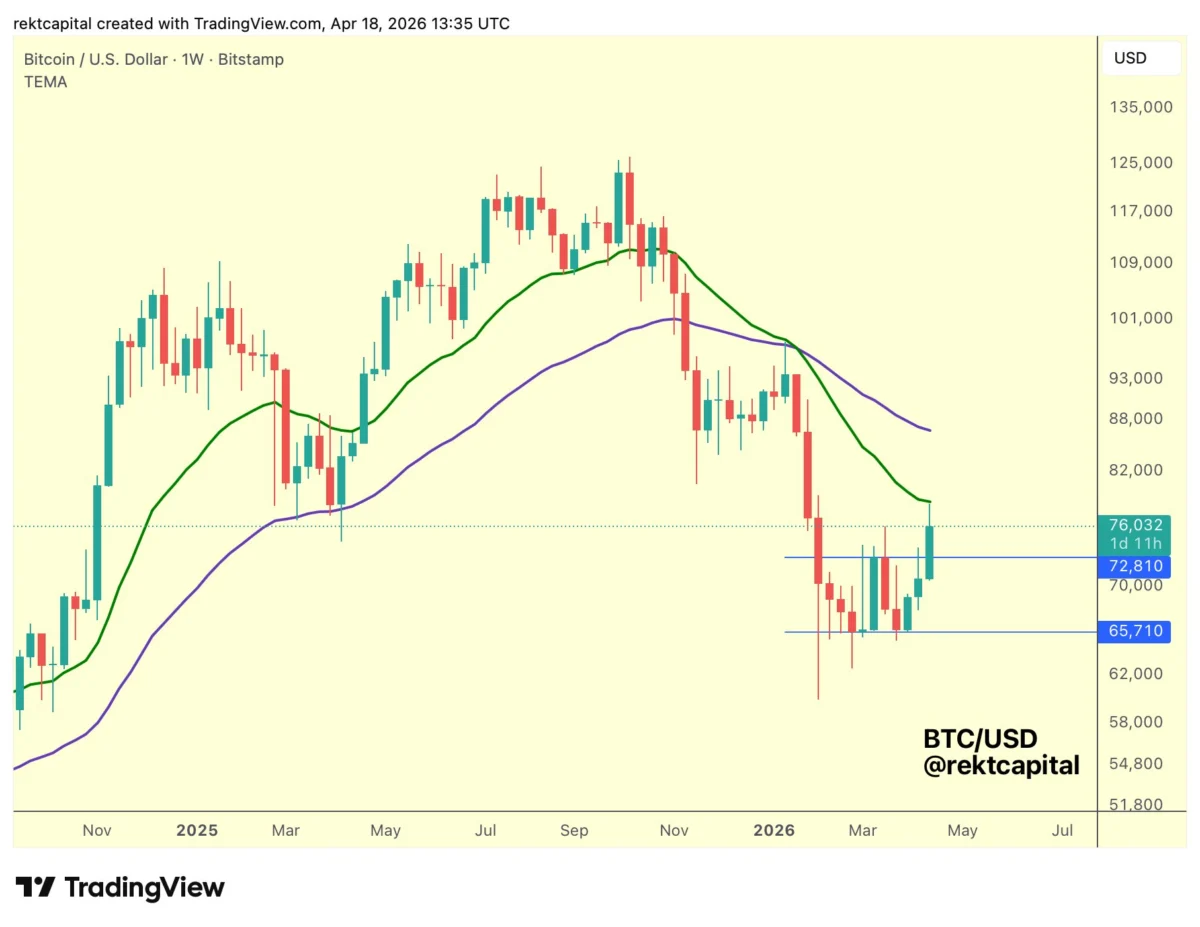
Bitcoin (BTC) found itself battling to protect the crucial $75,000 threshold into Sunday’s weekly close, as the broader cryptocurrency market grappled with a sudden resurgence of geopolitical uncertainty stemming from renewed fears surrounding the US-Iran conflict and its potential impact on global energy supply routes. This abrupt shift in market sentiment swiftly curtailed Bitcoin’s recent upward trajectory, which had seen it achieve impressive ten-week highs just days prior.
The digital asset’s recent momentum, which propelled it to a significant peak of $78,400 on Friday, was met with stiff resistance and a swift retracement as the weekend unfolded. Data from TradingView starkly illustrated the renewed selling pressure that re-entered the market, forcing Bitcoin to shed a substantial portion of its hard-won gains. This reversal underscores the fragile nature of market rallies when confronted with high-stakes geopolitical developments that threaten global stability and economic forecasts.

The catalyst for this market unease was a series of mixed and conflicting signals emanating from both US and Iranian sources throughout the weekend. What was initially perceived as a period of de-escalation, marked by assumed ceasefires and mutual agreements, now appears to have unravelled. The geopolitical landscape, notorious for its rapid shifts, once again demonstrated its capacity to inject volatility into seemingly disparate markets. Among the most concerning developments was the reported repeat closure of the Strait of Hormuz, a critical maritime chokepoint that immediately cast a shadow over global oil futures.
The Strait of Hormuz, a narrow waterway situated between the Persian Gulf and the Gulf of Oman, holds immense strategic importance. Approximately one-fifth of the world’s total petroleum consumption, and a significant portion of its liquefied natural gas, passes through this strait. Any disruption to its passage, whether threatened or actualized, sends immediate shockwaves through global energy markets, leading to spikes in oil prices and broader economic anxiety. News of an earlier, presumed ceasefire had previously driven WTI crude oil below $80 per barrel for the first time since March 10, signaling a period of reduced risk perception. However, the latest reports of the Strait’s closure effectively reversed this trend, reminding investors of the region’s inherent volatility and its direct link to global energy security.

Market observers and analysts were quick to flag the potential for an "eventful Sunday ahead," as summarized by the influential trading resource The Kobeissi Letter in its ongoing analysis on X. This sentiment captured the prevailing apprehension that the geopolitical situation was far from resolved and held the potential for further market-moving headlines as the new trading week loomed. The immediate impact on oil prices, visible in the CFDs on WTI crude oil chart, served as a stark reminder of the interconnectedness of global financial markets, where a localized geopolitical event can trigger a ripple effect across various asset classes, including the seemingly detached world of cryptocurrencies.
As BTC/USD attempted to consolidate around its local highs, and market sentiment teetered on the brink, experienced market participants urged caution. Trading resource Material Indicators highlighted the inherent fragility of market mood, noting that even a relatively minor input, such as a single social media post, could trigger a significant shift. "Sentiment is overwhelmingly bullish at the moment, but that could change with one Tweet in the coming days. Know your invalidations," Material Indicators advised its X followers. This warning underscores the highly reactive nature of the cryptocurrency market, where information, even speculative or unverified, can rapidly alter trading dynamics and trigger cascades of orders. The concept of "invalidations" is crucial here, referring to pre-defined price levels at which a trader’s thesis for a position is deemed incorrect, prompting an exit to manage risk.

The consequences of this renewed uncertainty were immediately visible in liquidation data. Coinglass, a leading crypto analytics platform, reported that long positions bore the brunt of the BTC price retracement, with total crypto liquidations reaching an eye-watering $260 million over the past 24 hours. Liquidations occur when traders, often using leverage, have their positions forcibly closed by exchanges because their collateral falls below a certain threshold due to adverse price movements. Such large-scale liquidations can exacerbate price downturns, creating a feedback loop where falling prices trigger more liquidations, leading to further price drops. This rapid unwinding of leveraged bets significantly contributes to market volatility and underscores the importance of prudent risk management, especially during periods of heightened geopolitical tension.
Beyond the immediate price action, technical analysts began to assess the broader implications for Bitcoin’s chart structure. Trader Daan Crypto Trades pointed to the potential formation of a gap in CME Group’s Bitcoin futures market as a direct result of the weekend’s price comedown. CME gaps occur when the price of Bitcoin on the Chicago Mercantile Exchange (CME) futures market closes on Friday at one level and then opens significantly higher or lower on Monday, leaving an unfilled "gap" on the chart. Historically, these gaps often act as short-term price magnets, with a common market theory suggesting that prices tend to return to "fill" these gaps eventually. "It’s going to be interesting to see the futures open today and how $OIL will react to the recent headlines regarding the strait," he added, emphasizing the dual focus on both crypto and traditional commodity markets.

Another prominent analyst, Rekt Capital, provided crucial insights into Bitcoin’s weekly close, placing significant importance on its interaction with the 21-week exponential moving average (EMA) near $78,900. "Bitcoin is rejecting from the 21-week EMA (green)," he observed alongside the weekly chart. The 21-week EMA is a widely watched indicator that often serves as a dynamic support or resistance level, reflecting the medium-term trend. A rejection from this level, particularly after a strong rally, can signal a potential shift in momentum or a period of consolidation. Rekt Capital further elaborated on the potential implications, stating, "It is this rejection that could force a post-breakout retest of the top of the Double Bottom (~$73k) next week, provided Bitcoin Weekly Closes just like this."
A "Double Bottom" pattern is a bullish reversal formation, and a retest of its breakout level (in this case, around $73,000) is often a healthy price action that confirms the strength of the prior breakout before a potential continuation of the uptrend. However, if Bitcoin fails to hold this level, it could signal deeper corrections. The interplay between the geopolitical headwinds and these critical technical levels creates a complex and uncertain outlook for Bitcoin in the immediate future.

The current geopolitical situation serves as a potent reminder of Bitcoin’s evolving role in the global financial ecosystem. While often hailed as a decentralized asset uncorrelated with traditional markets, and even a potential safe haven in times of economic turmoil, events like the US-Iran tensions demonstrate its continued susceptibility to macro-level shocks. In moments of heightened global risk, investors tend to de-risk across the board, moving out of perceived riskier assets, including cryptocurrencies, and into more traditional safe havens like the US dollar or gold, at least in the short term. The closure of the Strait of Hormuz, by threatening global energy supplies and potentially fueling inflation, adds another layer of complexity, intertwining Bitcoin’s fate with the broader economic narrative.
Looking ahead, market participants will be closely monitoring not only the technical levels for Bitcoin but, more critically, the ongoing developments in the Middle East. Any further escalation or de-escalation in US-Iran relations, and particularly news regarding the Strait of Hormuz, will likely dictate Bitcoin’s next major price moves. The interplay between geopolitical stability, oil prices, and the sentiment of an already "overwhelmingly bullish" crypto market will be key determinants. In such an unpredictable environment, a disciplined approach to risk management, coupled with a keen awareness of both on-chain and macro indicators, will be paramount for investors navigating these turbulent waters. Bitcoin’s ability to defend key support levels like $75,000 and the critical $73,000 mark will be a crucial test of its resilience against the backdrop of resurfacing global anxieties.