Faris Adani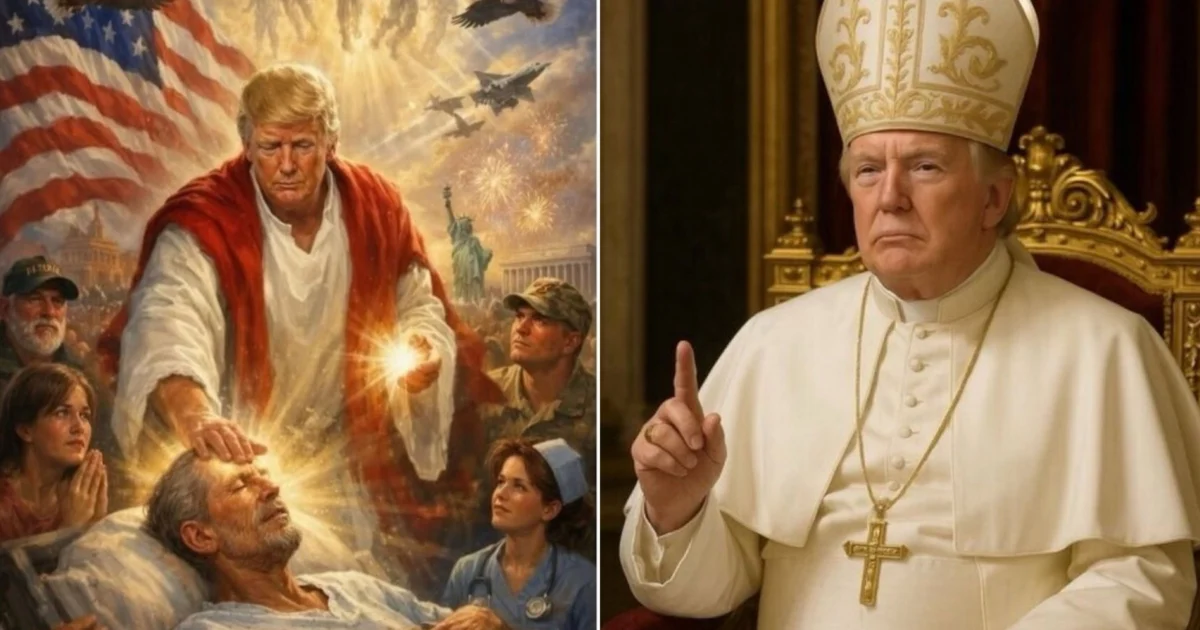
The former US President Donald Trump has inadvertently, or perhaps deliberately, ignited a "GOP holy war" and further tarnished his already controversial public image through a series of increasingly provocative and often offensive AI-generated images shared on his Truth Social platform, culminating this week in a widely condemned post depicting himself as Jesus Christ. This latest incident saw Trump sharing an AI-rendered image of himself in flowing robes, seemingly performing a miraculous healing on a sick man, while a celestial host of angels looked on and an American flag billowed patriotically in the background. The image, a prime example of what critics have dubbed "AI slop" due to its low artistic merit and potentially misleading nature, was swiftly met with a firestorm of criticism, not from his usual detractors on the left, but from his most fervent supporters, particularly Christian and far-right influencers who found the portrayal blasphemous and sacrilegious.
This incident, occurring in the volatile run-up to a pivotal election cycle, is not an isolated one but rather the latest in a dizzying and concerning series of AI-generated visuals propagated by the president. His digital history includes a bizarre image of himself depicted as the Pope, another showing him as a hyper-muscular figure, and, most egregiously, deeply racist clips that depicted former President Barack Obama and former First Lady Michelle Obama as apes. While these previous posts had already drawn significant condemnation, the self-portrayal as Jesus appears to have crossed a hitherto unbreachable line for a significant segment of his base, triggering a level of internal dissent rarely seen within his loyalist ranks. The sheer audacity of the image, coupled with its overt religious overtones, pushed many of his Christian and conservative followers to publicly disavow the post, leading to its swift, if sheepish, deletion.
Following the intense and immediate outcry, Trump attempted to downplay the controversy, telling reporters that he thought the image depicted "me as a doctor." This explanation was widely ridiculed and deemed implausible by observers across the political spectrum. The visual cues in the image – the robes, the celestial beings, the act of healing – bore undeniable resemblance to traditional Christian iconography of Jesus Christ, making the "doctor" excuse profoundly unconvincing. Critics quickly pointed out the absurdity of a president suggesting doctors typically wear ancient, Christ-like attire, especially given the clear religious context embedded within the image. This attempt at deflection only served to further highlight what many perceive as a casual disregard for religious sensibilities, even among those he claims to represent. It also raised questions about Trump’s understanding of the AI tools he employs, or whether the excuse was a calculated, albeit poorly executed, attempt to mitigate political damage.
The backlash was swift and severe, particularly from the very demographic Trump relies heavily upon for political support: evangelical Christians and the far-right. Conservative political commentator Cam Higby, a self-proclaimed staunch defender of Trump, articulated the sentiment of many, tweeting, "I support Trump, and I spend eight hours a day defending him. I will not defend blasphemy." Similarly, anti-trans activist Riley Gaines, another prominent conservative voice, posted, "A little humility would serve him well." These statements underscore a significant fracture within the Republican base, where personal loyalty to Trump often clashes with deeply held religious convictions. The notion of blasphemy, particularly from a figure often hailed by some evangelicals as a divinely appointed leader, struck a raw nerve, forcing a confrontation between political allegiance and spiritual doctrine. This internal "GOP holy war" demonstrated that even for his most ardent supporters, there are boundaries that, once crossed, provoke a strong, negative reaction. The incident laid bare the complexities of modern political identity, where tribal loyalties are tested by deeply ingrained moral and religious principles.
Adding a layer of irony and further exacerbating the perception of Trump’s contentious relationship with religious figures, the "Jesus" image faux pas came on the heels of another controversial exchange involving religious authority. In the days leading up to his latest AI gaffe, Trump had launched a scathing attack on Pope Leo, accusing the pontiff in a rambling Truth Social post of being "WEAK on crime and terrible for foreign policy." This accusation stemmed from Pope Leo’s outspoken criticism of the escalating war in Iran, where the pontiff had decried the president’s threat to "wipe out a whole civilization" as "truly unacceptable." Pope Leo had gone further, urging the faithful to "contact the authorities – political leaders, congressmen – to ask them, tell them to work for peace and to reject war, always." While Pope Leo’s direct thoughts on Trump’s self-depiction as Jesus remain unknown, the timing of these events painted a picture of a president seemingly at odds with established religious leadership while simultaneously attempting to appropriate religious imagery for his own political narrative. This pattern suggests a transactional view of faith, where religious symbols are leveraged for political gain, rather than respected for their inherent spiritual significance. Such maneuvers risk alienating not only religious leaders but also segments of the religious electorate who value genuine piety over political expediency.
Beyond the immediate political fallout, experts have warned that the White House’s consistent attempts to disregard offensive AI-generated content as mere "memes" or "internet slop" poses a significant threat to public trust and the integrity of information in an already heavily polarized digital landscape. David Rand, a Cornell University professor of information science, articulated this concern to the Associated Post in January, stating, "This presumably aims to shield them from criticism for posting manipulated media." Rand highlighted that casting such manipulated media as a joke or humorous post, similar to prior cartoons, is a deliberate strategy to deflect accountability. The danger, as numerous commentators have pointed out, is that such a strategy normalizes the dissemination of digitally fabricated content, making it increasingly difficult for the public to discern truth from falsehood. This erosion of trust, particularly when propagated by a head of state, has far-reaching implications for democratic discourse, media literacy, and the general stability of public perception. It cultivates an environment where skepticism toward all media, legitimate or not, becomes the default, making it harder for citizens to make informed decisions.
The repeated use of AI "slop" by a leading political figure like Trump contributes significantly to an environment already heavily marked by AI-facilitated disinformation. Each offensive post, each disingenuous explanation, further blurs the lines between reality and fabrication. This trend not only damages the individual’s public image but also undermines the collective capacity for critical thought and informed decision-making. When a president, or any high-profile political figure, consistently shares manipulated images—whether for humor, propaganda, or a combination thereof—it sends a dangerous message that visual evidence can no longer be trusted at face value. This can lead to a state of perpetual skepticism, where legitimate news is dismissed as "fake" and fabricated content gains traction, creating a fertile ground for conspiracy theories and societal fragmentation. The very act of posting these images, irrespective of intent, validates the technology for manipulative purposes and sets a precedent for its widespread adoption in political campaigns globally. It risks a future where the truth is not merely contested but rendered irrelevant in the face of convincing, albeit false, narratives.
The implications of Trump’s AI tactics extend beyond domestic politics, playing into a broader, global "AI propaganda war." As 404 Media reported late last month, even while Trump battles internal criticism over his AI posts, international adversaries are actively leveraging similar technologies, often with greater perceived success. The article highlighted instances where Iranian government-backed propagandists have posted their own AI slop, notably viral videos depicting Trump as a "war-hungry pedophile" in a LEGO movie-style animation. This suggests that enemy states are not only adopting these new tools but are, in some instances, arguably "beating Trump at his own game" – and critically, without alienating their core supporters. While Trump’s AI posts often create internal strife and expose him to charges of blasphemy or racism, the propagandist efforts of foreign adversaries appear to be more strategically deployed, aiming to discredit and dehumanize without facing the same internal moral or ethical backlash. This disparity in impact raises questions about the effectiveness of Trump’s digital strategy and the sophisticated ways in which AI can be weaponized in the geopolitical arena. The ease with which these foreign-generated images can spread online, often through unverified channels, poses a substantial threat to information security and international relations.
In conclusion, Donald Trump’s reliance on and propagation of offensive AI-generated imagery has become a self-inflicted wound, causing massive damage to his public image and fracturing his own political base. From the blasphemous depiction of himself as Jesus Christ to the racist portrayal of the Obamas as apes, these posts have not only drawn widespread condemnation but have also highlighted a deeper issue of eroding public trust in an age of pervasive digital manipulation. His disingenuous excuses and the White House’s attempts to dismiss these as mere "memes" only exacerbate the problem, contributing to a dangerous climate of disinformation. As political adversaries also master the art of AI propaganda, Trump’s current strategy appears to be backfiring, demonstrating a lack of strategic foresight and a profound misjudgment of his own supporters’ sensitivities. The ongoing saga serves as a stark warning about the perils of unbridled AI use in politics, underscoring the urgent need for greater transparency, accountability, and media literacy in navigating the increasingly complex digital landscape. The collateral damage from this "AI slop" extends far beyond immediate headlines, shaping perceptions, fueling division, and ultimately, challenging the very foundations of truth in public discourse.