Faris Adani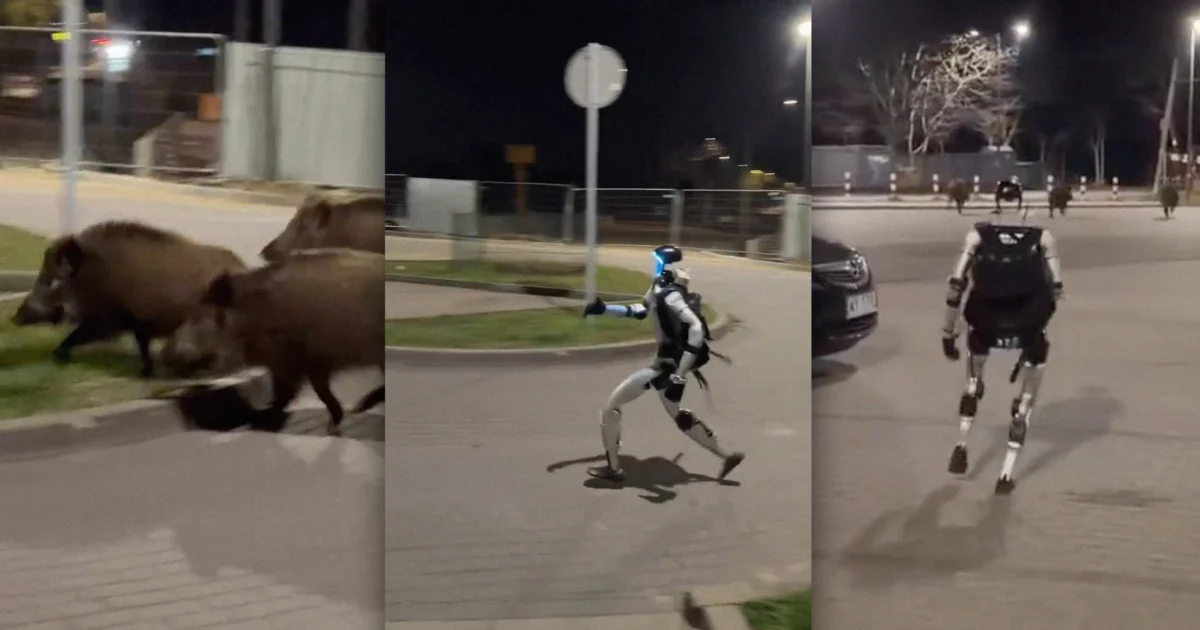
In a spectacle that perfectly encapsulates the quirky intersection of burgeoning robotics and mundane urban challenges, a customized Unitree G1 humanoid robot, affectionately dubbed Edward Warchocki, was recently filmed engaging in an improbable pursuit of wild boars through an empty car parking lot in Warsaw, Poland. The widely disseminated footage, which quickly went viral across social media platforms, captured the bipedal machine jogging across a grassy patch, its mechanical limbs pumping in a surprisingly fluid motion, as it attempted to herd a small flock of the formidable animals. The scene culminated in a rather human-like gesture of frustration as the boars, with their natural agility and speed, effortlessly evaded their robotic pursuer, leaving Edward Warchocki to raise a metallic fist in the air in a comical display of defeat. The robot’s accompanying social media account, playing into its manufactured persona, quaintly captioned the stunt: "I’m herding the wild boars into the forest."
This seemingly whimsical event, however, is set against a backdrop of a very real and pressing urban issue in the European capital. Warsaw, like many expanding cities bordering natural habitats, has been grappling with a significant and growing population of wild boars. These intelligent and adaptable animals, drawn by readily available food sources and a lack of natural predators, frequently venture into residential areas, causing property damage, posing traffic hazards, and occasionally exhibiting aggressive behavior. The proliferation of several thousand wild boars within city limits has prompted authorities to explore various control methods, including contentious culling efforts. Reports from last year detailed the difficult decision by the city’s mayor to authorize culling, which has even involved shootings in residential areas – a measure that, while effective, often sparks heated debate among residents and animal welfare advocates due to its perceived brutality and the ethical dilemmas it presents.
In this context, the sight of a humanoid robot attempting to address the issue, even as a clear publicity stunt, highlights the desperate search for innovative or at least attention-grabbing solutions. While chasing wild boars with a much slower, bipedal robot is undeniably impractical for solving the city’s wildlife management problem, it serves a different, perhaps equally important, purpose: public engagement and brand promotion. Edward Warchocki is not a serious ecological intervention; it is a meticulously crafted marketing stunt designed to capture headlines and showcase the capabilities of its underlying technology.
The Unitree G1, the model behind Edward Warchocki, represents a new wave of increasingly agile and cost-effective humanoid robots. Companies like Unitree, Boston Dynamics, and Tesla are pushing the boundaries of bipedal locomotion, balance, and manipulation. While early humanoid robots often struggled with basic mobility, the G1 demonstrates remarkable stability and dynamic movement, capable of traversing uneven terrain, executing complex maneuvers, and even performing backflips in laboratory settings. These advancements are not merely for entertainment; they are foundational steps towards robots that can eventually assist in logistics, hazardous environments, elder care, and a myriad of other practical applications where human-like dexterity and mobility are crucial. However, for now, the most compelling public face of these machines often involves viral feats that blend humor with a glimpse into the future.
Edward Warchocki has become a bona fide viral sensation in Poland, extending its antics far beyond boar-chasing. Its public appearances have included visiting the Polish parliament, engaging with local politicians, and participating in various cultural events. Previous videos show the bot performing on stage alongside a singer, exhibiting its dynamic movements in a choreographed routine, and even chasing marathon runners, adding a futuristic twist to traditional sporting events. Another memorable clip circulated on social media last month depicted the robot stumbling around while comically holding an empty beer bottle and a reusable grocery bag, playfully mimicking a tipsy human. These carefully orchestrated appearances are designed to anthropomorphize the machine, making it relatable, even endearing, to the public, fostering a sense of curiosity rather than apprehension about advanced robotics. The "Edward Warchocki" moniker itself, a distinctly human name, further reinforces this strategy, creating a character rather than just a piece of machinery.
This trend of giving humanoid robots distinct public personas is not unique to Poland. The United States has its own counterpart in the form of "Jake the Rizzbot," another Unitree G1 robot that gained notoriety for its public appearances, often sporting a cowboy hat, in Austin, Texas. Jake, too, became a local celebrity, showcasing the same blend of technological novelty and whimsical public interaction. Its story, however, took a more dramatic and legally significant turn. Last summer, Jake’s narrative evolved as its developer announced that the robot had "moved to California" and, in a move that captured significant media attention, "seemingly came out as gay." This narrative choice, whether a genuine expression of artistic intent or a further layer of anthropomorphic branding, resonated widely, making Jake a symbol of a new kind of public identity for non-human entities.
The Rizzbot’s journey then escalated into a high-profile incident when it was assaulted by popular streamer Darren Jason Watkins Jr., better known online as IShowSpeed. The baffling incident, which was captured on video and widely circulated, showed Watkins Jr. physically attacking the robot during a public appearance. This act of violence against a piece of advanced technology sparked considerable debate online, raising questions about accountability, the nature of property damage, and the ethical boundaries of human-robot interaction. In December, Jake’s developer took decisive legal action, filing a lawsuit against Watkins Jr. for a staggering $1 million in monetary relief. This lawsuit is a landmark event, pushing the boundaries of legal precedent concerning damage to sophisticated robotic property. It forces a critical examination of how society values and protects advanced machines, particularly those that are given public personas and become cultural figures. Is it merely property damage, or does the public persona of a robot introduce new complexities, perhaps even touching on elements of emotional distress for the developer or brand reputation damage?
These viral moments, from Edward Warchocki chasing boars to Jake the Rizzbot being assaulted, collectively offer a fascinating glimpse into our evolving relationship with humanoid robots. They highlight a paradox: while these machines are still far from seamlessly integrating into complex day-to-day human tasks, their capacity for entertainment and generating public discussion is undeniable. They serve as technological ambassadors, simultaneously showcasing rapid advancements in AI and engineering while also provoking questions about our future co-existence with intelligent machines. The playful anthropomorphism, the clever marketing stunts, and even the unfortunate incidents of aggression all contribute to shaping public perception, fostering both excitement and a nascent understanding of the ethical and legal frameworks that will inevitably need to govern a world where robots are increasingly present and visible. Whether as whimsical boar herders or contentious legal subjects, these humanoid robots are undeniably here, actively participating in the unfolding narrative of our technological future.