Faris Adani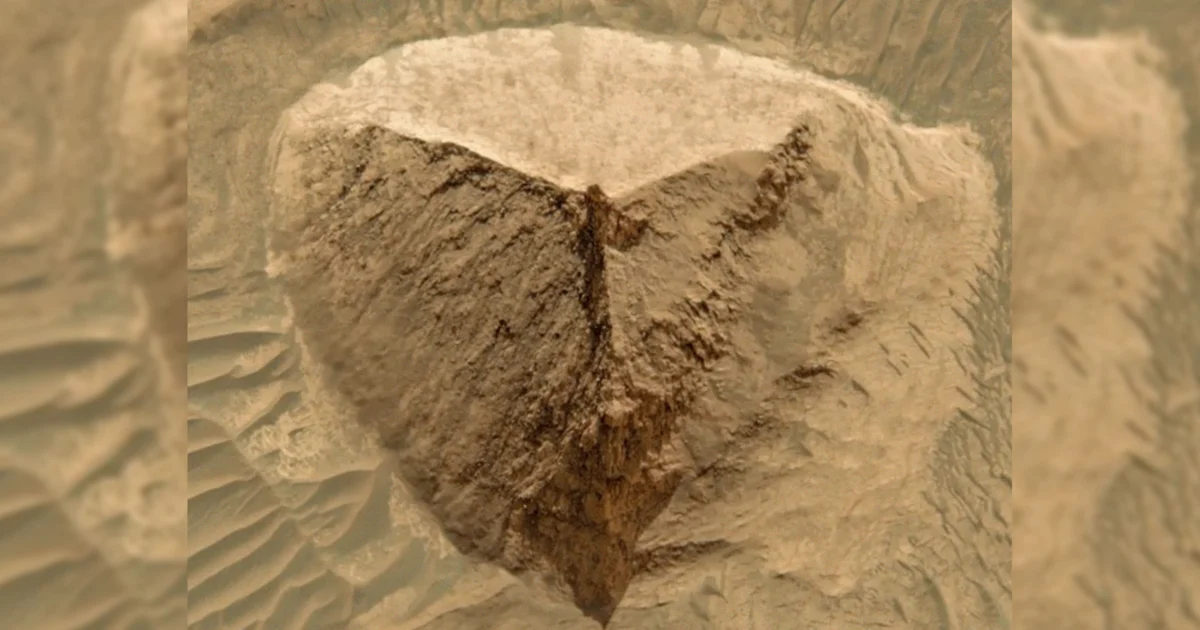
A peculiar geological formation on the Martian surface, bearing a striking resemblance to an Earthly pyramid, has once again ignited fervent discussions within the alien enthusiast community, prompting sensational headlines and a predictable wave of speculative theories. The image, widely circulated by self-proclaimed "Mars disclosure journalist" Brian Dobbs, depicts what he describes as a "three-sided pyramid the size of the Great Pyramid in Egypt," located within the vast Candor Chasma. While the visual is undoubtedly captivating, scientists are quick to pour cold water on the extraterrestrial claims, grounding the discussion firmly in planetary geology and the psychology of human perception.
For millennia, the colossal pyramids of ancient Egypt have served as a magnet for fascination, not just for their architectural grandeur but also for the enduring mysteries surrounding their construction. Conspiracy theorists, particularly those championing the "ancient astronauts" hypothesis popularized by figures like Erich von Däniken, have long posited that these monumental structures were either built by, or with the direct assistance of, advanced extraterrestrial visitors. The human tendency to project familiar patterns onto the unknown, coupled with a deep-seated desire for discovery, makes the notion of similar structures existing on other celestial bodies incredibly alluring. Thus, it comes as little surprise that a pyramid-like anomaly on Mars would instantly captivate the imagination of those predisposed to seeing signs of intelligent life beyond Earth.
The image in question originated from data captured by NASA’s Mars Global Surveyor spacecraft back in 2001, an orbiter that meticulously mapped the Martian surface for years, revealing countless intricate geological features. The feature highlighted by Dobbs is indeed visually striking: a prominent landform with what appears to be three distinct, relatively even ridges converging to a sharp peak. Its location within Candor Chasma, part of the colossal Valles Marineris canyon system – an immense geological scar stretching over 4,000 kilometers across the Martian equator – only adds to its dramatic presence. Tabloids, ever eager to capitalize on public intrigue, swiftly amplified the narrative, publishing articles about "mysterious" and "bizarre" Martian pyramids purportedly sparking "alien civilization theories" and "bewildering scientists," despite the scientific community’s consistent skepticism.
However, the superficial resemblance to an Earthly pyramid quickly begins to unravel under closer scrutiny. A fundamental distinction lies in the geometry: the iconic Great Pyramids of Giza are, in fact, four-sided structures, or even technically eight-sided due to subtle concave indentations on each face, but certainly not three. This basic morphological discrepancy immediately raises a red flag for direct comparison. More importantly, the scientific explanation for such formations on Mars points not to ancient architects, but to the relentless, sculpting power of natural geological processes.
Pascal Lee, chairman of the Mars Institute and a planetary scientist at the SETI Institute, definitively dismissed the alien speculation, stating, "Nothing to me screams anything close to ‘alien civilization’ here when I see that. This is not an alien archeological site." Lee and other planetary geologists attribute the formation to aeolian processes – erosion by wind – acting upon layered sedimentary rock over vast stretches of Martian geological time. Mars, with its thin atmosphere, experiences powerful dust storms and constant wind activity that acts as a potent sculptor of its landscape. Features known as ventifacts (rocks sculpted by wind-blown particles) and yardangs (elongated ridges formed by wind erosion) are common across the planet. In regions like Candor Chasma, where vast quantities of layered rock have been exposed by tectonic forces that created the canyon, differential erosion can carve out dramatic, often geometric, shapes. Softer rock layers erode more quickly, leaving harder, more resistant layers to stand proud, sometimes in strikingly angular forms that mimic artificial structures. Lee noted, "If you look more closely, there are rock layers that are very typical of the rock layers in this region that are sticking out of one side of this hill," providing direct evidence of its geological origin.
This phenomenon is not unique to Mars; Earth itself is replete with examples of natural formations that bear an uncanny resemblance to pyramids. Colombia’s Cerro Tusa mountain, for instance, rises 1,500 feet above the surrounding terrain in a strikingly pyramidal form, a testament to volcanic activity and subsequent erosion. In China’s Guizhou Province, a series of natural pyramid-like mountains and hills have long been a local wonder, shaped by millennia of tectonic uplift and fluvial erosion. Last year, even a massive, snow-covered, four-sided "pyramid" in Antarctica — actually a nunatak, a mountain peak protruding from a glacier — briefly sparked its own wave of alien conspiracy theories, until geologists clarified its glacial origins. These terrestrial examples serve as crucial analogues, demonstrating that nature is perfectly capable of producing structures that, at a glance, appear too perfect or deliberate to be mere chance.
The human tendency to perceive familiar patterns in random or ambiguous visual stimuli is a psychological phenomenon known as pareidolia. This is a recurring theme in the history of Mars exploration, with the most famous instance being the "Face on Mars." Discovered in 1976 by NASA’s Viking 1 orbiter, a mesa in the Cydonia region appeared remarkably like a human face, complete with eyes, nose, and mouth, casting distinct shadows that enhanced the illusion. For decades, this image fueled intense speculation about ancient Martian civilizations. However, subsequent, higher-resolution images taken by the Mars Global Surveyor in 1998 and the Mars Express orbiter in 2006, from different angles and lighting conditions, conclusively revealed it to be a natural Martian mesa, an eroded rock formation with no artificial features. Similarly, recent viral images of "spiderweb" formations being explored by NASA’s Curiosity rover, or the widely publicized "doorway" cut into a cliffside — both natural rock formations — highlight our ingrained desire to find meaning and familiarity in alien landscapes.
While the allure of discovering ancient alien ruins on Mars is undeniably strong, the scientific community approaches such anomalies with rigorous scrutiny, favoring natural explanations until definitive evidence points otherwise. The ongoing exploration of Mars, through orbiters, landers, and rovers, is a testament to humanity’s profound curiosity about our cosmic neighborhood. These missions are designed to unravel the true geological and climatic history of the Red Planet, searching for genuine signs of past or present microbial life, or conditions conducive to it. The vast canyon system of Valles Marineris, where this "pyramid" resides, is a geological marvel offering invaluable insights into Mars’s past, including its tectonic activity, volcanic history, and the role of water and wind in shaping its surface.
In conclusion, while the three-sided formation in Candor Chasma is visually intriguing and perfectly illustrates how nature can craft seemingly artificial geometries, the scientific consensus firmly identifies it as a product of Martian geology, specifically wind erosion acting on layered rock formations. It stands as another fascinating example of pareidolia on the Red Planet, a reminder of our powerful pattern-seeking brains and our enduring hope for extraterrestrial encounters. As researchers continue to meticulously study the rugged and diverse landscapes of Mars, the focus remains on unraveling its natural mysteries, rather than succumbing to the captivating, yet unsubstantiated, whispers of ancient alien civilizations.