anjir abdul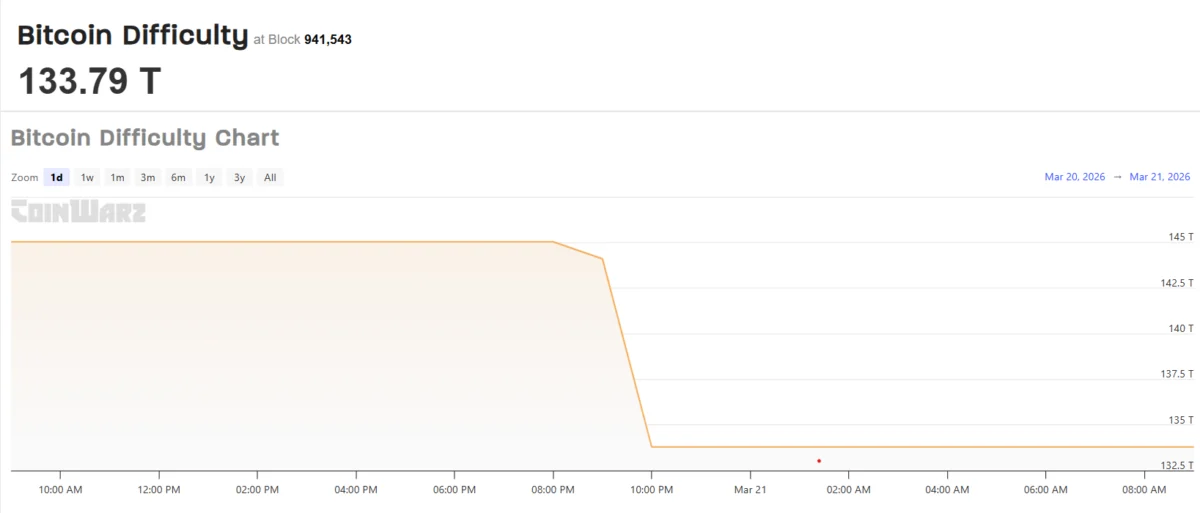
Bitcoin’s mining difficulty experienced a notable decline of approximately 7.7% during its latest automatic adjustment on March 20, settling at 133.79 trillion at block 941,472, marking the most substantial reduction observed since February, according to comprehensive data from CoinWarz. This significant recalibration reflects a dynamic period for the Bitcoin network and its global mining industry, influenced by a confluence of economic pressures, strategic shifts, and the inherent self-regulating mechanisms of the world’s leading cryptocurrency.
The recent adjustment brought the network’s difficulty down from around 145 trillion recorded in mid-March and a higher peak of roughly 148 trillion at the beginning of the year. For Bitcoin miners, a lower difficulty translates directly into a more favorable operational environment: it requires less computational power, or "hashrate," to successfully find a valid block and earn the associated block reward. This effectively improves the revenue generated per unit of hashrate for those mining operations that remain active, offering a much-needed reprieve amidst tightening profit margins.
The catalyst for this downward adjustment was a sustained period of slower-than-target block production across the preceding 2,016 blocks – the fixed interval after which Bitcoin’s difficulty algorithm automatically recalculates. According to insights from CloverPool data, the average time to mine a new block extended to approximately 12 minutes and 36 seconds. This duration significantly exceeded Bitcoin’s meticulously designed 10-minute target block time, signaling to the network that the collective hashrate dedicated to mining had decreased. Consequently, the network’s protocol mandated a downward recalibration of difficulty to restore the desired block production rate and maintain the predictable issuance schedule of new bitcoins.
This is not the first time Bitcoin’s difficulty has seen a sharp fall in recent memory. Just a month prior, in February, difficulty also dropped significantly following widespread weather-related disruptions across the United States. Severe winter storms temporarily knocked large American mining facilities offline, leading to a substantial but transient exodus of hashrate from the network. However, the network demonstrated its resilience as difficulty subsequently rebounded by about 15% as power conditions normalized and affected miners brought their operations back online, illustrating the robust self-correction mechanisms inherent to Bitcoin.
Bitcoin’s difficulty is a crucial metric that quantifies how challenging it is for miners to discover a valid hash that satisfies the network’s requirements for the next block. It is an automatically adjusting parameter, fundamental to Bitcoin’s economic policy, designed to maintain a consistent issuance rate of one new block approximately every 10 minutes, regardless of how much computing power is dedicated to mining. When an influx of computing power, or hashrate, joins the network, the difficulty rises to prevent blocks from being mined too quickly, ensuring the 10-minute target is upheld. Conversely, a reduction in the total hashrate dedicated to the network triggers a lower difficulty adjustment, making it easier for the remaining miners to find blocks and earn rewards, thereby incentivizing more miners to join or existing ones to stay.
The upcoming difficulty adjustment is tentatively projected for April 3, though this estimate is fluid and continually updated with each new block mined, reflecting the dynamic nature of the network.
Miners Pivot to AI as Power Costs and Halving Pressures Bite
This recent difficulty reset unfolds against a backdrop of significant strategic shifts within the Bitcoin mining industry. A growing number of publicly listed mining companies are increasingly exploring and investing in artificial intelligence (AI) and high-performance computing (HPC) infrastructure. This pivot is driven by a search for more stable and potentially higher returns on their substantial investments in power infrastructure and data center capacity, especially as the profitability of pure Bitcoin mining faces mounting pressure.
The impending Bitcoin Halving, expected in April 2024, looms large over the industry. This quadrennial event will slash the block reward for miners by 50%, reducing it from 6.25 BTC to 3.125 BTC per block. While historically a bullish catalyst for Bitcoin’s price, the halving immediately halves miners’ primary revenue stream, making operational efficiency and diversified income streams more critical than ever. Coupled with rising global energy costs and the competitive landscape for electricity, the economic viability of less efficient mining operations is increasingly challenged.

The competition for electricity and data center resources has intensified, leading some prominent crypto figures to express concerns. Last week, crypto trader Ran Neuner ignited a debate by arguing that AI had emerged as Bitcoin mining’s biggest competitor, with both industries vying fiercely for the same finite electricity resources. He provocatively declared that "AI has killed Bitcoin forever," a hyperbole designed to highlight the profound shift and potential challenges posed by this new rivalry. While Neuner’s statement is largely seen as an exaggeration, it underscores a genuine concern about the allocation of capital and resources.
In response to these evolving market dynamics, several major Bitcoin miners are actively reallocating resources or strategically pivoting. Companies like Core Scientific, MARA Holdings (Marathon Digital Holdings), Hut 8, and Cipher Mining have begun to dedicate portions of their existing data center capacity or are building new infrastructure specifically for AI workloads. Core Scientific, for instance, has secured substantial credit facilities to expand its data center capabilities, partly with an eye on HPC. Marathon Digital Holdings has also explored opportunities in AI, leveraging its energy expertise. Hut 8 has been particularly vocal about its diversification strategy, securing significant leases for AI data centers and investing heavily in high-performance computing, aiming to stabilize revenue streams beyond the volatile nature of Bitcoin mining. Cipher Mining has also signaled interest in expanding into HPC, recognizing the growing demand for specialized data center services.
This strategic pivot involves complex decisions, as it requires significant capital expenditure and expertise in a different technological domain. However, the potential for long-term contracts and more predictable revenue streams from AI and HPC services offers an attractive alternative to the often-cyclical and price-dependent profitability of Bitcoin mining. For some operators, this has also meant reducing their hashrate dedicated to Bitcoin or even shutting down less efficient mining rigs altogether, contributing to the observed decline in network hashrate and, consequently, difficulty.
The financial pressures on miners are evident in other actions as well. On February 21, Bitdeer, a major mining company, liquidated 943 BTC from its reserves and sold newly mined coins, effectively cutting its corporate Bitcoin holdings to zero. In its latest weekly update on March 21, the company confirmed that its BTC holdings remained at zero. This move, while potentially driven by various corporate financial strategies, can be interpreted as a step to bolster liquidity or fund diversification efforts, highlighting the difficult choices miners face in a challenging environment.
Implications for Bitcoin’s Network and Future Outlook
The recent difficulty drop, while beneficial for the profitability of remaining miners, also raises important questions about the overall health and security of the Bitcoin network. A sustained decline in hashrate could theoretically impact network security, though Bitcoin’s vast and decentralized nature makes a significant security breach highly improbable. More realistically, it reflects a period of consolidation and adaptation within the mining industry. Less efficient miners are being squeezed out, while more sophisticated operations are either doubling down on efficiency or diversifying into new ventures like AI.
The debate over whether "AI has killed Bitcoin forever" is, of course, a dramatic oversimplification. Bitcoin’s core value proposition as a decentralized, immutable digital currency remains intact, independent of the mining industry’s business models. However, the competition for power and the strategic shifts by miners could influence the future geographic distribution of hashrate and the operational profiles of mining companies. It forces a deeper conversation about sustainable energy sources for mining and the long-term economic incentives required to secure the network.
As the industry approaches the Halving, the current difficulty adjustment provides a temporary boost to miner profitability. However, the fundamental challenge of securing diminishing block rewards will remain. The ability of miners to adapt, innovate, and find new revenue streams, whether through AI, energy arbitrage, or other means, will be crucial for their survival and the continued robustness of the Bitcoin network. The next difficulty adjustment, currently estimated for early April, will offer further insights into how the network’s hashrate is responding to these complex and rapidly evolving market forces.
Cointelegraph is committed to independent, transparent journalism. This news article is produced in accordance with Cointelegraph’s Editorial Policy and aims to provide accurate and timely information. Readers are encouraged to verify information independently. Read our Editorial Policy https://cointelegraph.com/editorial-policy