Faris Adani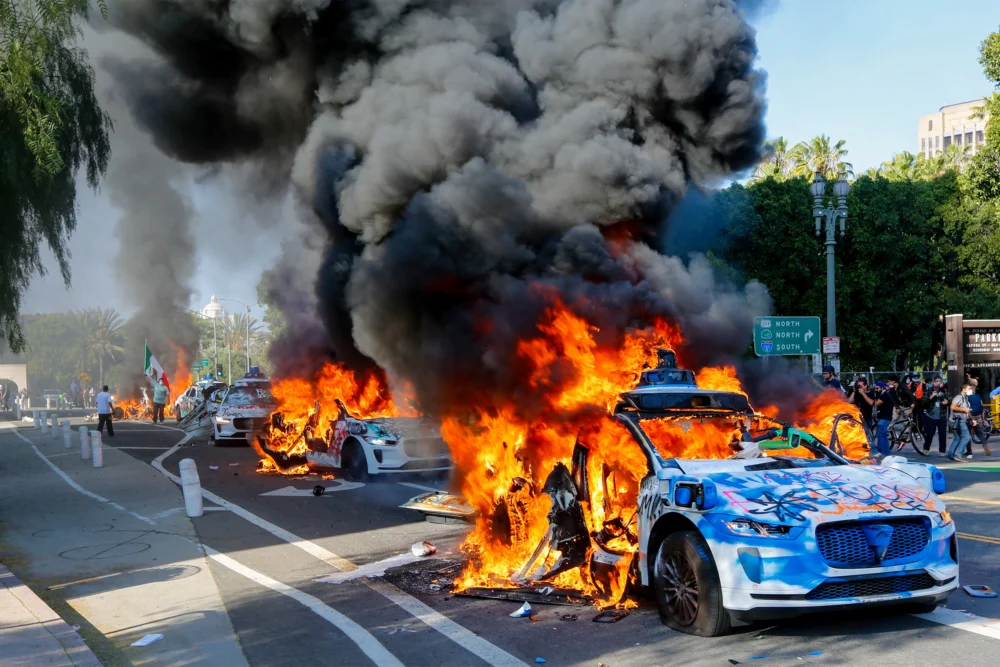
The promise of a driverless future, once heralded as an inevitable leap forward in urban mobility, is increasingly meeting a wall of public skepticism, anger, and outright resistance. What was once dismissed as isolated incidents of technological teething troubles is now crystallizing into a nationwide movement of dissent, fueled by anxieties over job displacement, safety concerns, and a profound sense of disenfranchisement from the decisions shaping their communities. A recent, pivotal hearing in San Francisco, following an incident that saw hundreds of Waymo robotaxis grind to a halt, served not merely as a regulatory review but as a powerful crucible for this burgeoning opposition, signaling a much larger societal reckoning with autonomous vehicles (AVs).
The San Francisco incident, where a widespread power outage left Waymo’s fleet of self-driving cars stranded and immobile across the city, was more than just a minor inconvenience; it was a potent symbol of vulnerability and a catalyst for collective outrage. For hours, the city’s arteries were choked, emergency services potentially hampered, and the daily lives of residents disrupted by a technology that promises efficiency but delivered chaos. This disruption provided a perfect storm for labor activists, beleaguered rideshare drivers, and concerned citizens to converge, transforming a municipal hearing into a public forum for a litany of grievances against the rapid, often unchecked, expansion of autonomous vehicle technology. The chorus of voices at the hearing painted a vivid picture of a public pushed to its limits, questioning not just the reliability of these machines, but their very place in society.
This localized eruption of frustration is, according to a groundbreaking new study, merely an early tremor preceding a much larger seismic event. Research compiled from over 4,600 responses by the Pew Research Center, spearheaded by the Department of Urban Studies and Planning at UC San Diego, has unearthed widespread and deeply rooted distrust in self-driving cars. The findings are stark and unequivocal: approximately 85 percent of those surveyed expressed a strong belief that the widespread deployment of driverless cars would inevitably lead to significant job losses. Even more alarmingly, a staggering 70 percent categorized self-driving cars as a "bad idea for society" or expressed profound uncertainty about the technology’s overall benefit. This leaves a minuscule fraction of the population with outright support for autonomous vehicles, painting a grim picture for an industry banking on widespread public adoption.
Behram Wali, the assistant professor at UC San Diego and lead author of the study, articulated the gravity of these findings to the San Diego Union-Tribune, stating, "If we don’t address these fears in a forward-looking manner, we may end up in a situation where we see a public backlash against this technology." Wali’s surprise at the intensity of the fears underscores a fundamental disconnect between the tech industry’s optimistic projections and the public’s ground-level anxieties. The core fear of job displacement resonates deeply, touching upon the livelihoods of millions of professional drivers, from taxi and rideshare operators to truck drivers and delivery personnel. The economic ripple effect of automating these roles could be catastrophic, fundamentally altering the fabric of the working class and exacerbating existing social inequalities. This isn’t just about individual jobs; it’s about the erosion of entire professions that have historically provided stable income and a pathway to the middle class for countless families. The absence of clear, proactive strategies from government or industry to mitigate this impending economic disruption only fuels the public’s apprehension.
Beyond economic fears, the 70 percent expressing societal doubts highlights a broader spectrum of concerns. Safety remains paramount, with numerous high-profile incidents involving autonomous vehicles — from unexpected stops causing traffic jams, to collisions with emergency vehicles, and instances of AVs obstructing first responders — eroding public trust. The perception that these machines are not yet truly safe, or that their decision-making processes are opaque and unaccountable, is a significant barrier to acceptance. Ethical dilemmas, such as the infamous "trolley problem" in a real-world scenario, also haunt public discourse: in an unavoidable accident, whose life should an algorithm prioritize? Furthermore, privacy concerns regarding the vast amounts of data collected by these vehicles, and the potential for surveillance, add another layer of apprehension. There are also questions about the equitable distribution of this technology’s benefits, and whether it truly serves the common good or primarily the interests of a select few tech giants.
Indeed, the study points to a future unrest that is already actively manifesting across the United States. Earlier in January, a united front of Lyft and Uber drivers took to the streets of San Francisco, protesting the burgeoning presence of Waymo vehicles and demanding stricter regulations from state authorities. These demonstrations are not isolated; similar rallies have echoed in the streets of Seattle, Los Angeles, and New York City, largely orchestrated by powerful labor unions and grassroots organizations representing rideshare workers. Their message is consistent: autonomous vehicles threaten not only their livelihoods but also public safety and the very character of their cities.
The opposition has gained significant organizational muscle. In Boston last October, a formidable coalition emerged, bringing together the venerable Teamsters Union with local grassroots organizers to vociferously oppose robotaxis. Tom Mari, president of Teamsters Local 25, issued a scathing statement that encapsulated the movement’s core arguments: "Driverless cars and trucks pose a serious threat to public safety, our communities, and the livelihoods of the countless dedicated men and women across the Commonwealth who work as professional drivers." He continued, drawing a sharp line in the sand, "These machines don’t benefit working people — they only serve the interests of out-of-state big tech billionaires, and their opinions shouldn’t outweigh the needs of Massachusetts residents." This framing of the conflict as a battle between local communities and distant, wealthy tech corporations resonates powerfully, transforming the technological debate into a socio-economic and political struggle. These groups are actively lobbying for moratoriums, stricter testing protocols, and legislation that prioritizes human oversight and local control over AV deployment.
The resistance, however, has not always remained within the bounds of civil protest. In a disturbing escalation, several incidents have seen crowds, fueled by frustration and anger, resort to vandalism and arson against Waymo vehicles. Images of robotaxis covered in graffiti, engulfed in thick black smoke and bright orange flames – like the one from Benjamin Hanson / Middle East Images via AFP via Getty Images – have become chilling symbols of this growing backlash. These acts, while illegal and dangerous, underscore the depth of public fury and a sense of desperation that some feel in the face of what they perceive as an encroaching, unaccountable technology. The symbolic destruction of these vehicles represents a visceral rejection of the driverless future being imposed upon them, a desperate cry against perceived corporate overreach and governmental inaction.
The challenge for the autonomous vehicle industry and policymakers is immense. Billions have been invested in a technology that promises to revolutionize transportation, reduce accidents, and enhance urban efficiency. Yet, this vision is increasingly clashing with a deeply skeptical and actively resistant public. The "move fast and break things" ethos of Silicon Valley is proving to be a dangerous approach when applied to public infrastructure and livelihoods. Without a concerted effort to address the legitimate fears of job loss, enhance transparency around safety, and genuinely engage with community concerns, the road ahead for self-driving taxis appears fraught with escalating conflict. The choice is clear: either bridge the chasm of distrust through dialogue, regulation, and a more human-centric approach to innovation, or face an ever-intensifying backlash that could derail the autonomous revolution altogether.