Faris Adani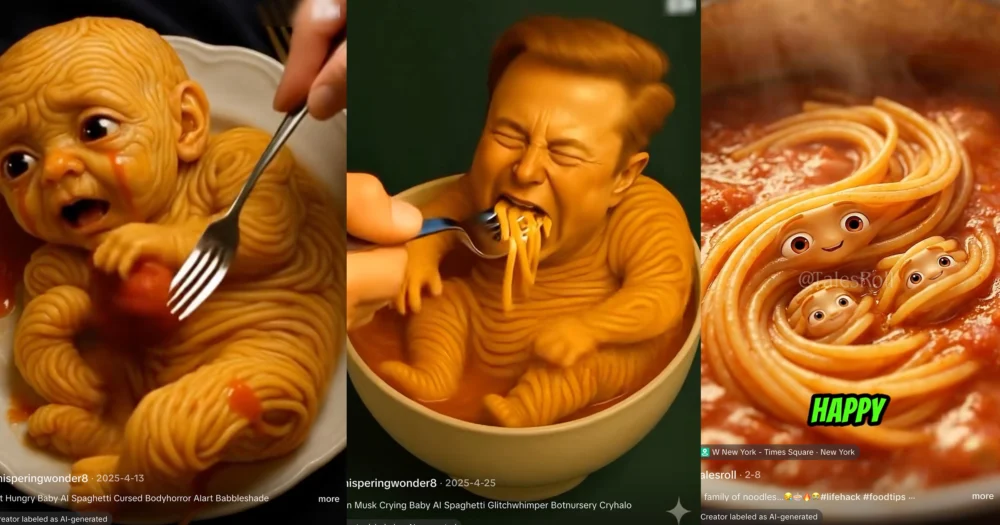
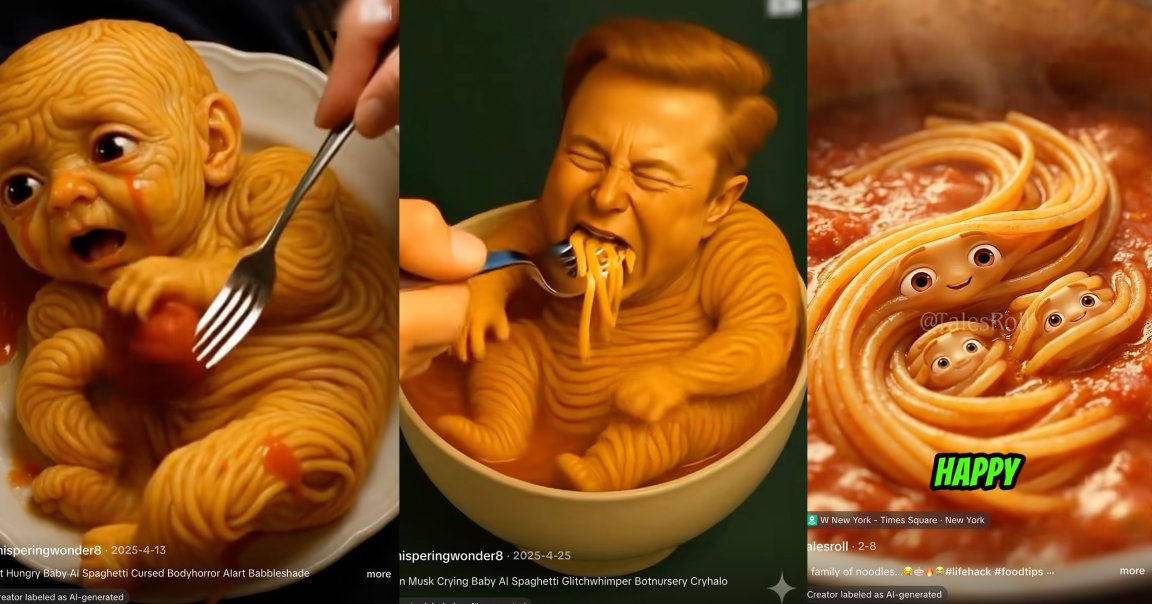
Screenshots via TikTok
Sign up to see the future, today
Can’t-miss innovations from the bleeding edge of science and tech
Disturbing AI Food Slop Is Strangling the Internet. The digital landscape is rapidly becoming inundated with a deluge of AI-generated content, often referred to as “AI slop,” and the latest, most unsettling trend to emerge involves anthropomorphized food items subjected to graphic, traumatic scenarios, predominantly featuring spaghetti families screaming in agony as they are prepared for consumption. This bizarre and disturbing phenomenon is rapidly gaining traction across platforms like TikTok and Instagram, representing a new low in the quality and ethical implications of AI-generated media.
The pervasive spread of AI slop has been a growing concern, morphing from oddities to genuinely disturbing spectacles. We’ve witnessed everything from AI-generated images of women crashing through glass bridges to deeply unsettling visuals of cat parents grinding their children into mincemeat, and even scenarios depicting poor people rioting in Walmart. These examples highlight a troubling pattern: AI models, when prompted without sufficient ethical guardrails or given ambiguous instructions, can produce content that is not only nonsensical but often grotesque, violent, or culturally insensitive. The sheer volume of this content is overwhelming, making it increasingly difficult for users to navigate their feeds without encountering these unsettling creations.
The latest iteration of this digital pollution is particularly visceral: anthropomorphized food, primarily spaghetti, portrayed in extreme distress. These vertical videos, ubiquitous on TikTok and Instagram, depict families of sentient pasta being boiled alive, chopped, or fried, all while expressing fear and pain. The premise is inherently unhinged, designed to shock and disturb, and unfortunately, it’s proving effective, garnering millions of views and reactions.
One particularly poignant and horrifying example making the rounds features a mother pasta bundle sobbing, “My tiny little noodles, my sweet girls, don’t look down,” as her family is prepared for the pot. Her baby bundles cry out in terror, “Mommy, the air is burning, I’m scared,” and “I don’t wanna fall.” The scene then graphically shows the spaghetti submerged into boiling water, followed by a shot of a masculine spaghetti bunch weeping from the kitchen counter, lamenting, “My wife, my daughters… where are you my love.” This specific clip, shared by user @talesroll on TikTok, is a stark illustration of the disturbing narrative depth these AI models are capable of generating, even if the execution remains surreal and uncanny.
The psychological impact of such content is profound. Humans are wired for empathy, and while we rationally understand that spaghetti is not sentient, the visual and auditory cues designed by these AI models exploit our innate capacity for compassion. The anthropomorphism forces an emotional connection, making the simulated suffering unsettling. This deliberate attempt to evoke distress has sparked outrage and discomfort among viewers, with many expressing a desire to disengage from social media. As one user on X (formerly Twitter) declared after encountering a similar video, “I gotta get the f**k off of tiktok.” The sentiment is widely shared, reflecting a growing fatigue and aversion to the increasingly bizarre and often horrific content algorithmically pushed into feeds.
The “spaghetti family” trend has further degenerated on Instagram, evolving into short reels featuring humanoid babies made of pasta strands. These grotesque creations are shown crying when poked by a fork, or even being outright devoured. One video, with over 400,000 likes, bears the caption, “Thought it was just spaghetti… then it cried,” prompting a user to comment, “Ure paying for my therapist.” This illustrates the emotional toll on viewers, who are confronted with imagery that blurs the lines between food, infants, and torture, creating a deeply unsettling psychological experience.
Even more bizarrely, some clips abandon the “baby” concept entirely, such as one AI video simply captioned “dinner” that depicts an unsettling cat-human creature quivering on a countertop before projectile vomiting an endless strand of pasta-bile. The comments section is a testament to the bewildered and disgusted reactions of viewers, with one user lamenting, “Bro all I wanted was dinner ideas.” This exemplifies the unpredictable and often nonsensical nature of AI slop, where the creative boundaries are only limited by the absurdity of the prompts and the algorithms’ interpretations.
The proliferation of these videos raises critical questions about the current state of AI technology and its deployment on mainstream platforms. These disturbing clips are likely generated using advanced text-to-video AI models, where creators input prompts designed to be shocking or emotionally manipulative. The ease with which such content can be generated and disseminated is alarming. Once a successful (in terms of engagement, even negative) formula is found, countless variations can be produced rapidly, flooding the internet with similar material. This rapid iteration and propagation contribute to the “strangling” effect, making it nearly impossible for platforms to effectively moderate.
Social media platforms like TikTok, Instagram, and X bear a significant responsibility. Their algorithms are designed to maximize engagement, often prioritizing novel, shocking, or emotionally charged content, regardless of its quality or ethical implications. This creates a perverse incentive for creators to produce increasingly extreme AI slop, as it is more likely to be amplified and reach a wider audience. The sheer volume of AI-generated content also poses an insurmountable challenge for human moderators, leading to a reliance on automated systems that are often ill-equipped to understand context, nuance, or the psychological impact of such disturbing imagery.
The “AI slop” phenomenon is more than just an annoyance; it represents a degradation of the online experience. It contributes to information overload, makes it harder to discern authentic content, and exposes users, including potentially vulnerable populations like children, to disturbing and inappropriate material. The continuous exposure to such content can lead to desensitization, normalize grotesque imagery, and erode trust in digital media. As AI capabilities advance, the distinction between real and AI-generated content will become even more blurred, raising concerns about the future of digital literacy and critical thinking.
Looking ahead, the challenges posed by AI slop are immense. Content moderation strategies need to evolve rapidly to keep pace with generative AI. This might involve more sophisticated AI-powered detection systems that can identify not just explicit violence but also emotionally manipulative or psychologically distressing content. Furthermore, platforms must reconsider their algorithmic incentives, perhaps prioritizing quality and ethical content over raw engagement metrics. There’s also a need for greater transparency from AI developers about their models’ capabilities and limitations, as well as robust ethical guidelines for content creation.
The trend of traumatized food, while seemingly niche and bizarre, is a microcosm of a much larger problem. It underscores the urgent need for a collective effort from AI developers, platform providers, policymakers, and users to address the growing tide of AI-generated garbage. The digital world is becoming increasingly polluted, and without concerted action, the internet risks drowning in a sea of unsettling, nonsensical, and potentially harmful “slop.” What fresh horrors the AI slop farmers will cook up next week is impossible to say, but rest assured it’s coming for your feed, whether you want it to or not, signaling a critical juncture in how we manage and consume digital content in the age of advanced AI.
More on AI slop: YouTube Filling With Horrifying AI Slop for Children