anjir abdul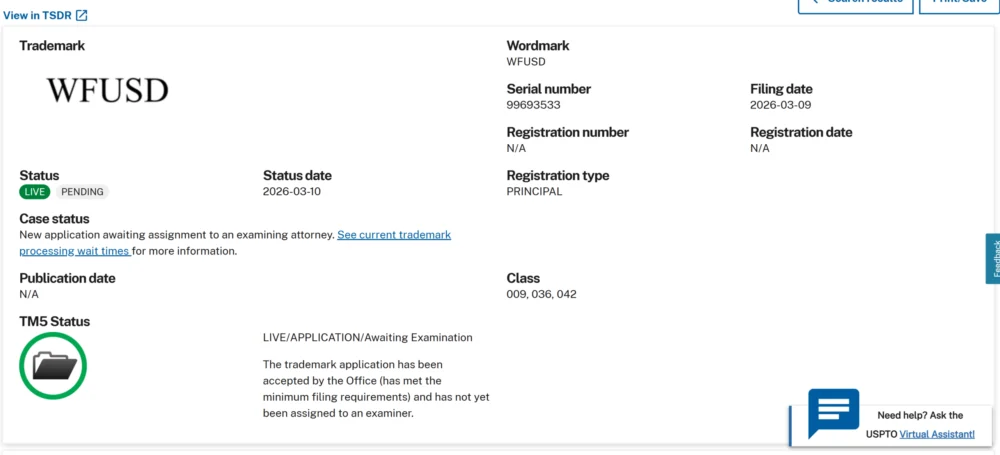
A detailed trademark application, bearing the serial number 99693533, was officially submitted to the US Patent and Trademark Office (USPTO) on Tuesday, seeking comprehensive protection for the distinctive name "WFUSD." As of its submission, the application remains in the initial stages, awaiting assignment to an examining attorney who will then review its merits against existing trademarks and legal requirements. This procedural step is standard for all new applications and precedes any substantive examination, indicating that while the intent is clear, the formal process has just begun.
The strategic importance of this filing cannot be overstated, as it meticulously outlines a remarkably broad spectrum of potential products and services explicitly linked to digital assets. Among the core offerings detailed are "cryptocurrency trading services," which would allow clients to buy and sell various digital currencies, and "cryptocurrency exchange services," implying the establishment of a platform for direct exchange between different cryptocurrencies or fiat and crypto. Further extending its reach, Wells Fargo has also sought protection for "cryptocurrency payment processing," enabling merchants and consumers to transact using digital assets, and "financial brokerage services for cryptocurrency trading," positioning itself as an intermediary facilitating crypto investments. The application also covers the fundamental "electronic transfer of virtual currencies," underpinning all digital asset movements.
Beyond transactional services, the trademark extends into the foundational technological infrastructure of the blockchain ecosystem. The filing specifically lists "downloadable software for staking digital assets," a crucial component of many proof-of-stake blockchains where users lock up their crypto to support network operations and earn rewards. It also covers software for "accessing non-fungible tokens (NFTs)," indicating potential ventures into digital collectibles, art, or tokenized real-world assets. Furthermore, the application includes "managing crypto wallets," which would provide secure storage solutions for digital assets, and "executing digital asset trades," suggesting sophisticated trading platforms or algorithms.
This move by Wells Fargo is not an isolated incident but rather a part of a broader trend among major financial institutions exploring and integrating digital assets into their offerings. For instance, a related development saw Western Union file a "WUUSD" trademark, similarly signaling its interest in cryptocurrency services, particularly stablecoins and payment processing. Such filings underscore a growing institutional recognition of digital assets as a legitimate and potentially lucrative frontier for financial services.
The Wells Fargo filing further delves into advanced blockchain applications, including "software-as-a-service platforms for tokenizing assets." This particular offering is highly significant, as asset tokenization involves representing real-world assets—ranging from real estate and commodities to equities and intellectual property—as digital tokens on a blockchain. This process can enhance liquidity, fractional ownership, and transparency, revolutionizing traditional asset markets. The application also references services for "verifying blockchain transactions," crucial for maintaining the integrity and security of decentralized ledgers, and "enabling cryptocurrency staking operations," reiterating the bank’s interest in participating in the economic mechanisms of proof-of-stake networks. Moreover, "authentication services" and "blockchain-based data transmission tools used in decentralized applications" are listed, pointing towards robust security features and capabilities to interact with the rapidly expanding ecosystem of decentralized finance (DeFi) applications. These services collectively suggest a comprehensive strategic vision, moving beyond mere transactional services to engage with the core technological and operational aspects of blockchain.
While trademark filings, by their very nature, do not serve as an ironclad guarantee of an imminent product launch, they are, nonetheless, a powerful indicator of strategic intent and future direction. Companies of Wells Fargo’s stature frequently leverage these filings to proactively secure brand protection for potential future offerings, safeguarding intellectual property as they explore new markets and technologies. This forward-looking approach allows them to lay the groundwork for innovation without immediately committing to specific products, offering flexibility in a rapidly evolving technological landscape.

Wells Fargo stands as a venerable institution in the American financial landscape, recognized as a prominent multinational financial services company and one of the esteemed "Big Four" US banks, alongside JPMorgan Chase, Bank of America, and Citigroup. With a vast network of branches, extensive customer base, and deep roots in consumer and commercial banking, its entry into the crypto space carries substantial weight, potentially legitimizing digital assets further in the eyes of mainstream consumers and traditional investors. The bank’s cautious but deliberate exploration of crypto services reflects a broader shift within the traditionally conservative banking sector, which has, for years, viewed cryptocurrencies with a mixture of skepticism and apprehension. This gradual pivot underscores the undeniable traction and potential that digital assets have gained, even among the most established financial players.
The "WFUSD" trademark application emerges amidst a discernible acceleration in the efforts of major banks to engage with stablecoins. This trend was highlighted by reports in 2025 indicating that several leading US banks, including JPMorgan, Bank of America, Citigroup, and Wells Fargo itself, were actively engaged in discussions regarding the feasibility of launching a joint stablecoin project. Such a collaborative initiative would represent a significant milestone, potentially creating a standardized, bank-backed digital currency for interbank settlements and corporate transactions, thus streamlining financial operations and reducing costs.
Earlier this year, Fidelity Digital Assets, a subsidiary of the global asset management giant Fidelity Investments, launched its own stablecoin, the Fidelity Digital Dollar (FIDD). This innovative offering is a 1:1 US dollar-pegged, fully collateralized stablecoin operating on the Ethereum blockchain. FIDD aims to provide institutional clients with a secure and transparent means of engaging with digital assets while leveraging the stability and regulatory clarity of a dollar-backed instrument. The success and adoption of FIDD could serve as a blueprint or catalyst for other financial institutions, including Wells Fargo, to accelerate their own stablecoin initiatives.
The broader implications of Wells Fargo’s foray into crypto with "WFUSD" are profound. It represents a further convergence of traditional finance (TradFi) and decentralized finance (DeFi), potentially bridging the gap between established financial infrastructure and the innovative capabilities of blockchain technology. For institutional investors, such services from a trusted banking giant could significantly lower barriers to entry into the crypto market, offering familiar regulatory oversight, robust security protocols, and integrated financial services that standalone crypto exchanges may not fully provide. This institutional validation could unlock substantial capital flows into the digital asset ecosystem, fostering greater liquidity and market maturity.
However, Wells Fargo’s journey into the crypto sphere will not be without its challenges. The regulatory landscape for digital assets in the United States remains complex and fragmented, with various agencies asserting jurisdiction and often differing in their approaches. Navigating these regulatory ambiguities while ensuring compliance with anti-money laundering (AML) and know-your-customer (KYC) mandates will be paramount. Furthermore, integrating cutting-edge blockchain technology into Wells Fargo’s legacy IT infrastructure, which spans decades and serves millions of customers, presents significant technical hurdles related to scalability, security, and interoperability. The bank will also face intense competition from established crypto-native companies and other financial institutions that have already made inroads into the digital asset space.
The "WFUSD" trademark could potentially represent a Wells Fargo-branded stablecoin, likely pegged to the US dollar, akin to JPMorgan’s JPM Coin, which is used for internal wholesale payments. Such a stablecoin could facilitate instant settlements, reduce counterparty risk, and enable new financial products and services for Wells Fargo’s corporate and institutional clients. For instance, it could be used for cross-border payments, corporate treasury management, or even as collateral in decentralized lending protocols, all within a regulated framework. The concept of "WFUSD" aligns perfectly with the current industry trend of major banks exploring proprietary stablecoins to enhance efficiency and innovation in their financial operations.
In conclusion, Wells Fargo’s trademark filing for "WFUSD" is far more than a routine administrative step; it is a powerful declaration of intent. It signifies a strategic commitment from one of the world’s largest banks to actively participate in the digital asset economy, moving beyond mere observation to direct engagement. By seeking protection for a wide array of crypto-related services, from trading and payments to staking and tokenization, Wells Fargo is positioning itself to be a significant player in the evolving landscape where traditional finance and blockchain technology increasingly intertwine. This development not only underscores the mainstreaming of digital assets but also sets the stage for a future where major financial institutions could offer a comprehensive suite of regulated, secure, and integrated crypto services to a broad client base, reshaping the contours of global finance.