anjir abdul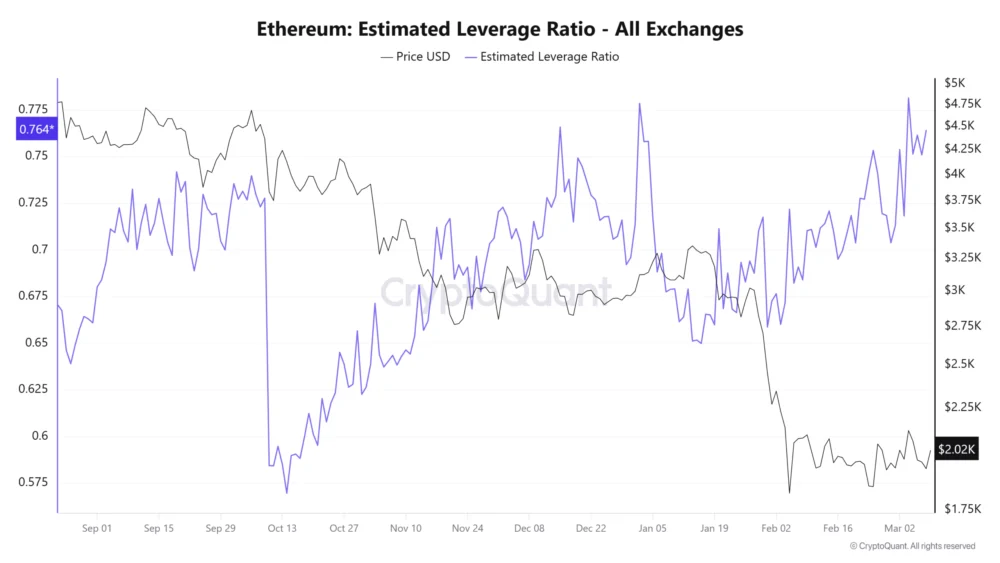
The Ethereum ecosystem is currently a cauldron of intensified activity, with Ether (ETH) clawing its way back above the pivotal $2,000 mark on Monday, driven by a dramatic escalation in its derivatives market across major exchanges. Recent data paints a compelling picture of aggressive positioning, revealing a massive inflow of over 110,000 Ether into derivatives platforms, coinciding with a key leverage indicator surging to unprecedented highs. This confluence of factors strongly suggests that market participants are bracing for, and indeed actively seeking to instigate, significant volatility as ETH endeavors to break free from its established monthly trading range. The prevailing sentiment among a segment of traders points towards a potential "short squeeze" scenario, where an upward price movement could trigger a cascade of forced buybacks from overleveraged short positions, potentially propelling Ether towards the ambitious target of $2,500.
The dramatic uptick in Ether’s derivatives market activity is undeniable. On March 7th, derivatives exchanges recorded a staggering net inflow of 110,343 ETH. This figure represents the third-largest single-day spike in 2026, underscoring the magnitude of capital being deployed into leveraged trading instruments. To put this into perspective, a larger inflow was observed on February 6th, a day that saw ETH rally approximately 13% from its yearly low of $1,736. Historically, as highlighted by CryptoQuant data, such substantial spikes in derivatives inflows have frequently acted as harbingers of either short-term price drawdowns or, more commonly, periods of pronounced market volatility. This suggests that while capital is flowing in, market participants are not necessarily expecting a smooth ride but rather a decisive move in one direction or another. The nature of these inflows often involves traders opening new futures contracts, options positions, or perpetual swaps, all of which allow for amplified exposure to price movements with a relatively smaller initial capital outlay, hence the term "leverage."

Simultaneously, the estimated leverage ratio for Ether has ascended to a new all-time high of 0.78 on Wednesday, eclipsing the previous record of 0.778 established on January 1st. This metric, meticulously tracked by CryptoQuant, serves as a crucial barometer for gauging the collective risk appetite within the market. It calculates the amount of open interest (the total number of outstanding derivatives contracts) relative to the total reserves held by exchanges. A higher reading, such as the one witnessed recently, unequivocally indicates that a significantly larger proportion of active trading positions are reliant on borrowed capital. In essence, traders are taking on more risk, betting larger sums relative to their actual holdings. Such highly leveraged market conditions are inherently prone to amplifying price movements. When prices move against a heavily leveraged position, it can trigger forced liquidations – a process where the exchange automatically closes the position to prevent further losses, often leading to a domino effect where multiple liquidations in quick succession can accelerate the price trend in the direction of the initial move. This phenomenon is precisely what bulls might be hoping to exploit to initiate a short squeeze.
From a technical analysis standpoint, Ether has been navigating a well-defined monthly trading range, oscillating between the psychological support of $1,800 and the resistance of $2,000. This range-bound behavior followed a "swing failure pattern" (SFP) near $2,150 last Wednesday. An SFP is a classic technical signal where the price briefly surpasses a previous high (or low) but fails to sustain the breakout, swiftly reversing back into the range. In this instance, the rejection above $2,150 signaled robust profit-taking by bears or early long positions, leading to a retracement towards internal liquidity levels situated around $1,900 and $1,950, which had formed earlier in the week.

However, the tide appears to be turning. The one-hour chart now displays a clear bullish pivot, tracking the recovery that commenced on Monday following a decisive "liquidity sweep" near $1,908 on Sunday. A liquidity sweep occurs when the price briefly dips below a significant support level (or above resistance) to "collect" stop-loss orders from traders positioned on the wrong side, only to reverse sharply thereafter. This often indicates that institutional or large-scale players are accumulating positions at lower prices, having absorbed the available sell-side liquidity. The market’s immediate focus has now shifted towards the supply zone spanning $2,050 to $2,100, which solidified late last week. This zone represents an area where significant selling pressure previously emerged, likely due to a concentration of resting sell orders or profit-taking from earlier long positions. A definitive breakout above this critical range, followed by its successful establishment as a new support level, would be a profoundly bullish signal, potentially paving the way for ETH to surmount the $2,150 barrier with considerable momentum.
The potential for a short squeeze is further underscored by granular liquidation data. CoinGlass’s seven-day liquidation map reveals a dense cluster of short positions concentrated just above the current price level. Specifically, approximately $273 million in cumulative short-liquidation leverage is positioned around $2,030. These large concentrations of short liquidations frequently act as "magnet levels" for the price. As Ether’s price approaches these thresholds, it triggers stop-loss orders and forced liquidations of overleveraged short positions. When a short position is liquidated, the exchange automatically buys back the asset in the open market to close the trade, effectively adding buying pressure. This forced buying, if triggered in quick succession across numerous positions, can create a powerful feedback loop, dramatically accelerating upside volatility and potentially propelling the price far beyond initial targets. The presence of such a significant liquidation cluster so close to the current price provides a strong incentive for bulls to push the price higher and capitalize on this dynamic.

Adding another layer of bullish conviction, prominent crypto analyst Cyril-DeFi recently highlighted that ETH/USD is currently testing a long-term ascending trendline. This trendline has historically served as a robust support level for Ether’s price, having been tested and held successfully multiple times since the last major market cycle. Cyril-DeFi observed, "Every time the price touched this support, it eventually led to a strong bounce. Right now, the $1.9k–$2k area looks like a key level that could determine the next move." The resilience of this long-standing trendline, combined with the current accumulation signals and liquidation dynamics, paints a picture of a market poised for a significant upward move should this support continue to hold. A successful defense of this critical area could reaffirm the underlying strength of Ether’s long-term market structure, bolstering confidence among investors and traders.
Beyond these immediate technical and derivatives market indicators, the broader cryptocurrency market sentiment remains largely positive. As reported, crypto funds recently saw $619 million in inflows, demonstrating resilience despite geopolitical tensions and fluctuating commodity prices. While Bitcoin often acts as the primary driver for the overall market, Ethereum’s unique position as the leading smart contract platform, with ongoing developments in its staking ecosystem and the ever-present anticipation of spot Ether ETFs, adds another layer of fundamental support. Should the current bullish momentum continue, and the market successfully navigate the resistance zones, a move towards $2,500 would represent a significant psychological and technical milestone, potentially igniting further retail and institutional interest.

However, it is crucial to temper this optimism with a healthy dose of caution. The very nature of leveraged trading, while offering amplified gains, also carries exponentially higher risks. While the current setup appears conducive to a powerful short squeeze, market conditions can shift with startling rapidity. Unforeseen macroeconomic events, regulatory changes, or a sudden change in broader market sentiment could swiftly invalidate bullish scenarios. Every investment and trading decision involves inherent risks, and diligent personal research remains paramount. The path to $2,500 for Ether is paved with both immense opportunity and considerable volatility, demanding keen observation and strategic decision-making from all market participants. The question remains, with leverage surging and shorts exposed, will the bulls manage to orchestrate the squeeze needed to send Ether to this next significant price target? Only time, and the relentless dynamics of the market, will tell.