anjir abdul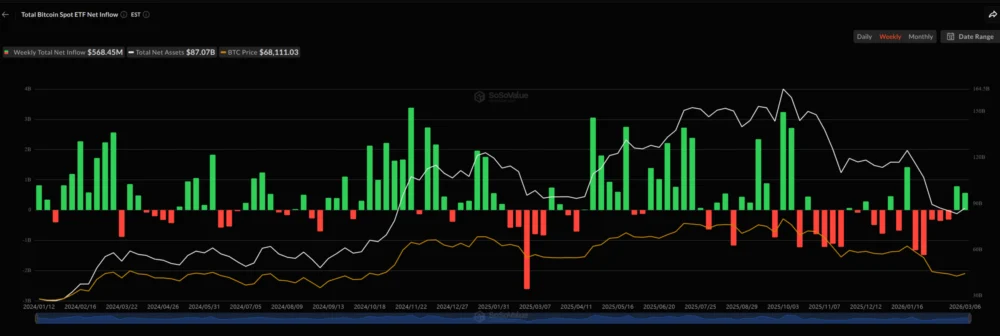
US spot Bitcoin exchange-traded funds (ETFs) have successfully navigated a period of investor hesitancy, recording their second consecutive week of net inflows and marking the first back-to-back weekly gains in five months, signaling a robust resurgence in institutional and retail investor confidence. This renewed appetite comes after a challenging stretch for the nascent asset class, which had previously experienced significant outflows.
The latest figures underscore a powerful turnaround, with spot Bitcoin (BTC) ETFs attracting approximately $568.45 million in net inflows this week, according to comprehensive data from SoSoValue. This impressive performance follows an equally strong showing in the preceding week, which saw inflows of roughly $787.31 million. Cumulatively, over these two weeks, the products have drawn in well over $1.35 billion, demonstrating a clear and accelerating shift in investor sentiment back towards digital asset exposure via regulated financial instruments. This positive momentum is particularly noteworthy given the broader market dynamics and the relatively short history of these investment vehicles.
Prior to this encouraging rebound, US spot Bitcoin ETFs had endured a prolonged period of sustained investor withdrawals. The products recorded a staggering cumulative outflow of approximately $3.8 billion over a five-week streak, a period that tested the resolve of many market participants and raised questions about the immediate future trajectory of institutional Bitcoin adoption. The most significant weekly withdrawal during this challenging phase occurred in the week ending January 30, when spot Bitcoin ETFs witnessed roughly $1.49 billion in net redemptions, highlighting the volatility and sensitivity of capital flows in this emerging market. These outflows were often attributed to profit-taking following Bitcoin’s rally and a period of macroeconomic uncertainty, alongside the unique dynamics surrounding Grayscale’s GBTC conversion, which saw significant redemptions as investors moved to lower-fee alternatives.
Analyzing the daily flow patterns for the most recent week provides further insight into the nuanced market sentiment. The week commenced with remarkable strength, as spot Bitcoin ETFs recorded substantial inflows of $458.19 million on Monday, indicating strong initial demand. This positive trend continued into Tuesday with $225.15 million in inflows, followed by an even larger influx of $461.77 million on Wednesday, demonstrating sustained buying pressure mid-week. However, the momentum experienced a reversal in the latter part of the week, with the funds seeing $227.83 million in outflows on Thursday and $348.83 million in redemptions on Friday. This pattern of strong early-week inflows followed by end-of-week profit-taking or rebalancing suggests a dynamic market where investors are actively managing their positions, potentially locking in gains or adjusting portfolios ahead of the weekend. Despite the late-week dip, the overall net inflow for the week remained strongly positive, reinforcing the narrative of a renewed bullish outlook.

The positive trend was not confined to Bitcoin alone. US spot Ether (ETH) ETFs also registered their second consecutive week of net inflows, mirroring Bitcoin’s recovery and signaling broader confidence in the digital asset space. These funds attracted roughly $23.56 million in net inflows this week, building upon the $80.46 million in inflows recorded the previous week. This marks their first back-to-back weekly gains since early October last year, indicating a significant turning point for Ether-based investment products. The renewed interest in Ether ETFs is particularly significant following the recent regulatory developments, where the U.S. Securities and Exchange Commission (SEC) approved 19b-4 filings for several spot Ether ETFs, paving the way for their eventual launch. While trading has not yet commenced for these products, the anticipation and regulatory progress have undoubtedly fueled investor enthusiasm for existing Ether-related investment vehicles.
Before this encouraging rebound, spot Ether ETFs, much like their Bitcoin counterparts, had faced a sustained withdrawal streak. They recorded more than $1.38 billion in cumulative outflows across five consecutive weeks, reflecting a period of uncertainty and divestment from the Ethereum ecosystem. The largest weekly outflow during this period occurred in the week ending January 23, when the funds recorded roughly $611 million in net redemptions. This period of significant outflows highlighted the sensitivity of Ether-related products to market sentiment and broader regulatory concerns surrounding cryptocurrencies.
The latest reporting week for Ether ETFs also saw mixed results in daily flows, reflecting a similar pattern of volatility as observed with Bitcoin ETFs. They recorded a strong start with $38.69 million in inflows on Monday, demonstrating initial investor confidence. However, this was followed by $10.75 million in outflows on Tuesday, suggesting some profit-taking or rebalancing. Inflows returned robustly on Wednesday with $169.41 million, indicating strong mid-week interest, but the momentum subsequently faded later in the week. Despite these fluctuations, the overall net positive flow for Ether ETFs over two consecutive weeks underscores a growing belief in Ethereum’s long-term value proposition, especially with the imminent launch of spot Ether ETFs.
Beyond the immediate weekly figures, a broader, more profound trend is emerging in the digital asset investment landscape. Fernando Nikolić, Blockstream’s director of marketing, highlighted a striking comparison in a recent post on X, noting that Bitcoin ETFs have already matched approximately 15 years of cumulative inflows seen by gold ETFs in less than two years. This achievement is nothing short of remarkable, especially considering that gold, a traditional safe-haven asset, had a decade-and-a-half head start in the ETF market. This comparison not only underscores the unprecedented speed of adoption for Bitcoin as an institutional asset but also challenges conventional wisdom about asset allocation and the role of "digital gold."
Nikolić further elaborated on the significance of this milestone, pointing out that this rapid accumulation of capital occurred despite a 46% Bitcoin drawdown and several months of negative price performance. This resilience suggests that institutional demand for Bitcoin remains robust and deeply rooted, even amid periods of market weakness and price volatility. It indicates that sophisticated investors are increasingly viewing Bitcoin not merely as a speculative asset, but as a legitimate, long-term store of value and a strategic component of diversified portfolios. The speed at which Bitcoin ETFs have attracted capital reflects a fundamental shift in how global investors perceive and access this new asset class, leveraging the familiarity and regulatory framework of traditional financial products.

In a powerful commentary, Nikolić encapsulated this paradigm shift: "Anyone still arguing about whether bitcoin is ‘digital gold’ is wasting their breath. Bitcoin isn’t trying to be gold. Bitcoin is making gold look slow." This statement boldly asserts Bitcoin’s superior characteristics, such as its absolute scarcity, ease of transfer, divisibility, and resistance to censorship, which collectively offer advantages over physical gold in the digital age. The efficiency of capital deployment through Bitcoin ETFs, coupled with Bitcoin’s inherent properties, positions it as a formidable contender, if not a superior alternative, to traditional safe-haven assets. This rapid institutional embrace of Bitcoin via ETFs signifies a coming-of-age for the cryptocurrency market, bridging the gap between innovative digital assets and the established world of traditional finance.
The implications of these trends extend far beyond mere financial statistics. The sustained inflows into both Bitcoin and Ether ETFs are a testament to the increasing mainstream acceptance of cryptocurrencies as legitimate investment assets. This institutional validation is crucial for the long-term growth and stability of the crypto market. It suggests that traditional financial institutions and their clients are moving beyond initial skepticism, recognizing the potential for significant returns and diversification benefits that digital assets can offer. As more capital flows into these regulated products, it further solidifies the market infrastructure, enhances liquidity, and provides a clearer regulatory pathway for future innovation in the crypto space.
Moreover, the performance of these ETFs can influence the underlying assets’ prices. Sustained buying pressure from large institutional funds can act as a significant tailwind for Bitcoin and Ether, potentially pushing them to new all-time highs. This is particularly relevant in the context of global macroeconomic factors, such as fluctuating interest rates, inflation concerns, and geopolitical uncertainties, which often drive investors towards alternative assets. Cryptocurrencies, with their decentralized nature and finite supply (especially Bitcoin), offer a compelling hedge against traditional financial market volatility and inflationary pressures.
Looking ahead, the successful track record and growing popularity of spot Bitcoin and Ether ETFs are likely to encourage further development and adoption of similar products for other digital assets. This expanding ecosystem of regulated crypto investment vehicles will continue to democratize access to cryptocurrencies for a broader range of investors, from large institutional funds to individual retail investors. The ongoing regulatory clarity, particularly in the United States, will play a critical role in shaping the future trajectory of this market, potentially unlocking even greater capital flows and fostering an environment ripe for innovation and growth within the digital asset economy. The recent weekly inflows represent not just a momentary recovery, but potentially the early stages of a sustained growth phase for crypto ETFs, solidifying their position as a vital conduit between traditional finance and the burgeoning world of digital assets.