anjir abdul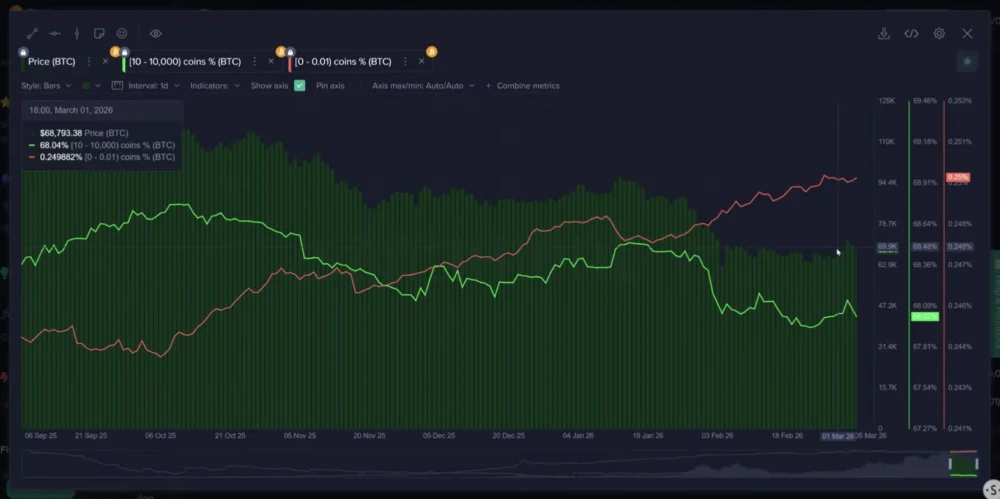
As the cryptocurrency market navigates a period of significant volatility in March 2026, Bitcoin’s recent dip below the $70,000 mark has ignited a familiar divergence in investor behavior, prompting warnings from leading on-chain analytics platform Santiment. While retail investors appear eager to "buy the dip," scooping up BTC at reduced prices, the sophisticated movements of large institutional holders, commonly referred to as "whales," suggest that the current price correction may be far from over. This conflicting activity, where smaller investors accumulate as major players offload, has historically presaged further downward price action, raising concerns across the crypto landscape.
The current market sentiment is particularly fragile, given Bitcoin’s extraordinary journey to an all-time high of $126,000 just a few months prior, in October 2025. Following that peak, the flagship cryptocurrency experienced a substantial downtrend, with a notable drop to as low as $60,000 on February 6, 2026, before showing a modest recovery. Now, as Bitcoin struggles to maintain support above $70,000, currently trading at $67,984 at the time of publication, the critical question for investors is whether this is a healthy consolidation or the precursor to a deeper plunge.
Santiment, a renowned crypto sentiment and on-chain analytics platform, meticulously tracks the behavior of various market participants to identify trends and potential shifts. In a comprehensive report released on Friday, the platform highlighted a concerning pattern: "The moment Bitcoin hit $74k, these key stakeholders began taking profit." These "key stakeholders" are identified as whales – entities holding between 10 and 10,000 Bitcoin. Their recent actions stand in stark contrast to the burgeoning buying interest from retail investors, those holding less than 0.01 Bitcoin.
According to Santiment’s data, whales demonstrated significant accumulation between February 23 and March 3, 2026, precisely when Bitcoin was trading within a range of $62,900 and $69,600. This strategic buying during a period of lower prices underscores their calculated approach to market entry. However, as Bitcoin staged a temporary rally, climbing past $70,000 and briefly touching $74,000 on Wednesday, these same whale addresses rapidly initiated profit-taking. Santiment’s analysis reveals that this cohort offloaded approximately 66% of their recent purchases, signaling a strong conviction that the rally might be short-lived or that current prices offered an opportune moment to secure gains.
Simultaneously, the platform observed a surge in buying activity from retail investors. This demographic, often driven by emotional responses such as the fear of missing out (FOMO) during rallies or the perceived opportunity to "buy the dip" after a significant price drop, began increasing their positions as whales were selling. This inverse relationship in trading behavior is a critical indicator for Santiment. "When retail buys while whales sell, it typically signals that the correction is not yet over," the report emphasized. This historical pattern suggests that smart money (whales) often front-runs broader market movements, using retail enthusiasm as liquidity to exit positions, thereby paving the way for further price declines.
The implications of this whale-retail divergence are profound. Whales, with their deep pockets and often superior market insights derived from extensive research and access to sophisticated tools, are generally considered "smart money." Their movements can significantly influence market direction due to the sheer volume of their trades. When they sell into a retail-driven buying frenzy, it often indicates a lack of underlying institutional conviction in the immediate upside, suggesting that the current price levels might be unsustainable. Retail investors, on the other hand, while a vital component of market liquidity, can sometimes act as contrarian indicators, especially when their buying becomes exuberant during a downtrend or when prices appear to be topping out. Their collective action, while powerful, can sometimes be a lagging indicator, reacting to price movements rather than anticipating them.
Further compounding the bearish sentiment is the broader market’s psychological state. The Crypto Fear & Greed Index, a widely referenced barometer of market emotions, has plunged significantly. On Saturday, it fell by 6 points, pushing it further into "Extreme Fear" territory with a grim score of 12. The index, which measures factors like volatility, market momentum, social media sentiment, surveys, Bitcoin dominance, and Google trends, uses a scale from 0 (Extreme Fear) to 100 (Extreme Greed). A score of 12 indicates profound pessimism and anxiety among investors, a stark contrast to the euphoria witnessed during the market’s ascent to $126,000. Such extreme fear can lead to panic selling, further exacerbating downward price pressure, or, for contrarian investors, present a potential opportunity for long-term accumulation.
Echoing Santiment’s cautious outlook, prominent figures in the crypto analysis space have also voiced concerns about the immediate future. Michael van de Poppe, founder of MN Trading Capital, shared a similar perspective on Friday, warning that a further decline for Bitcoin is entirely plausible. "If Bitcoin doesn’t find support in this $67-68K region, then we’re likely going to retest the lows for liquidity before bouncing back upwards," van de Poppe stated in an X post. This technical analysis highlights a critical support zone. Should Bitcoin fail to hold above $67,000-$68,000, it could trigger stop-loss orders and force further capitulation, leading to a "retest of the lows." This phrase refers to a scenario where the price revisits previous support levels (like the $60,000 mark seen on February 6) to "flush out" weaker hands and absorb liquidity before a potential reversal. Such moves are common in volatile markets as market makers and large players seek to capitalize on panic.
Adding another layer of analysis, economist Timothy Peterson offered a long-term perspective, suggesting a potential floor for the current downtrend. Peterson referenced the Bitcoin Price to Metcalfe Value chart, a model that applies Metcalfe’s Law to Bitcoin’s network value. Metcalfe’s Law posits that the value of a telecommunications network is proportional to the square of the number of connected users of the system (n^2). In the context of Bitcoin, this model aims to value the cryptocurrency based on its active user base, offering a fundamental valuation against its market price. Peterson, in an X post, confidently asserted, "This valuation level has always marked a bottom for Bitcoin. About 99.5% chance it stays above $60k." His analysis suggests that while short-term volatility may persist, the $60,000 level represents a robust historical floor based on fundamental network growth, providing a glimmer of hope amidst the prevailing bearish sentiment.
The recent price decline has also been accompanied by significant activity in the institutional investment space, particularly concerning US-based spot Bitcoin Exchange-Traded Funds (ETFs). These ETFs, which revolutionized institutional access to Bitcoin, saw their largest outflow day since February 12, 2026, registering a staggering $348.9 million in net outflows across the 11 approved products, according to data from Farside. The introduction of these ETFs in early 2026 was a major catalyst for Bitcoin’s journey to its all-time high of $126,000, attracting billions in institutional capital. However, sustained outflows indicate a shift in institutional sentiment, potentially driven by profit-taking after the immense run-up, reallocation of assets, or a more cautious stance on market conditions. Large institutional outflows from ETFs can exert considerable selling pressure on Bitcoin, as ETF issuers must sell underlying BTC to meet redemption requests, further contributing to the market’s current weakness.
This confluence of factors – retail accumulation met by whale distribution, extreme market fear, expert warnings about critical support levels, and significant institutional outflows from ETFs – paints a complex and uncertain picture for Bitcoin in March 2026. While the cryptocurrency market is no stranger to dramatic corrections, especially after reaching new all-time highs, the current dynamics suggest that investors should exercise heightened caution. The journey from $126,000 to below $70,000 represents a substantial correction, testing the conviction of both seasoned and novice investors.
Historically, Bitcoin markets are characterized by cycles of boom and bust. Major bull runs are often followed by steep corrections that can retrace a significant portion of previous gains before establishing new bases for future growth. The current environment could be interpreted as a necessary cleansing of speculative excess, paving the way for a healthier, more sustainable rally in the future. However, the immediate outlook, as articulated by Santiment and other analysts, points towards the possibility of further downside. Investors are advised to remain vigilant, conduct thorough due diligence, and avoid making emotionally driven decisions in these volatile times. The $60,000 mark, as suggested by Timothy Peterson’s Metcalfe Value model, stands out as a critical level to watch, potentially serving as a robust floor if the market capitulation deepens. Until a clear shift in whale behavior or a sustained rebound in institutional inflows emerges, the "Bitcoin dip may not be over."