Faris Adani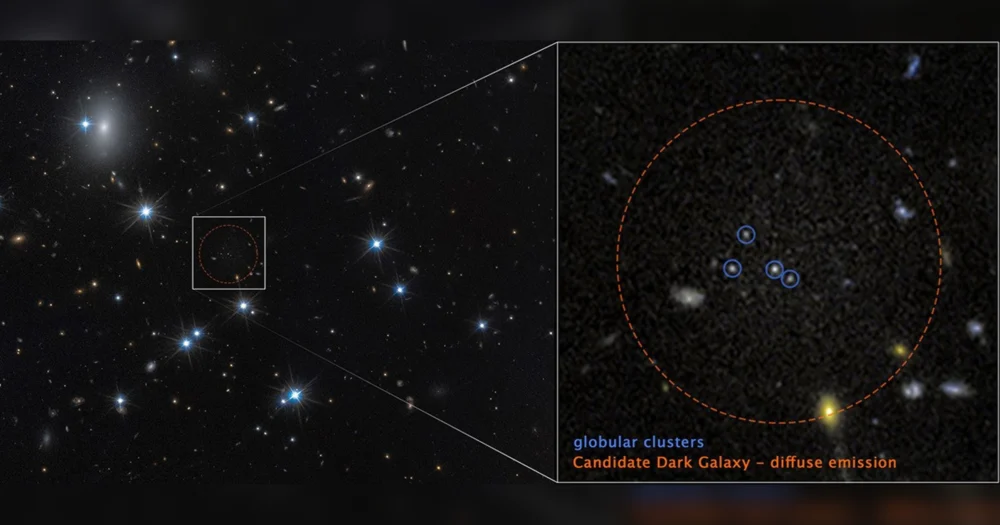
The universe, a tapestry woven with stars, galaxies, and cosmic wonders, holds an even deeper mystery in its invisible threads: dark matter, a pervasive and enigmatic substance that gravitationally dominates the cosmos, outweighing the familiar baryonic matter – the "ordinary stuff" that forms stars, planets, and ourselves – by a staggering five-to-one ratio. While its presence is inferred through its gravitational effects on visible matter, dark matter itself remains elusive, undetectable by current direct methods. Yet, some corners of this vast cosmic expanse are far more saturated with this unseen constituent than others, offering tantalizing clues to its nature. In a groundbreaking revelation, a team of astronomers utilizing the venerable Hubble Space Telescope, alongside the European Space Agency’s Euclid mission and the ground-based Subaru Telescope in Hawaii, has identified a truly extraordinary celestial object: a galaxy situated approximately 300 million light-years away that appears to be composed of at least 99.9 percent dark matter. This astonishing discovery, detailed in a new study published in The Astrophysical Journal Letters, describes a galaxy so heavily dominated by the invisible substance that it is barely discernible, presenting an unprecedented case study for the elusive "dark galaxies" that scientists have theorized about for decades. This tenebrous realm, now dubbed CDG-2, stands as one of the most dark matter-heavy galaxies ever observed, offering a compelling candidate for these hypothetical entities that are thought to contain vanishingly few, if any, stars. Dayi Li, an astrophysicist at the University of Toronto and the lead author of the study, clarified in an interview, "To be technically correct, CDG-2 is an almost-dark galaxy; it belongs to a broader class of objects called low surface brightness galaxies." He further emphasized the profound significance of this find: "But the importance of CDG-2 is that it nudges us much closer to getting to that truly dark regime, while previously we did not think a galaxy this faint could exist." The very concept of a "dark galaxy" challenges conventional understanding of galaxy formation, which typically postulates a significant interplay between dark matter halos and the gas and dust that coalesce to form stars. Such an object, almost entirely devoid of visible stellar populations, would represent a nearly pristine dark matter laboratory, offering an unparalleled opportunity to study the fundamental properties of this mysterious cosmic component without the confounding influence of baryonic matter. The primary challenge in identifying such an object lies precisely in its invisible nature. How does one locate something that is composed almost entirely of unseen material? The ingenious methodology employed by Li’s team centered on searching for bright spots within the vast cosmic canvas: globular clusters. These ancient, tightly packed, spherical conglomerations of hundreds of thousands of old stars are essentially relics of the universe’s first generation of star formation. They are gravitationally bound structures that, in an otherwise empty or nearly empty realm, would betray the presence of a larger underlying gravitational scaffold – a dark matter halo – holding them together. The collaborative observational power of the Hubble Space Telescope, renowned for its unparalleled resolution and deep-field imaging capabilities, the Euclid Space Telescope, designed to map the geometry of the dark universe, and the Subaru Telescope, with its wide-field imaging and advanced adaptive optics from its perch atop Mauna Kea, proved instrumental. Together, these instruments allowed the astronomers to pinpoint four distinct globular clusters within one of the largest and brightest structures in the universe: the Perseus Cluster. The Perseus Cluster is a colossal grouping of thousands of galaxies, enveloped in a vast cloud of superheated gas that emits X-rays, making it one of the most massive objects known in the observable universe. Such a dense and dynamic environment is characterized by intense gravitational interactions, where older, larger galaxies can gravitationally strip away star-forming material from younger, smaller neighbors, effectively stunting their stellar development. This environmental "hunch" proved crucial to the discovery. The astronomers found that even though these four globular clusters appeared to be languishing in an otherwise empty stretch of the Perseus Cluster, they were surrounded by a faint, diffuse halo of glowing matter. This subtle luminosity, though minimal, served as the telltale sign of a galaxy, a vast dark matter halo whose gravitational embrace still held these ancient star clusters. Li explained the implications of this environmental interaction: "The material that this galaxy needed to continue to form stars was no longer there, so it was left with basically just a dark matter halo and the four globular clusters." This scenario paints a vivid picture of cosmic cannibalism and environmental sculpting, where the harsh conditions within a galaxy cluster can effectively "starve" a nascent galaxy of its gas, preventing further star formation and leaving behind a ghost-like remnant dominated by its dark matter scaffold. The enthusiasm among other astronomers regarding these findings is palpable. Neal Dalal, a researcher at the Perimeter Institute for Theoretical Physics in Waterloo, highlighted the profound scientific utility of such a discovery. He explained that dark or nearly dark galaxies like CDG-2 could provide a "cleaner probe of dark matter physics." In typical galaxies, such as our own Milky Way, the luminous stars and gas exert significant gravitational forces and engage in complex baryonic processes that can profoundly impact the distribution and dynamics of dark matter. This intricate interplay makes it exceedingly difficult to "disentangle the effects of ordinary matter from the effects of dark matter" when trying to model and understand dark matter’s fundamental properties. CDG-2, with its minimal baryonic content, effectively removes this complicating factor, offering an unprecedented opportunity to observe dark matter’s gravitational behavior in a relatively unperturbed state. This "clean" environment could allow physicists to test various dark matter theories, from weakly interacting massive particles (WIMPs) to alternative models, with greater precision. It could shed light on questions about dark matter’s particle nature, its interaction cross-section, and how it forms the foundational structures of the universe. The discovery also has significant implications for our understanding of galaxy formation and evolution. The existence of an almost-dark galaxy like CDG-2 challenges existing models and forces a re-evaluation of the conditions under which galaxies can form and persist. It suggests that a galaxy does not necessarily need a substantial stellar population to be considered a galaxy; rather, its defining characteristic might be the presence of a gravitationally bound dark matter halo. Future research will undoubtedly focus on validating the properties of CDG-2 with even more detailed observations, potentially using the James Webb Space Telescope’s infrared capabilities to search for any faint, hidden stellar populations, or the upcoming Vera C. Rubin Observatory’s vast survey power to hunt for more such elusive galaxies. Each new observation of such a dark matter-dominated system brings scientists closer to solving one of the most enduring mysteries in cosmology: the true nature of dark matter, the invisible scaffolding upon which the visible universe is built. As telescopes continue to push the boundaries of observation, these "almost-dark" realms promise to illuminate the dark side of the cosmos, one ghostly galaxy at a time.