anjir abdul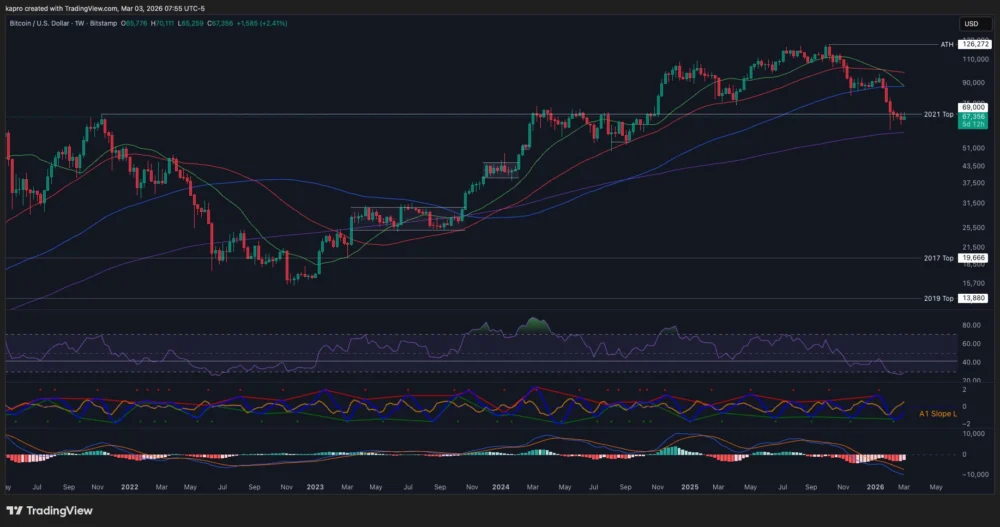
The recent surge in geopolitical risk, specifically the heightened rhetoric and potential for conflict involving Iran, created immediate and tangible concerns over the stability of global oil supplies. With the Strait of Hormuz, a critical chokepoint for a substantial portion of the world’s seaborne oil shipments, coming into focus, market participants rapidly began to price in the risk of supply disruptions. This fear manifested as a broad-based sell-off across various asset classes, with Bitcoin (BTC) erasing its latest ascent towards $70,000, illustrating its continued sensitivity to macro-level events despite its growing maturity as an asset.
On Tuesday, Bitcoin experienced a notable 3.2% price loss, bringing the cryptocurrency back into the vicinity of $66,000, a level that has served as both support and resistance in recent trading sessions. This retracement highlighted the precarious nature of Bitcoin’s recent rally, which had shown signs of exhaustion even before the latest geopolitical tremor. The aspiration to reclaim $70,000 is more than just a psychological milestone; it represents a significant technical barrier that, once breached and held, could signal a renewed bullish momentum and potential for further upward price discovery. Its repeated failure to overcome this level, especially under the pressure of external macro factors, reinforces the notion that strong fundamental catalysts are still required to sustain higher valuations.
The broader market reaction was swift and decisive. Stock markets worldwide experienced considerable weakness, with the S&P 500 and Nasdaq Composite Index both declining by approximately 2% shortly after the Wall Street open. This synchronized downturn across equities underscores the interconnectedness of global financial systems and the pervasive impact of major geopolitical shocks. Traditionally viewed as a safe-haven asset, gold also succumbed to the selling pressure, falling significantly and targeting the $5,000 support level, a move that surprised some analysts given its historical role during times of uncertainty. The sell-off in gold, often considered a barometer for global fear, suggests that the market’s immediate reaction was one of broad de-risking and a rush to liquidity, rather than a flight to traditional safe havens.

"The market is beginning to price-in a longer war," noted trading resource The Kobeissi Letter in a terse but impactful statement on X, encapsulating the underlying fear gripping investors. This sentiment points to concerns extending beyond immediate supply disruptions, suggesting that market participants are now contemplating a more protracted period of instability, which could have long-term implications for global trade, inflation, and economic growth. Such a scenario naturally dampens appetite for risk assets and encourages a more conservative portfolio allocation.
From a technical perspective, Bitcoin’s failure to flip key trend lines to support provided further ammunition for bears. Keith Alan, cofounder of trading resource Material Indicators, a prominent voice in the crypto analysis community, articulated this sentiment clearly. "So far $BTC bulls have failed to muster any momentum," he told his X followers, observing the inability of buyers to sustain upward pressure. Alan drew parallels to a challenging period in Bitcoin’s recent history, stating, "After losing the 2021 Top and the 21-Day SMA again, I’m having flashbacks to March – Nov 2024 when we endured 8 months of consolidation in this range. Nothing about Monday’s rally has the DNA of a bull recovery." This comparison to a prolonged period of consolidation, where Bitcoin struggled to break out of a tight range, serves as a stark warning to bulls that the path to higher prices might be fraught with extended sideways movement and renewed tests of lower support levels. The 21-Day Simple Moving Average (SMA) is a widely watched short-term trend indicator, and losing it typically signals a shift in momentum towards the downside, confirming bearish control in the immediate term.

Despite the prevailing bearish sentiment and the broader market downturn, some analysts found reasons for cautious optimism when examining Bitcoin’s performance on shorter time frames. Michaël van de Poppe, a well-known crypto trader and analyst, highlighted Bitcoin’s comparatively stable response to the ongoing geopolitical crisis. He observed, "Gold down 6%. Silver down 11%, 20% in 2 days. Platinum down 13%. #Bitcoin only down 3%. It’s still stuck in the range, and obviously volatility is high during these events. Lower side of the range = buying opportunity." This perspective suggests that while Bitcoin did decline, its relative resilience compared to traditional precious metals, which are often seen as safe havens, could be interpreted as a sign of underlying strength or a maturing market. The idea of the "lower side of the range" presenting a buying opportunity reflects a common trading strategy where dips within an established trading channel are seen as chances to accumulate an asset before a potential rebound.
Daan Crypto Trades echoed this sentiment, commenting, "Not doing the worst since the escalation in the middle east. Actually outperforming stocks & precious metals for a change." He further elaborated, "Now we haven’t really seen it move up either as it is mostly holding steady in this same range. But good to keep an eye on. The sign of strength you’d want to see is if BTC also joins in on the eventual bounce stocks & metals will see." This analysis points to Bitcoin’s ability to hold its ground rather than capitulate, suggesting that its correlation with traditional markets might be evolving. The "sign of strength" he references is a critical indicator for many traders: if Bitcoin can not only weather the storm but also actively participate in a subsequent recovery across broader markets, it would lend significant credibility to its narrative as a robust, independent asset.

The weakening of gold amid hopes of a Bitcoin influx is a particularly intriguing dynamic. Cointelegraph had previously reported on the intricate relationship between rising oil prices and their potential impact on BTC price action, often through the channel of inflation expectations and central bank responses. Nik Bhatia, founder of global macro research company The Bitcoin Layer, vividly described gold as "absolutely smashed." He further elaborated on gold’s technical posture, stating, "Gold looks very toppy at worst and technically damaged at best," while acknowledging its impressive year-to-date gains of 16%. This assessment suggests that despite its strong performance leading up to the crisis, gold’s recent sharp decline and technical breakdown could signify a shift in investor preference or a re-evaluation of its safe-haven status.
Last week, Michaël van de Poppe had already expressed hopes that a potential capital rotation from gold to BTC was "already getting underway." This thesis posits that as younger, digitally native investors seek alternative stores of value and hedges against inflation or geopolitical instability, they might increasingly turn to Bitcoin, viewing it as a "digital gold" with superior properties in terms of scarcity, divisibility, and portability. The current market dynamics, where gold shows weakness while Bitcoin demonstrates relative resilience, albeit within a range, could be seen by proponents of this thesis as further evidence of this ongoing rotation. Should the geopolitical tensions persist and traditional financial systems face sustained pressure, the argument for Bitcoin as a superior, censorship-resistant store of value could gain further traction, potentially accelerating this capital migration.

In conclusion, Bitcoin’s latest attempt to reclaim the $70,000 threshold was thwarted by the potent combination of escalating Middle East tensions and the resulting fears over global oil supplies and inflation. While the immediate market reaction saw a broad-based sell-off impacting equities and even traditional safe havens like gold, Bitcoin’s relative stability in the face of such a significant macro shock provided a glimmer of optimism for some analysts. The coming days will be crucial in determining whether Bitcoin can leverage this comparative resilience to find renewed bullish momentum or if it will succumb to the broader bearish sentiment, potentially settling into a prolonged period of consolidation as geopolitical uncertainties continue to shape the global financial landscape. The narrative of Bitcoin as a potential digital gold remains a key point of discussion, especially as traditional assets like physical gold show vulnerability in times of crisis. However, for now, the shadow of oil prices and geopolitical risk looms large, keeping the aspirational $70,000 target just out of reach for Bitcoin bulls.