isnaini azizah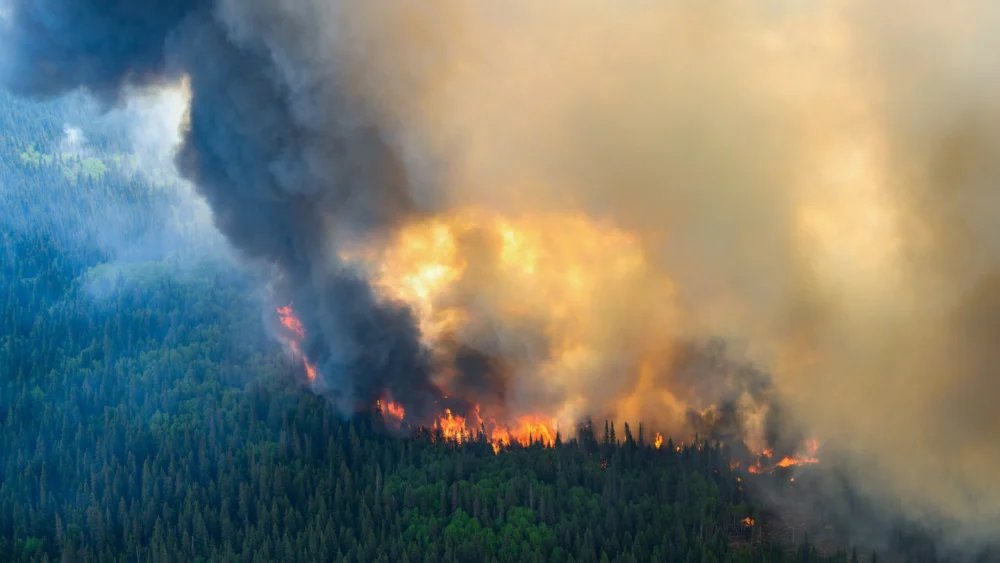
In the summer of 2023, Quebec found itself in the throes of a sweltering heatwave, a precursor to a devastating wildfire season that would etch itself into Canada’s history. On June 1st alone, the province was seared by thousands of lightning strikes, igniting over 120 new blazes. These fires, fueled by parched forests and withered grasslands, raged for weeks, contributing to a national crisis. Canada ultimately battled nearly 7,000 wildfires, which scorched tens of millions of acres, released an estimated 500 million tons of carbon emissions, and forced hundreds of thousands of Canadians to abandon their homes. The statistics are stark: lightning was the spark for almost 60% of these wildfires, and these ignitions were responsible for a staggering 93% of the total area burned.
Amidst this unfolding catastrophe, a Vancouver-based weather modification startup, Skyward Wildfire, has emerged with a bold claim: they possess the technology to prevent future catastrophic fires by stopping the very lightning that ignites them. The company recently secured millions of dollars in funding, which it intends to channel into accelerating product development and expanding its operational reach. Until recently, Skyward Wildfire prominently featured on its website a statement asserting that its technology had demonstrated the capability to prevent "up to 100% of lightning strikes." This assertion, however, was met with skepticism from researchers who have studied the complexities of human intervention in lightning phenomena. Following inquiries from MIT Technology Review, the company revised its claim.
Nicholas Harterre, who manages government partnerships at Skyward, explained in an email that the original statement "reflected an observed result under specific conditions, but it was not intended to suggest uniform outcomes and has been removed." He further acknowledged that "in complex atmospheric systems, consistent 100% outcomes are not realistic, as the experts you spoke to rightly pointed out." The company’s current statement asserts that it has demonstrated it "can prevent the majority of cloud-to-ground lightning strikes in targeted storm cells." Skyward has not publicly disclosed the specific methods it employs, with Harterre only stating that the materials used are "inert and selected in accordance with regulatory standards."
However, available documentation suggests Skyward’s approach is rooted in a method first explored by U.S. government agencies in the early 1960s: seeding clouds with metallic chaff. This chaff consists of narrow fiberglass strands coated with aluminum, a material commonly used by the military as a countermeasure to disrupt radar signals, such as by fighter jets to evade guided missile systems. Decades-old field trials by U.S. agencies indicated that this technique could, to some extent and under specific conditions, reduce lightning strikes. If Skyward can deploy this method reliably and at scale, it could offer a potent tool in combating the escalating risks posed by climate change, which is driving up global temperatures, desiccating forests, and is predicted to increase the frequency of lightning strikes.
Sam Goldman, Skyward’s founder and CEO, articulated the company’s mission in a LinkedIn statement last year: "Preventing lightning on high-risk days saves lives, billions in wildfire costs, and is one of the highest-leverage and most immediate climate solutions available." Despite this optimistic outlook, researchers and environmental observers remain cautious, citing numerous unanswered questions. These include the efficacy of cloud seeding under diverse weather and climate conditions, the quantity of material required, the frequency of application, and the potential for unforeseen secondary environmental impacts of large-scale lightning suppression. Some observers have also expressed concern about Skyward’s apparent advancement of weather modification field trials in Canada without broad public notification or open discussion of the materials being introduced into the atmosphere.
Keith Brooks, programs director at Environmental Defence, a Canadian advocacy organization, concedes that "it’s reasonable" to explore new technologies for mitigating escalating fire dangers. However, he stresses the importance of proceeding "cautiously and really transparently, with a robust scientific methodology that’s open to scrutiny."
Skyward’s website provides limited technical details, but the company states it collaborated with Canadian wildfire agencies in 2024 and 2025 to demonstrate its technology. They have also developed AI tools to predict lightning strikes with the potential to initiate fires. Last month, Skyward announced it had raised CAD $7.9 million (approximately USD $5.7 million) in an extended seed funding round, with investors including Climate Innovation Capital, Active Impact Investments, and Diagram Ventures. "Our first season demonstrated that prevention is possible at scale," Goldman stated, adding that this funding "allows us to expand into new regions and support partners who need reliable, operational tools to reduce wildfire risk before emergencies begin."
While Skyward does not use the term "cloud seeding" in its public communications, a press release from a conservation group’s Fire Grand Challenge highlighted its selection as a finalist, stating that the company suppresses lightning "by cloud seeding with safe, non-toxic materials to neutralize storm charges," as previously reported by The Narwhal. Further details emerged from a grant write-up by Unorthodox Philanthropy, which supported Skyward’s efforts. This document described the Skyward team’s chosen method: "an inert substance consisting of aluminum covered glass fibers, which is regularly used in military operations to intercept and confuse enemy radar and can also discharge clouds."
Additional proprietary information was disclosed in a document released by the World Bank, which included materials from companies developing fire risk mitigation strategies. Skyward’s diagrams illustrate aircraft dispensing particles into clouds to prevent cloud-to-ground lightning strikes in "high risk areas." The company also details its use of artificial intelligence for forecasting lightning storms, prioritizing treatments, targeting storm cells, and optimizing flight paths. Harterre emphasized that the technology would be deployed judiciously, reserved for storm events with elevated wildfire risk, which he noted constitute less than 0.1% of lightning activity in any given area. "Our objective is to reduce the probability of ignition on the limited number of extreme-risk days when fires threaten lives, critical infrastructure, and ecosystems, and when suppression costs and impacts can escalate rapidly," he stated.
The World Bank document indicates that Skyward partnered with Alberta Wildfire in August 2024 to "prove suppression by plane and drone," reporting a "60-100% reduction" in lightning compared to "control cells." Further field trials are planned for the summer of 2025 with wildfire agencies in British Columbia and Alberta, aiming for "landscape level solutions with more advanced aircraft, sensors and forecasting." The BC Wildfire Service acknowledged awareness of Skyward’s developing technology, stating that "preliminary trials were conducted by Skyward to gain a better understand [sic] of the technology and its applicability in B.C." They added that if such a project were to move forward, they would engage to learn and ensure they utilize all available tools. However, the BC agency declined to provide details on materials used, test locations, or public disclosure requirements, and Alberta Wildfire did not respond to similar inquiries.

Understanding the science behind lightning is crucial to evaluating Skyward’s claims. Clouds, composed of water vapor, droplets, and ice crystals, are dynamic environments. Within them, ice particles collide, causing electron transfer and generating ions with positive and negative charges. Updrafts separate these charges, creating an electrical field. When this field becomes sufficiently strong, an electrostatic discharge occurs—lightning.
The 2023 fire season in Canada, while severe, was not exceptional in terms of lightning strike frequency. However, the prevailing heat and dryness meant that nearly every strike had a high probability of igniting a fire, according to Piyush Jain, a research scientist at the Canadian Forest Service and lead author of a study in Nature Communications. Climate change, however, is projected to increase lightning frequency. Warmer air holds more moisture and provides greater convective energy, intensifying atmospheric vertical movement that fuels cloud formation and lightning storms. "So the conditions are there, and the conditions are likely to increase," Jain noted. While lightning forecasts vary by region, a clearer trend is emerging in the rapidly warming Arctic, where lightning-ignited fires have substantially increased in the boreal region and are predicted to continue rising. This trend, combined with longer fire seasons, warmer temperatures, and drier vegetation, exacerbates the risk of more severe fires and increased greenhouse gas emissions, as highlighted by Brendan Rogers, a senior scientist at the Woodwell Climate Research Center. In fact, Canada’s emissions from the 2023 fires far exceeded its fossil fuel emissions for that year.
Scientists have explored lightning prevention for decades, with most research occurring in the latter half of the 20th century. During the post-war era’s period of economic optimism, U.S. research agencies and corporations conducted extensive cloud seeding experiments. These efforts aimed to increase rainfall, reduce hail, dissipate fog, and even redirect hurricanes. At its peak in the early 1950s, an estimated 10% of the U.S. land area was subject to weather modification programs, as noted by Phillip Stepanian and Earle Williams in a 2024 history of lightning suppression.
Harry Gisborne, then chief of fire research at the U.S. Forest Service, inquired about using cloud seeding to induce downpours to extinguish hard-to-reach wildfires. Vincent Schaefer, a pioneer in cloud seeding, suggested an even more ambitious goal: preventing the lightning that sparked fires in the first place. This led to Project Skyfire, a multi-agency research program that conducted experiments through the 1950s and 1960s in various locations, including Arizona, Idaho, and Montana. Researchers concluded that seeding reduced cloud-to-ground lightning by over half, though the sample sizes were small, and statistical significance remained a question. Soviet scientists also conducted field experiments on lightning suppression during the 1950s, with limited documented details.
A near-catastrophe in 1969, when lightning struck the Apollo 12 space shuttle twice shortly after launch, reignited U.S. government interest. NASA and NOAA launched Project Thunderbolt, utilizing metallic chaff, a standard military countermeasure. Researchers had previously proposed that chaff, acting as a conductor, could neutralize charges within a storm by facilitating electron transfer, thereby preventing the development of strong electric fields necessary for lightning. NASA and NOAA conducted experiments with chaff from the early to mid-1970s, yielding "generally promising field results." However, NASA eventually terminated the program due to concerns about potential interference with radio communications, leading to the abandonment of lightning suppression research and a return to reliance on weather forecasters for hazard mitigation.
Phillip Stepanian, a technical staff member at MIT Lincoln Laboratory, believes it is "unambiguously true that this technique can be used to reduce lightning strikes in a storm," but with significant caveats. Key uncertainties remain regarding the required quantities of material, its persistence, and its effectiveness under varying climate and weather conditions. His co-author, Earle Williams, a research scientist at MIT specializing in atmospheric electricity, expresses more skepticism. While acknowledging that chaff "has an impact on the electrification of thunderstorms," he states that its effectiveness in reducing or eliminating lightning activity "remains controversial" and requires further investigation. Williams has pointed to shortcomings in earlier research, including unaccounted-for differences in cloud heights and detection systems that only captured cloud-to-ground strikes, not the more prevalent intracloud lightning.
A more recent study, a pre-print co-authored by Williams and Stepanian, analyzed data from weather radars in Florida. They compared 35 storms during which chaff was detected with 35 instances where it was absent. While storms with chaff present were generally "smaller and shorter-lived," the total number of lightning flashes (including ground, intracloud, and cloud-to-air) was significantly higher in chaff-carrying clouds. The authors concluded, "so far, it is hard to draw any conclusion about lightning suppression using chaff." Williams suggests that large chaff concentrations might be necessary for suppression, a deployment challenge given the material’s rapid dilution in turbulent storm clouds. Skyward’s Harterre countered that storms in Florida differ significantly from those in the Canadian provinces where the company operates, and their work focuses on regions where operational feasibility and wildfire risk are highest.
The prospect of releasing increased amounts of chaff raises concerns about its broader atmospheric and environmental impacts. U.S. military studies suggest chaff is generally non-toxic, disperses widely, and breaks down in the environment. However, a 1998 U.S. Government Accountability Office report noted potential impacts on civilian air traffic control radar and weather forecasts, as well as a "potential but remote chance of collecting in reservoirs and causing chemical changes." Stepanian suggests that if lightning suppression requires higher chaff concentrations than currently used by the military, further environmental impact studies would be necessary.
Brooks of Environmental Defence Canada seeks greater transparency regarding the materials Skyward uses, their sourcing, their environmental residues, and potential impacts on wildlife. He also expresses unease about the "potential for unintended consequences if we start to mess with a complex system, like weather," and the fact that "there are pilots going on without people knowing about them." Harterre stated that Skyward adheres to all applicable regulations and conducts field activities "in coordination with relevant authorities and with appropriate authorization," adding that deployments are limited to defined high-wildfire-risk storm conditions and use lower volumes and concentrations than military applications.
It remains unclear whether Skyward has significantly advanced the science of lightning suppression or resolved the lingering questions from past research. The company has not publicly released data from its field trials, published peer-reviewed papers, or disclosed its testing methodologies. Williams and his colleagues expressed skepticism regarding Skyward’s earlier claim of "up to 100%" lightning prevention, emphasizing the need for transparency and verifiable data. Harterre indicated that Skyward intends to release more technical information as its programs mature.
Skyward’s investors, meanwhile, express high hopes for the company’s potential to mitigate fire dangers. Kevin Kimsa, managing partner of Climate Innovation Capital, stated that "mitigating the exponentially increasing risk of wildfires can only happen if we shift from reactive suppression to proactive prevention." Brendan Rogers, from the Woodwell Climate Research Center, while not having worked with Skyward, stresses the importance of understanding environmental impacts and consulting with affected communities, including Indigenous peoples. However, he remains "optimistic" about the potential role of lightning suppression if it proves effective and safe, as preventing wildfires is considerably more cost-effective than fighting them and avoids risks to firefighters, ecosystems, infrastructure, and communities. "If you’re able to go after fires before they’ve even ignited, you remove a lot of that from the equation," he concluded.