anjir abdul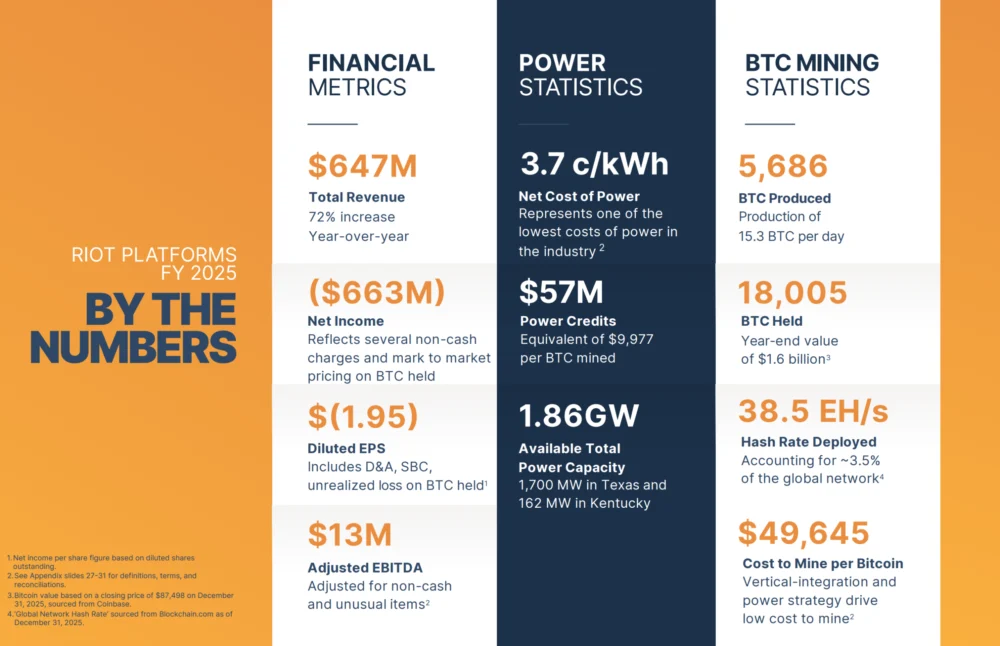
Riot Platforms, a prominent player in the Bitcoin mining sector, announced a groundbreaking year in 2025, achieving record annual revenue of $647.4 million, marking a substantial 72% increase from the $376.7 million reported in the previous year. This impressive financial milestone, detailed in a Monday announcement, underscores the company’s significant growth trajectory amidst a dynamic cryptocurrency landscape and an evolving strategic focus. The report highlights Riot’s expanding operational capabilities and its shrewd management of digital assets, culminating in a robust financial position as it navigates both traditional Bitcoin mining and emerging opportunities in high-performance computing.
The primary catalyst for this revenue surge was a monumental $255.3 million jump in Bitcoin (BTC) mining revenue, which alone reached an impressive $576.3 million in 2025. This increase was attributed to a dual tailwind: a significant rise in Riot’s operational hashrate and higher average Bitcoin prices throughout the year. The company’s relentless pursuit of efficiency and scale saw it produce 5,686 Bitcoin in 2025, a notable increase from the 4,828 BTC mined in 2024. This growth in production is a testament to Riot’s strategic investments in new, more powerful mining equipment and the expansion of its facilities, allowing it to capture a larger share of the global block rewards despite increasing network competition.
However, the path to profitability was not without its challenges. The average cost to mine one Bitcoin, excluding depreciation, climbed to $49,645 from $32,216 in 2024. Riot attributed this substantial increase primarily to a 47% surge in the global network hashrate, which inherently raised mining difficulty. The Bitcoin network’s difficulty adjustment mechanism ensures that blocks are mined at a consistent rate, meaning as more miners join the network, the computational power required to find a new block increases. This intensified competition necessitates greater energy consumption and more advanced hardware, driving up operational costs per Bitcoin. This impact was, thankfully, partially offset by a remarkable 68% increase in power credits received during the year. These credits, often generated through participation in demand response programs where miners temporarily curtail operations during peak grid demand in exchange for financial incentives, exemplify Riot’s strategic energy management and its ability to monetize its flexible power consumption. Beyond mining, Riot’s engineering revenue also demonstrated strong growth, reaching $64.7 million compared with $38.5 million in 2024, indicating diversification and expertise in areas related to infrastructure and specialized services within the digital asset ecosystem.

Despite achieving record revenues, Riot reported a net loss of $663 million for the year. This seemingly contradictory outcome can be primarily attributed to non-cash accounting adjustments and significant changes in the "paper value" of its Bitcoin holdings. Under generally accepted accounting principles (GAAP), companies holding digital assets like Bitcoin often have to record impairment charges if the market price of the asset falls below its carrying value at the time of acquisition, even if the asset is not sold. These revaluation losses, alongside other non-operational expenses, can significantly impact the net income figure. To provide a clearer picture of its core operational performance, Riot highlighted its Adjusted Earnings Before Interest, Taxes, Depreciation, and Amortization (EBITDA), which stood at a positive $13 million for the year. Adjusted EBITDA is a crucial metric for investors, as it strips away non-cash expenses like depreciation and amortization, as well as the impact of interest and taxes, offering a more direct view of the cash flow generated from the company’s primary business activities.
A cornerstone of Riot’s financial strength and long-term strategy is its substantial Bitcoin treasury. The company concluded 2025 with an impressive 18,005 Bitcoin on its balance sheet. This includes 3,977 BTC pledged as collateral, a common practice for companies to secure loans or finance expansion without immediately selling their prized digital assets. Based on a year-end Bitcoin price of $87,498, these holdings were valued at approximately $1.6 billion, making Riot one of the largest corporate holders of Bitcoin globally. Beyond its crypto assets, the company also maintained a healthy cash reserve of $309.8 million, of which $76.3 million was restricted, further bolstering its liquidity and capacity for future investments and operational needs. This "hodl" strategy, where mined Bitcoin is held rather than immediately sold, positions Riot to benefit significantly from future price appreciation, albeit with exposure to market volatility.
Riot’s strategic evolution extends beyond just accumulating Bitcoin. In January 2026, the company made headlines by signing a pivotal data center agreement with leading chipmaker AMD and simultaneously selling a portion of its Bitcoin holdings to acquire 200 acres of land in Rockdale, Texas. This move signifies a decisive pivot towards artificial intelligence (AI) and high-performance computing (HPC) infrastructure. The shift was notably influenced by activist investor Starboard Value, which had previously urged Riot to accelerate its transition, projecting that a successful pivot towards AI and HPC could unlock a valuation of up to $21 billion for the company. The rationale behind this astronomical valuation lies in the surging demand for specialized data center capacity capable of handling the intensive computational requirements of AI models and advanced analytics. By leveraging its existing power infrastructure, land assets, and expertise in managing large-scale data centers, Bitcoin miners like Riot are uniquely positioned to capitalize on this burgeoning market. The partnership with AMD, a titan in the semiconductor industry, further validates Riot’s ambition and provides access to cutting-edge hardware essential for high-performance computing.
This strategic redirection is not an isolated incident but rather indicative of a broader industry trend. Several other major Bitcoin miners are also converting their mining facilities and power capacities into data center operations. Companies such as Hive Blockchain Technologies, Hut 8 Mining, TeraWulf, and Iren are actively repurposing their infrastructure, recognizing the diminishing returns from pure Bitcoin mining in increasingly competitive and capital-intensive environments. Some pioneers, like CoreWeave, have already fully transitioned from crypto mining to specializing in AI infrastructure, demonstrating the viability and profitability of this pivot. This shift allows these companies to diversify their revenue streams, reduce their dependence on volatile crypto prices, and tap into the robust and growing demand for AI computing resources, often commanding higher margins and more stable contract revenues.

However, 2025 proved to be a challenging year for many publicly traded Bitcoin miners as crypto prices generally weakened, impacting profitability across the board. The broader crypto market experienced a slump, characterized by lower trading volumes, decreased investor sentiment, and tighter liquidity, which collectively put pressure on miners’ margins. For instance, Core Scientific reported fourth-quarter revenue of $79.8 million, a 16% year-on-year decrease and falling below analyst forecasts, with mining revenue almost halved to $42.2 million. Similarly, TeraWulf missed its estimates, reporting quarterly revenue of $35.8 million, down from $50.6 million in the previous quarter. Marathon Digital Holdings (MARA), another industry giant, posted even steeper losses, reporting a staggering fourth-quarter net loss of $1.71 billion, a stark contrast to the net income of $528 million a year earlier, as revenue slipped 6% to $202.3 million. These figures underscore the significant financial pressures faced by miners during periods of market downturns, highlighting the volatility inherent in their business model and the critical importance of efficient operations and strategic diversification. The struggles of these peers make Riot’s record revenue and strategic pivot appear even more significant, suggesting a level of resilience and foresight that allowed it to weather the storm more effectively or position itself for future growth.
In conclusion, Riot Platforms’ 2025 performance paints a picture of a company successfully navigating a complex and volatile industry. While reporting record revenues driven by increased Bitcoin mining and a rising market price for the digital asset, the company also grappled with higher mining costs and significant accounting losses due to market fluctuations in its Bitcoin holdings. Its strategic pivot towards AI and high-performance computing, backed by a substantial Bitcoin treasury and a visionary partnership with AMD, positions Riot to capitalize on emerging technological demands. This proactive diversification, amidst a backdrop of struggling competitors and a challenging crypto market, distinguishes Riot as a forward-thinking entity aiming to build a resilient and multifaceted business model that extends beyond the traditional confines of Bitcoin mining into the lucrative realm of advanced computing infrastructure. The coming years will undoubtedly test the efficacy of this bold strategy, but for now, Riot Platforms stands as a compelling example of adaptation and growth in the digital frontier.