Faris Adani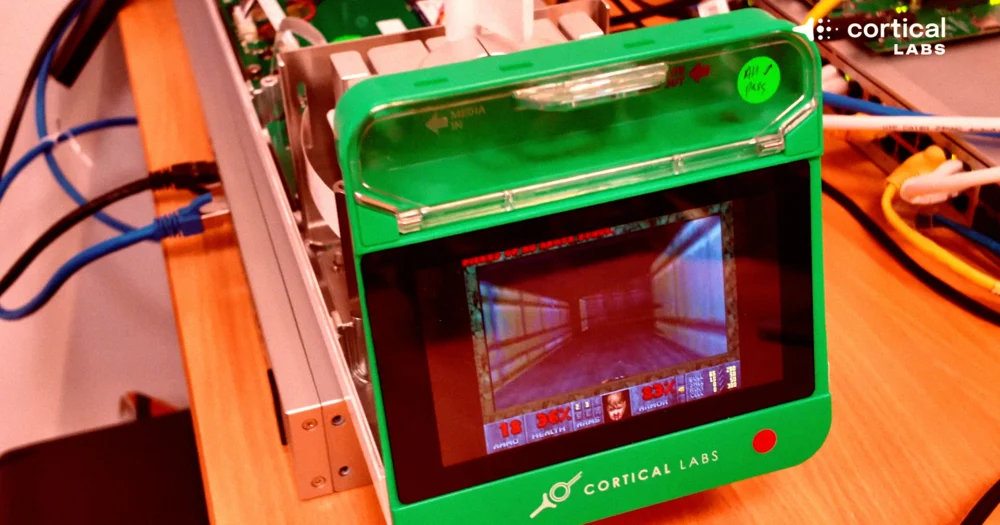
Researchers Get Human Brain Cells Running Doom
In a groundbreaking display of bio-computational prowess, Australian biotech startup Cortical Labs has announced that its ‘mini-brains,’ composed of living human brain cells, have learned to play the iconic 1993 first-person shooter game, Doom. This astonishing feat represents a significant leap from their previous achievement in 2022, when they first made headlines for teaching these neural networks to play the much simpler video game Pong. The company’s recent YouTube announcement showcased the sophisticated progression of their CL1, the “world’s first code deployable biological computer,” highlighting how far the technology has advanced in just under a year since its public debut, and four years since the initial research began.
The journey began in 2022, when Cortical Labs captivated the scientific and tech communities by revealing their “DishBrain” system. This system comprised 800,000 to one million living human brain cells cultured in a petri dish, demonstrating an unprecedented ability to learn and interact with a digital environment. The cells, kept alive and functional, were connected to a computer system that translated the game’s simple visual inputs into electrical signals, which then stimulated the neurons. In turn, the neurons’ electrical responses were translated back into game actions. As Cortical Labs chief scientific officer Brett Kagan told NPR at the time, the “big splash” was not just that they learned, but “how quickly it learns, in five minutes, in real time.” He further emphasized to New Scientist that this rapid, adaptive learning capability was a “truly amazing thing that biology can do,” distinguishing it from conventional AI learning speeds.
The transition from Pong to Doom marks a monumental escalation in complexity. Pong, a two-dimensional game with simple paddles and a ball, requires basic reactive movements. Doom, on the other hand, presents a far more intricate, three-dimensional environment, demanding spatial awareness, navigation, target acquisition, and strategic decision-making. “So we showed that biological neurons could play the game Pong,” Kagan explained in the recent video announcement. “This was a massive milestone because it demonstrated adaptive, real-time, goal-directed learning. But it took us 18 months with our original hardware and software to get this to work. And Pong was much simpler.” He elaborated on the new challenge: “Doom was much more complex. It’s 3D. It has enemies. It needs to explore, it’s an environment, and it’s hard.” This leap signifies a significant advancement in the ability to interface biological neural networks with complex digital systems and to leverage their inherent learning capabilities for more sophisticated tasks.
This remarkable achievement also taps into a long-standing meme within the tech community: the quest to run Doom on increasingly bizarre and unconventional hardware. From its humble origins, the game has been successfully ported to a multitude of devices, showcasing the ingenuity of hackers and engineers. We’ve seen Doom running on a satellite in space, on cells of E. coli bacteria, inside a candy bar, and even inside another copy of Doom. The addition of living human brain cells to this eccentric list not only continues the tradition but elevates it to a new philosophical and scientific level, probing the very nature of computation and intelligence.

Living Human Brain Cells Play DOOM on a CL1
To achieve this, Cortical Labs faced the daunting challenge of bridging the gap between the digital world of Doom and the biological language of neurons. Kagan explained that the key was to “translate the digital world of Doom into the biological language of neurons, which is electricity.” This intricate translation process involved mapping the video feed from the game, which consists of visual pixels and game states, into “patterns of electrical stimulation.” These electrical patterns were then fed into the neural culture within the CL1 device. The neurons reacted to this stimulation by firing, and these reactions were monitored as spikes in the device’s activity. The innovative aspect lies in how these neural responses were then interpreted back into game actions. Cortical Labs CTO David Hogan clarified: “If the neurons fire in a specific pattern, the Doom guy shoots. If they fire in another pattern, he moves right, and so on.” This closed-loop system allows the biological computer to receive sensory input, process it, and generate motor output, all within the game’s environment.
The speed of development was also impressive. Independent developer and collaborator Sean Cole utilized Cortical Labs’ cloud platform and its Application Programming Interface (API) to essentially train the neurons. Hogan noted that this entire process took “less than a week,” showcasing the accessibility and efficiency of the CL1 platform for external researchers and developers. This rapid integration points towards a future where biological computing could be a more accessible tool for experimentation and development.
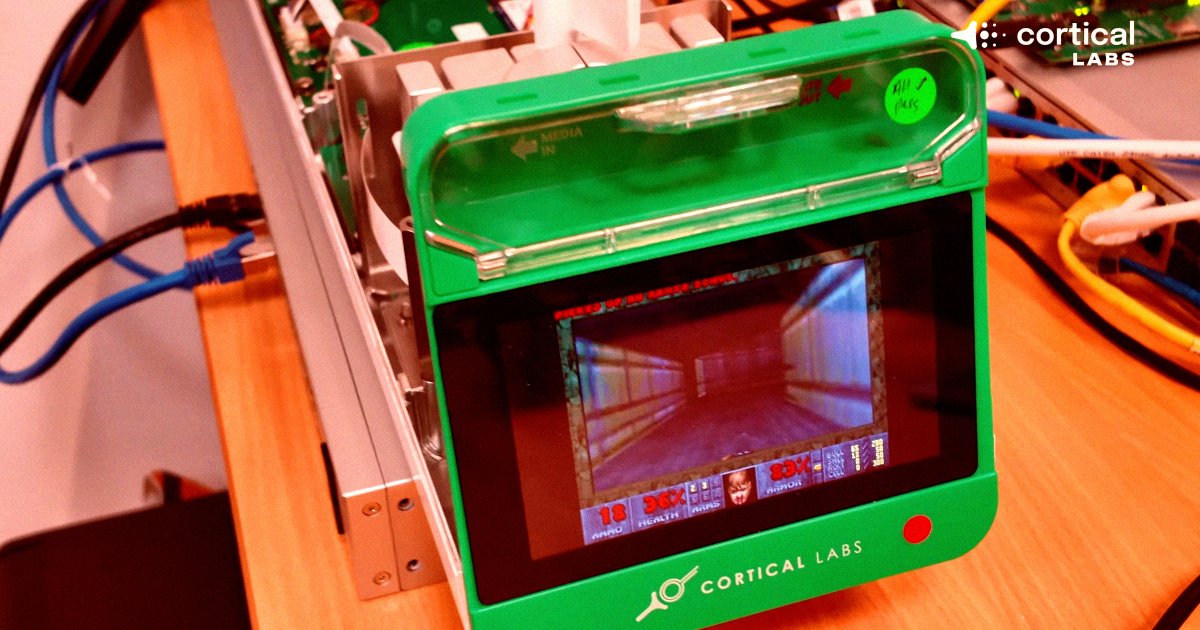
Despite the awe-inspiring nature of the demonstration, Kagan readily admitted that the neurons are not yet master gamers. “Right now, the cells play a lot like a beginner who’s never seen a computer,” he said. “And in all fairness, they haven’t. But they show evidence that they can seek out enemies, they can shoot, they can spin.” This indicates that while the basic mechanisms for interaction and goal-directed learning are present, the complex strategies and fine motor skills required for advanced gameplay are still nascent. The significance, however, lies not in their current skill level, but in the proof of concept: biological neurons can be integrated into complex digital systems and taught to perform tasks.
The true breakthrough extends beyond mere gaming. This technology offers a unique window into understanding how biological brains process information, learn, and adapt. Kagan articulated this profound difference, telling New Scientist, “Yes, it’s alive, and yes, it’s biological, but really what it is being used as is a material that can process information in very special ways that we can’t recreate in silicon.” This highlights the fundamental difference between silicon-based computation, which relies on rigid, pre-programmed logic gates, and biological computation, which leverages the inherent plasticity and parallel processing capabilities of neurons. University of Manchester computer science professor Steve Furber, while acknowledging the achievement, added a crucial caveat: we still don’t fully understand the underlying mechanisms of how these neurons are learning or “knowing” what is expected of them. This underscores that while we can observe the input-output relationship, the intricate internal processes remain a frontier of scientific inquiry.
Nonetheless, the implications of this exciting demonstration are vast and far-reaching. Beyond gaming, the ability to control and interact with biological neural networks opens doors to numerous potential applications. Imagine complex robotic arms controlled not by algorithms, but by living neural tissue, capable of learning and adapting in real-time. This could revolutionize prosthetics, advanced robotics, and even autonomous systems. Furthermore, this platform could serve as an invaluable tool for neurological research, allowing scientists to study learning, memory, and the effects of drugs or diseases on brain function in a controlled, live environment. It could accelerate the development of treatments for neurodegenerative disorders or mental health conditions by providing a dynamic biological model.
Looking ahead, Kagan stated in the company’s video announcement that Cortical Labs is now focused on helping its neurons “really begin to excel at [Doom] and then take on even more complicated tasks.” This ambitious vision suggests a roadmap towards increasingly sophisticated biological computers capable of tackling challenges currently beyond the reach of conventional AI or silicon processors, potentially paving the way for entirely new paradigms of computation.
The public reaction to Cortical Labs’ latest feat has been a mix of awe, wonder, and a touch of unease, particularly within the gaming community. “I know this is a technical achievement far greater than anything I will ever achieve, but I gotta admit… Something about this feels very wrong to me,” one Reddit user wrote. This sentiment reflects deeper ethical and philosophical questions surrounding the creation of sentient or semi-sentient biological entities, even if only a few hundred thousand neurons in a dish. The concept of “mini-brains” learning to play games inevitably raises discussions about consciousness, artificial intelligence, and the boundaries of life itself. Others, however, chose to find humor in the situation. “What’s the big deal, my brain cells play Doom as well,” another user mused, highlighting the relatable, if tongue-in-cheek, connection between human experience and this cutting-edge research.
In essence, Cortical Labs’ success in teaching human brain cells to play Doom is more than just a novelty; it’s a profound step towards understanding and harnessing the unique computational power of biological intelligence. By blurring the lines between biology and technology, they are not only creating new tools for research and development but also sparking essential conversations about the future of computing, the nature of intelligence, and our place in a world increasingly shaped by both silicon and neurons.
More on Cortical Labs: Weird New Computer Runs AI on Captive Human Brain Cells