Faris Adani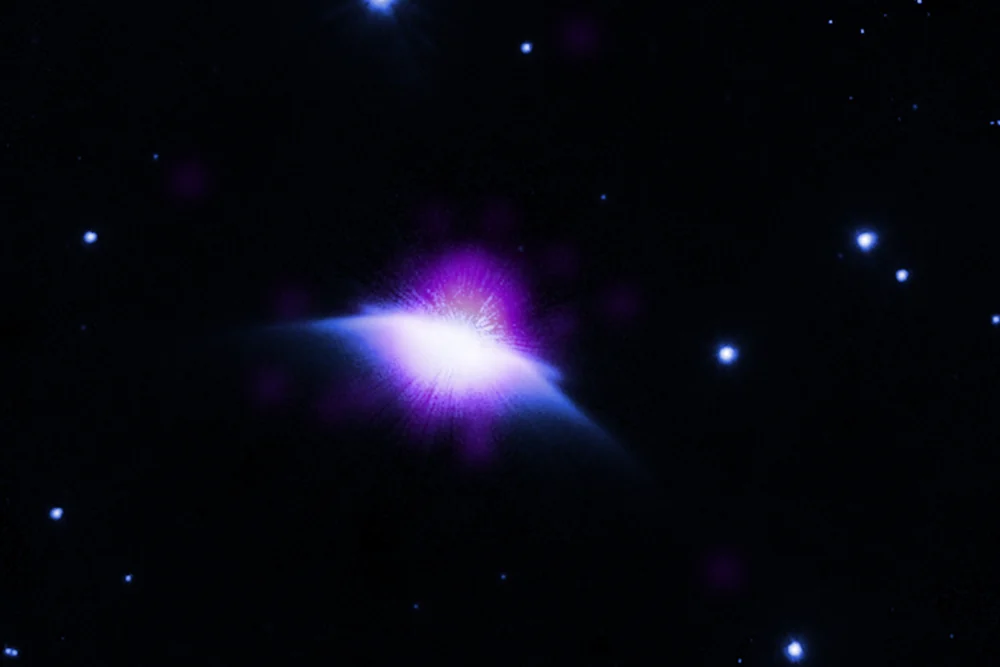
In a groundbreaking astronomical discovery that offers an unprecedented glimpse into the early life of stars, including our own Sun, scientists utilizing NASA’s venerable Chandra X-ray Observatory have detected a colossal astrosphere—a massive bubble of hot gas—being actively inflated by a young, Sun-like star named HD 61005, located a mere 120 light-years away from Earth. This celestial phenomenon, aptly likened to a star blowing a cosmic bubble, provides a unique opportunity to understand the formative processes that shaped our solar system’s protective heliosphere billions of years ago.
The "bubble" in question is not the ephemeral creation of a child’s toy but a dynamic, immense structure forged from the relentless outpouring of superheated gases propelled by the star’s potent stellar winds. This astrosphere, an expansive region of space dominated by the star’s influence, entirely envelops HD 61005, serving as a cosmic time capsule that mirrors the potential early stages of our own solar system’s development. Our Sun’s equivalent protective envelope is known as the heliosphere, a magnetic bubble that shields Earth and the other planets from the harsh realities of interstellar space, including high-energy cosmic rays. The observation of HD 61005’s astrosphere marks the first time such a structure has been directly observed around a G-type yellow dwarf star, a stellar classification to which our Sun also belongs, making this finding particularly resonant for heliophysics and stellar evolution studies.
Designated HD 61005, this star shares remarkable similarities with our Sun in terms of mass and temperature, yet it stands at a dramatically younger age—a mere 100 million years, a nascent youth compared to the Sun’s venerable 4.6 billion years. This age difference is crucial, as young stars are typically far more active and energetic than their older counterparts. The detection of its astrosphere, detailed in a new study poised for publication in The Astrophysical Journal, thus offers an unparalleled window into the vigorous processes that govern the early lives of stars like ours. The lead author, Carey Lisse, an astronomer at Johns Hopkins University in Baltimore, emphasized the significance of this observation in a statement: "We have been studying our Sun’s astrosphere for decades, but we can’t see it from the outside. This new Chandra result about a similar star’s astrosphere teaches us about the shape of the Sun’s, and how it has changed over billions of years as the Sun evolves and moves through the galaxy."
Stellar winds are the lifeblood of these cosmic bubbles. They are streams of charged particles—primarily electrons and protons—ejected from a star’s upper atmosphere, or corona, at incredible speeds. For HD 61005, these stellar winds are exceptionally powerful, traveling approximately three times faster and possessing a density 25 times greater than those emanating from our Sun. This intense outflow plays a critical role in shaping the surrounding environment of a star system, influencing the distribution of dust and gas, and, most importantly, creating a protective shield against the hazardous interstellar medium (ISM) and high-energy cosmic radiation that permeates deep space. Without such a shield, planetary atmospheres could be stripped away, and the conditions for life, as we know it, would be far more challenging to maintain.
The heliosphere, our Sun’s protective bubble, extends far beyond the orbit of Pluto, encompassing all the planets in our solar system. Its boundary, known as the heliopause, is where the Sun’s stellar wind collides with the interstellar medium. Beyond this boundary lies true interstellar space. The study of HD 61005 offers a chance to observe a proto-heliosphere, providing invaluable data for models attempting to reconstruct the Sun’s early evolution and the formation of its own protective bubble. Understanding how these astrospheres form and interact with their surroundings can also shed light on the habitability of exoplanets, as a robust astrosphere could be a prerequisite for shielding potential biospheres on orbiting worlds.
Adding to its distinctiveness, the HD 61005 system has been charmingly nicknamed the "Moth" due to the appearance of its remnant dust disk in infrared observations. This disk, composed of leftover material from the star’s formation, stretches out beyond the astrosphere and appears to have "wings" that are swept back as the star hurtles through space, much like the wings of an insect in flight. This asymmetric dust disk contrasts sharply with the remarkably spherical shape of the astrosphere itself. This spherical integrity, despite the star’s rapid motion and the heavy dust cloud it navigates, strongly suggests that the stellar wind is sufficiently powerful and symmetrical to maintain the astrosphere’s shape against external pressures.
The astrosphere of HD 61005 is truly colossal, boasting a diameter of 200 astronomical units (AU). To put this into perspective, one AU is the average distance between the Earth and the Sun, approximately 150 million kilometers (93 million miles). Thus, this astrosphere extends 200 times the Earth-Sun distance, reaching far beyond the outer limits of our own Kuiper Belt, roughly five times the maximum extent of our Sun’s heliosphere. This immense size, especially given its dense surroundings, underscores the sheer power of HD 61005’s stellar wind. Astronomers postulate that our Sun, too, once traversed regions of dense gas and dust in its youth, making HD 61005 an exceptional "Doppelgänger" for unraveling the mysteries of our star’s early evolution.
The comparative analysis between HD 61005 and our Sun yields profound insights into the variability of stellar environments. Lisse mused, "It is amazing to think that our protective heliosphere would only extend out to the orbit of Saturn if we were in the part of the galaxy where the Moth is located, or, conversely, that the Moth would have an astrosphere 10 times wider than the Sun’s if it were located here." This highlights how the local interstellar environment significantly influences the size and shape of a star’s protective bubble. The density and composition of the interstellar medium through which a star travels dictate the pressure exerted on its astrosphere, thereby affecting its overall extent.
The observations from the Chandra X-ray Observatory were crucial for this discovery because X-rays are emitted by extremely hot gas, precisely the kind of plasma that makes up stellar winds and astrospheres. Complementary data from infrared observations (like those revealing the dust disk) and optical telescopes helped paint a comprehensive picture of this dynamic system. The synthesis of data across different electromagnetic spectrums is a hallmark of modern astrophysics, allowing scientists to probe various components and processes within celestial objects.
This discovery opens new avenues for research into star formation, planetary system evolution, and astrobiology. By observing young stars in different environments, astronomers can refine their models of stellar wind generation and its interaction with the interstellar medium. Such models are vital for predicting the evolution of planetary atmospheres around distant exoplanets and assessing their potential for harboring life. Future missions, including next-generation X-ray observatories and the James Webb Space Telescope, will undoubtedly build upon these findings, providing even more detailed insights into these fascinating cosmic bubbles and their profound implications for understanding our place in the universe. The "Moth" and its colossal bubble serve as a vibrant reminder that the cosmos is a dynamic laboratory, constantly revealing the intricate processes that govern the birth, life, and death of stars and the systems they foster.