Faris Adani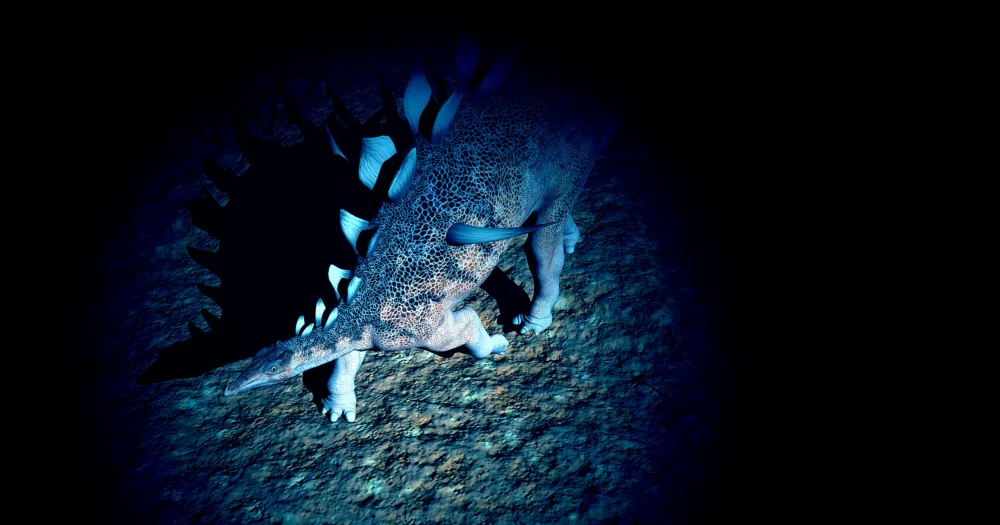
This Is How Big a Telescope Aliens Would Need to See Dinosaurs on Earth
Sign up to see the future, today
Can’t-miss innovations from the bleeding edge of science and tech
The universe is a tapestry woven with threads of time and light, where distant events linger as faint echoes across unimaginable cosmic distances. This profound concept comes into sharp focus when we consider a pivotal moment in Earth’s deep past: the cataclysmic event approximately 66 million years ago. It was then that a colossal asteroid, famously dubbed Chicxulub, slammed into our planet, unleashing an extinction-level event – known as the Cretaceous-Paleogene (K-Pg) extinction – that eradicated a staggering 75 percent of all life, including the vast majority of non-avian dinosaurs.
This cosmic collision not only irrevocably reshaped Earth’s biological landscape but also forms the basis for a truly mind-bending thought experiment concerning potential extraterrestrial observers. Imagine an advanced alien civilization, perhaps millions of light-years more technologically sophisticated than our own, situated precisely 66 million light-years away from Earth. Due to the immutable, finite speed of light, any light rays that left Earth during the very period of the dinosaurs’ reign, before the Chicxulub impact, would only just be reaching these distant aliens now. Theoretically, if they possessed the right observational tools, these extraterrestrials would still be able to witness dinosaurs roaming the primeval surface of our planet, a snapshot of life preserved in the cosmic flow of time.
The Astronomical Challenge: Glimpsing the Ancient Past
While the idea of aliens observing a living Earth from 66 million years ago is captivating and ignites the imagination, the practicalities of such an endeavor are astronomically daunting. As astronomer and renowned science communicator Phil Plait, affectionately known as “The Bad Astronomer” for his keen ability to debunk myths and explain complex science, meticulously explored in a compelling column for Scientific American, the feat of spotting Earth, let alone discerning any specific signs of life – particularly a 33-foot-long Tyrannosaurus rex – would necessitate a telescope of truly colossal, almost incomprehensible, proportions.
“I’ve thought of it myself but never worked out the math — except to think, ‘Probably pretty big,’ which turns out to dramatically underestimate the actual answer,” Plait wrote in his column. “But what’s really lovely is that grappling with this admittedly bizarre thought experiment has some real-life implications for the future of the science.”
Plait’s candid admission underscores the common intuition that such a task would demand a “big” telescope, but his subsequent calculations reveal just how much that intuition falls short of the mind-boggling reality. The thought experiment, while inherently whimsical, serves as a powerful and concrete illustration of the immense limits of our current technology and the staggering scale of the universe we inhabit.
Unpacking the Impossibly Big Telescope
To truly grasp the sheer scale of this observational challenge, Plait delved into the fundamental principles of optics and astronomical resolution. His back-of-the-envelope calculations, based on a hypothetical Tyrannosaurus rex measuring a formidable 33 feet (approximately 10 meters) in length, yielded an “apparent size” of about 10-21 degrees. To put this infinitesimally small angle into perspective, imagine trying to spot a single atom from across the entire observable universe – that’s the kind of minuscule angular resolution we’re talking about. It’s a size so small it defies everyday analogy, pushing the boundaries of human comprehension.
To determine the theoretical resolving power needed to distinguish such an object, Plait employed Dawes’s limit. This empirical formula, derived by the British astronomer William Rutter Dawes in the 19th century, defines the maximum angular resolution that a telescope can achieve for closely spaced objects. Essentially, it dictates the smallest detail a telescope can distinguish, and it is inversely proportional to the diameter of the telescope’s objective lens or primary mirror. The larger the mirror, the finer the detail it can resolve.
Applying Dawes’s limit to the T. rex’s almost unimaginable apparent size, Plait arrived at a conclusion that borders on science fiction: such a telescope would require a primary mirror with an astonishing diameter of 3.4 light-years across.
Let that profound figure truly sink in: 3.4 light-years. To contextualize this breathtaking dimension, Plait elaborated, “That’s a mirror that would span three-quarters the distance to Alpha Centauri!” Alpha Centauri, our closest stellar neighbor system, is approximately 4.37 light-years away from our Sun. This means the required mirror would be so vast it would literally encompass multiple star systems if hypothetically placed within our own cosmic neighborhood. The sheer engineering impossibility of constructing, launching, assembling, and maintaining the precise shape of such a structure across light-years of space is immediately and overwhelmingly apparent.
And the mass of such an object? Even if this monumental mirror were impossibly thin, say just one millimeter thick, its calculated mass would be “more than 100 million times the mass of Earth.” Building a single object with the mass equivalent of 100 million Earths, and then not only manufacturing it but also deploying it into space, assembling its components, and maintaining its incredibly precise curvature across light-years, moves beyond the realm of known physics and engineering into pure, unadulterated fantasy.
The Promise and Pitfalls of Interferometry
Of course, a hypothetical, highly advanced extraterrestrial civilization, potentially millions of light-years more evolved than our own, might not rely on a single, monolithic mirror. They could conceivably employ far more sophisticated techniques, such as interferometry. Astronomical interferometers utilize an array of multiple, smaller telescopes working in perfect concert, combining their collected light signals to effectively mimic the resolving power of a single, much larger telescope. This ingenious technique is already successfully employed by human astronomers to achieve significantly higher resolutions than any individual telescope could provide on its own.
A prime example of this technology in action is the Event Horizon Telescope (EHT). This groundbreaking global network of radio telescopes, strategically spread across continents, effectively creates an Earth-sized virtual telescope. The EHT made history by capturing the first-ever image of a black hole’s shadow – specifically, the supermassive black hole M87* at the center of the Messier 87 galaxy, and later, Sagittarius A* at the heart of our own Milky Way. While an incredible technological marvel, the EHT operates at radio wavelengths and still only achieves resolutions capable of imaging the fuzzy outline of a black hole’s event horizon, not individual objects on a planet tens of millions of light-years away.
Even with an advanced alien interferometer designed to observe Earth at optical wavelengths from 66 million light-years, the scale of the challenge remains staggering. Plait calculated that even with such an array, the total mirror material required would still amount to “a billion trillion metric tons of mirror — a decent fraction of the mass of Earth.” While this mass would be distributed across numerous individual telescopes, the challenge of manufacturing, deploying, and maintaining such a distributed system across vast interstellar distances, with nanometer-level precision for millions of years, remains truly formidable.
Beyond the mirror material itself, there are myriad other profound challenges for our hypothetical alien observers. They would need to devise an incredibly precise method to move and position this gargantuan array over millions of years. They would have to accurately track Earth’s subtle movements – its orbit around the Sun, the Sun’s movement within the Milky Way, and the Milky Way’s own complex cosmic dance through the universe – over the immense timescale of light travel. Furthermore, the light from a T. rex, even if perfectly resolved, would be incredibly faint. As Plait astutely noted, “From 66 million light-years away, a T. rex is pretty faint; at that distance, even the Sun would be too faint to see using something like the Hubble Space Telescope,” let alone a relatively small dinosaur reflecting sunlight.
Earth’s own dynamic atmosphere would also present a significant hurdle for any distant observers, causing distortions and blurring of light. While space-based telescopes mitigate this for us, aliens observing from afar would effectively be looking through Earth’s ever-changing atmospheric lens, further complicating image clarity and requiring advanced atmospheric compensation techniques.
Our Own Glimpses into the Cosmic Past
To truly appreciate the immense gap between this thought experiment and our current technological capabilities, it’s insightful to consider humanity’s most powerful observational tools. NASA’s venerable Hubble Space Telescope, a workhorse of astronomy for over three decades, revolutionized our understanding of the universe, revealing breathtaking cosmic vistas and profound scientific insights. However, its successor, the James Webb Space Telescope (JWST), represents a quantum leap forward in observational power and sensitivity.
The JWST, primarily an infrared observatory, has allowed us to peer into the farthest visible reaches of space, capturing light from just hundreds of millions of years after the Big Bang, approximately 13 billion years ago. This is vastly further back in time and distance than the 66 million light-years required to see dinosaurs. Yet, even with JWST’s incredible power, the objects observed at these extreme distances are primarily entire galaxy clusters, which appear merely as faint, reddish dots in its observations. We are not even close to achieving the resolution needed to make out individual stars within these distant galaxies, let alone continents, atmospheric features, or any definitive signs of life on exoplanets.
The JWST’s incredible sensitivity allows it to detect the faint, stretched-out light (known as redshifted light) from the earliest galaxies. This is analogous to looking at a very old, extremely dim photograph. While we can discern the overall shape and presence of the subjects (entire galaxies), we cannot make out individual faces or intricate details within the cosmic crowd. To resolve a T. rex from 66 million light-years away would be akin to identifying a specific individual in a photograph taken of an entire city from orbit, with the photograph itself being 66 million years old.
Beyond Whimsy: Real-World Implications for Exoplanet Research
Despite the “somewhat whimsical and fun to fiddle with” nature of the dinosaur-spotting thought experiment, as Plait himself admitted, its implications for the future of astronomical science are profoundly real and far-reaching. It starkly highlights the immense technological leap required to directly image and characterize exoplanets, especially in humanity’s ongoing, ambitious search for extraterrestrial life.
Consider a more modest, yet still incredibly challenging, goal: resolving features like clouds on exoplanets located merely ten light-years away. Even for this comparatively short distance, Plait calculated that it would necessitate “a telescope array that stretched a few hundred kilometers across.” While still a monumental undertaking, such an array is conceivably within the realm of future engineering, perhaps involving sophisticated space-based interferometers or constellations of precisely synchronized telescopes orbiting our own Sun.
“We aren’t ready to build that now, but in a few decades, perhaps,” Plait concluded with an optimistic vision for the future. The ability to discern continents, oceans, and atmospheric weather patterns on planets orbiting other star systems would represent a truly revolutionary achievement in astrophysics. It would fundamentally transform our understanding of planetary science, potentially allowing us to identify truly habitable worlds and even detect biosignatures – distinct chemical evidence of life – in their atmospheres. This thought experiment, therefore, serves as both a humbling reminder of our current technological limitations and an inspiring vision for the boundless potential of future astronomical exploration.
The captivating idea of aliens watching dinosaurs from afar is a profound testament to the incredible properties of light and time within the cosmos. While the practicalities of such an observation remain firmly entrenched in the realm of science fiction for now, the journey of calculating those impossibilities provides invaluable insights into the immense challenges and soaring aspirations of modern astronomy. It pushes us, as a species, to dream bigger, to innovate further, and to continue our relentless quest to understand our unique place in a universe teeming with ancient light and untold, mesmerizing secrets.