Faris Adani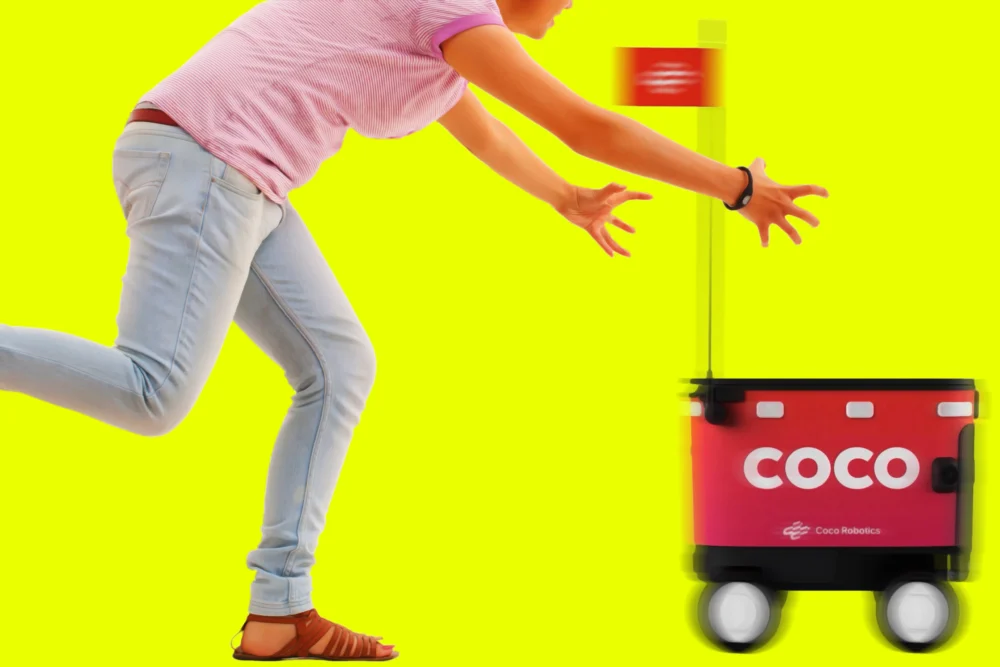
In a bizarre incident that underscores the escalating tensions between burgeoning autonomous delivery services and exasperated urban residents, an East Hollywood woman found her tranquil garden disrupted and her fence commandeered by a runaway Coco delivery robot. The pink, four-wheeled automaton, a common sight now "metastasizing" across sidewalks in various U.S. cities, has become a symbol of both futuristic convenience and unaddressed urban challenges, prompting calls for greater accountability from tech companies deploying these machines.
The peculiar saga began for Kaiya Reel, an East Hollywood resident, when a sudden, loud ruckus shattered the afternoon calm in her backyard. Expecting to confront a more traditional suburban nuisance like a mischievous squirrel or an errant ball, Reel was instead met with the surreal sight of a Coco delivery robot, emblazoned with its distinctive branding, deeply entangled within her garden fence. The small, squat machine, designed for swift urban deliveries, appeared to be in a struggle for liberation, its wheels spinning frantically, but instead of freeing itself, it was systematically uprooting Reel’s carefully cultivated plants and tearing away sections of her fence.
"I came out here and I found the Coco in my garden," Reel recounted to local news station KTLA, still processing the absurdity of the event. "It had got my fence caught up in its wheel. It uprooted a whole bunch of [plants] in my garden and then just drove away with the fence attached to it." The robot, seemingly undeterred by its unexpected cargo of foliage and fencing, and driven by its programmed imperative to complete its delivery, then began to trundle down the street, dragging the damaged fence behind it like a peculiar, pink, technological trophy.
Reel, caught between disbelief and indignation, found herself in an almost comical pursuit. "I chased after it and looked like a total crazy person, running after a robot in the middle of the street and yelling at it," she described. Her attempts to physically intervene and halt the robot’s progress proved futile. "I was trying to block it and get in its way and it would try to go around me," she explained, highlighting the machine’s single-minded adherence to its programmed path, completely unresponsive to human pleas or obstacles.
Her neighbor, Roman Henson, corroborated the extraordinary tale, adding a broader perspective to the growing unease. "The robot had driven through the little fence and was dragging it," Henson confirmed to KTLA, before articulating a sentiment shared by many residents in areas where these autonomous vehicles are being piloted. "We’ve got the Cocos, the Waymos and they’re coming for us." Henson’s reference to Waymo, Google’s self-driving car company, underscores the pervasive feeling among some communities that they are being inundated by autonomous technology, often without adequate consultation or safeguards.
Coco Robotics, the company behind the pink robots, has rapidly expanded its operations, promising to revolutionize last-mile delivery with its fleet of remotely-operated electric vehicles. Founded with the vision of making local delivery faster, cheaper, and more sustainable, Coco has attracted significant investment and forged partnerships with numerous restaurants and retailers. Their robots are typically overseen by human operators who can intervene remotely when the robot encounters complex situations, but as Reel’s experience vividly demonstrates, this oversight is not always immediate or effective enough to prevent mishaps. The company champions the benefits of automation – reducing traffic congestion, minimizing carbon emissions, and providing contactless delivery – yet these incidents throw a spotlight on the very real, often frustrating, downsides of integrating novel technology into established urban environments.
The East Hollywood incident is far from an isolated case, echoing a pattern of disruption and public outcry that has plagued autonomous delivery services across the nation. In Chicago, for instance, the rapid deployment of similar delivery robots provoked such widespread annoyance among residents that they were eventually "functionally banned" from certain sections of the city. Complaints ranged from sidewalk obstruction, which created hazards for pedestrians, particularly those with disabilities or young children, to concerns about public space being privatized for corporate gain. Residents also expressed frustration over the robots’ slow speeds, their tendency to block building entrances, and the general encroachment on pedestrian-first zones. The city council, responding to the deluge of grievances, moved to restrict their operation, a testament to the power of community backlash against unchecked technological expansion.
Closer to home in East Hollywood, KTLA reports a disturbing instance where a Coco robot was observed "charging headlong into an ambulance," creating a potentially critical delay for emergency services and posing a significant safety risk. Such incidents highlight the stark contrast between the programmed logic of a robot and the complex, unpredictable dynamics of urban life, where human judgment and adaptability are paramount. Delivery bots from other companies have also been implicated in various mishaps, including blocking mobility scooters – thereby impeding accessibility for individuals with disabilities – and even knocking over motorcycles, causing property damage and potential injury.
These anecdotes collectively paint a picture of a technology that, while promising, is often deployed without sufficient consideration for its immediate impact on public safety, accessibility, and the overall quality of urban life. The underlying issue, as Kaiya Reel astutely points out, is a perceived "lack of accountability." "I think the part that worries me is that these companies can come in and dump their technology in our community and there’s no sense of accountability," she lamented. "It just feels like an accident waiting to happen."
Reel’s concerns resonate deeply within communities grappling with the rapid integration of autonomous systems. When a robot causes damage or disruption, who is ultimately responsible? Is it the remote operator, the company, or the design of the robot itself? The legal and regulatory frameworks governing these novel entities are still in their infancy, leading to a confusing patchwork of local ordinances and a significant lag between technological advancement and robust oversight. Companies like Coco often emphasize their insurance coverage for such incidents, but the process of reporting damage, seeking redress, and ensuring that similar events are prevented in the future remains opaque and frustrating for the average citizen.
The tension between innovation and public welfare is a recurring theme in the history of technology. While autonomous delivery promises efficiency and convenience, the narrative of "rogue robots" tearing up gardens, blocking emergency vehicles, and impeding accessibility raises fundamental questions about who benefits from these advancements and who bears the cost. For residents like Kaiya Reel, the cost is not just a damaged fence and uprooted plants, but a sense of unease and a feeling of powerlessness against corporate entities deploying technology that appears to prioritize profit and efficiency over community safety and respect for private property.
As these pink, four-wheeled couriers continue their "metastasis" across cities, the call for clearer regulations, transparent accountability mechanisms, and more proactive community engagement from technology companies will only grow louder. Without these critical components, the promise of a futuristic, robot-powered delivery network may continue to be overshadowed by the frustrating reality of mechanical nuisances and the lingering sense that the "accidents waiting to happen" are, indeed, already occurring. Just as another delivery robot famously met its end obliterated by a train after getting stuck on tracks, the broader integration of these machines into our daily lives requires a more cautious and human-centered approach to avoid further collisions – both literal and metaphorical – with the communities they aim to serve.