anjir abdul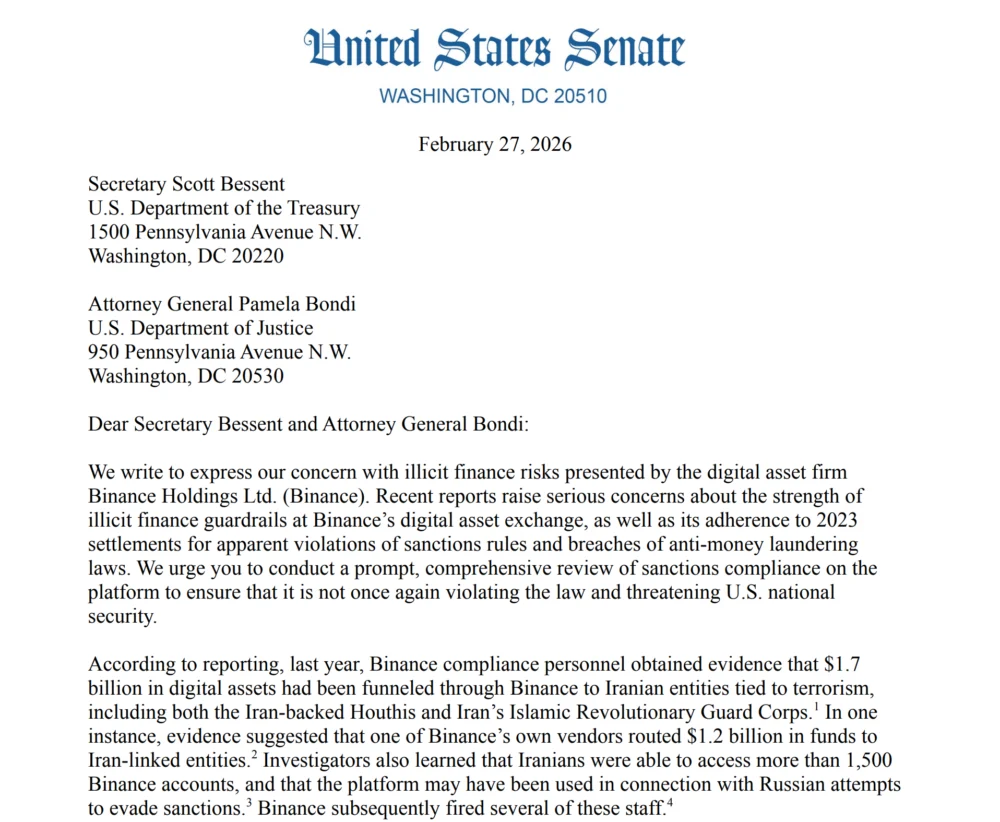
In a comprehensive letter dispatched on Friday to Treasury Secretary Janet Yellen and Attorney General Merrick Garland, the influential lawmakers called for a "prompt, comprehensive review" of Binance’s compliance mechanisms and its fidelity to the landmark settlement agreements it forged with US authorities in late 2023. The urgency of their demand underscores growing congressional concern over the potential for digital asset platforms to be exploited for illicit financial activities, particularly in an increasingly complex geopolitical landscape.
The senators’ letter specifically highlighted grave allegations suggesting that a staggering sum of approximately $1.7 billion in digital assets may have transacted through Binance, ultimately reaching Iranian entities. What makes these allegations particularly alarming is the reported linkage of some of these Iranian entities to designated terrorist organizations, including groups associated with the Houthis and the Islamic Revolutionary Guard Corps (IRGC). The letter further noted that investigators had reportedly identified more than 1,500 accounts allegedly accessed by users within Iran, a nation subject to stringent US sanctions, and also flagged potential activity connected to Russian sanctions evasion, amplifying the severity of the alleged breaches.
Adding another layer of concern, the senators’ correspondence cited reports indicating that certain Binance compliance staff members who had reportedly uncovered suspicious transactions were subsequently dismissed from their positions. Furthermore, law enforcement agencies have reportedly expressed concerns that the exchange has become less cooperative in providing crucial customer information necessary for investigations, raising questions about Binance’s commitment to transparency and its obligations to assist in combating financial crime. These claims, if substantiated, could point to a systemic issue within the exchange’s internal compliance culture, potentially undermining the very safeguards designed to prevent illicit financial flows.
The signatories of the impactful letter included a diverse group of senators: Chris Van Hollen, Ruben Gallego, Angela D. Alsobrooks, Andy Kim, Raphael Warnock, Tina Smith, Catherine Cortez Masto, Mark R. Warner, Elizabeth Warren, Jack Reed, and Lisa Blunt Rochester. Their collective action signals a unified congressional front demanding accountability from major players in the digital asset space, particularly those with a significant global footprint.
Beyond the historical allegations, the senators also voiced profound concerns regarding Binance’s newer product offerings and strategic partnerships. They specifically mentioned the launch of payment cards in various parts of the former Soviet Union and collaborations tied to stablecoin initiatives. The lawmakers cautioned that these innovations, while potentially expanding access to digital assets, could inadvertently or deliberately facilitate sophisticated methods of sanctions evasion, creating new avenues for illicit actors to circumvent international financial controls. The rapid evolution of crypto products, without commensurate robust compliance frameworks, presents a persistent challenge for regulators striving to maintain financial integrity.
To ensure timely action and oversight, the senators explicitly requested that the Treasury Department and the Department of Justice provide a comprehensive report by March 13, detailing any steps taken or planned to thoroughly examine Binance’s conduct and its adherence to regulatory requirements. This deadline underscores the senators’ intent to keep the pressure on federal agencies to actively investigate and address the raised concerns.
This latest congressional scrutiny is not an isolated incident. Just days prior, on Tuesday, Senator Richard Blumenthal, who holds the significant position of ranking member on the Senate Permanent Subcommittee on Investigations, independently launched his own congressional inquiry into Binance. Senator Blumenthal dispatched a separate letter directly to Binance CEO Richard Teng, demanding the production of an extensive array of documents and internal records pertinent to the exchange’s sanctions controls and compliance protocols. The parallel nature of these inquiries from different congressional bodies highlights the multifaceted and intense governmental interest in Binance’s operations.
The backdrop to these escalating probes is Binance’s extensive legal entanglement with US authorities throughout 2023. In November of that year, Binance pleaded guilty to charges including money laundering violations, operating an unlicensed money transmitting business, and sanctions violations, in a monumental settlement with the Department of Justice (DOJ), the Financial Crimes Enforcement Network (FinCEN), and the Office of Foreign Assets Control (OFAC). As part of this historic agreement, Binance agreed to pay over $4.3 billion in penalties, one of the largest corporate resolutions in US history. Its founder and then-CEO, Changpeng "CZ" Zhao, also pleaded guilty to violating the Bank Secrecy Act and stepped down from his leadership role, facing a potential prison sentence. A crucial component of this settlement was the requirement for Binance to appoint an independent monitor to oversee its compliance for three to five years, ensuring that the exchange implements and maintains robust AML and sanctions programs. The current senatorial probes are, in essence, an oversight mechanism to ascertain if Binance is truly upholding the commitments made under these stringent settlement agreements.
In response to the mounting allegations and media reports, Binance has consistently denied claims of facilitating illicit transactions. In a statement issued to Cointelegraph this week, a company spokesperson reiterated that Binance identifies and reports suspicious activity to authorities and rigorously enforces policies that do not permit Iranian users to access its platform. The spokesperson contended that recent media coverage has inaccurately portrayed the exchange’s operational realities and its commitment to compliance.
Further reinforcing its defensive stance, Binance last week publicly disputed a separate report, initially published by Fortune, which claimed that the exchange had processed over $1 billion in Iran-linked transfers. The company also vehemently denied allegations within that report suggesting that it had dismissed investigators who had flagged these issues. Richard Teng, Binance’s current CEO, has been particularly vocal in challenging media narratives. He specifically criticized a Wall Street Journal report alleging $1.7 billion in Iran-related activity, labeling it as defamatory and indicating that the exchange was seeking a retraction. Teng has consistently maintained that Binance has evolved into a compliance-focused organization, investing heavily in sophisticated AML technologies and expanding its compliance team to meet global regulatory standards.
The intensifying scrutiny from US lawmakers and federal agencies underscores a broader trend of increased regulatory pressure on the cryptocurrency industry. As digital assets become more integrated into the global financial system, governments worldwide are demanding greater transparency and accountability from exchanges to prevent their platforms from being exploited by malicious actors for money laundering, terrorism financing, and sanctions evasion. The outcome of these investigations into Binance will not only have profound implications for the world’s largest cryptocurrency exchange but will also send a clear message to the entire digital asset ecosystem about the imperative of robust compliance and adherence to international financial regulations. The demand for a report by March 13 signifies a critical juncture for Binance as it navigates these serious allegations under the watchful eye of the US government.