Faris Adani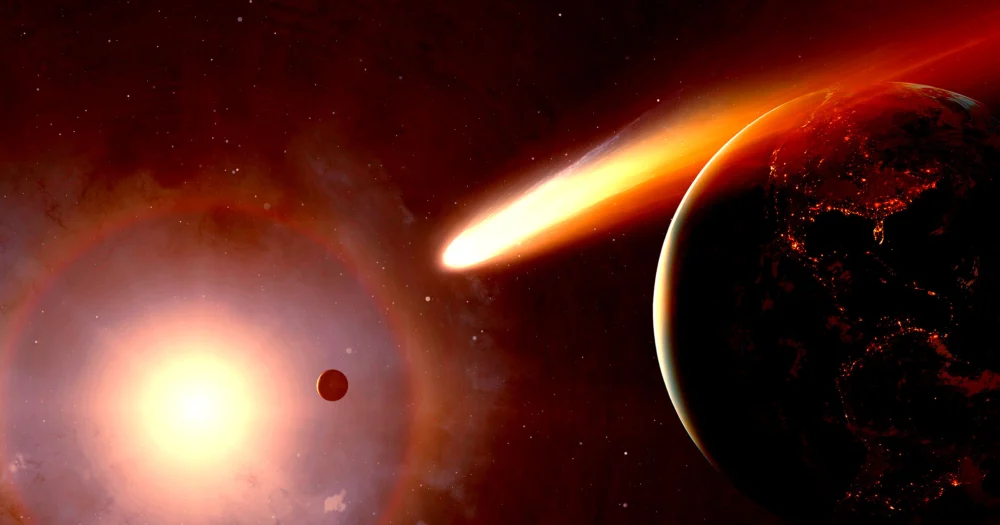
Daring Space Mission Would Catch Up With 3I/ATLAS and Intercept It. The scientific community is abuzz with an audacious proposal to dispatch a probe to catch up with 3I/ATLAS, an interstellar object that has provided an exceptionally rare glimpse into the composition of planetary systems beyond our own. Discovered in July of last year, 3I/ATLAS captivated astronomers as it made its closest approach to our Sun in late October, offering a fleeting but invaluable opportunity for study before it began its swift exit from our solar system. This celestial wanderer, whose designation signifies it as the third identified interstellar object, has been observed releasing copious amounts of carbon dioxide and water vapor, materials potentially dating back billions of years and offering a pristine window into its distant origins.
The journey of 3I/ATLAS through our solar system has been a beacon for astronomers eager to understand the diversity of cosmic building blocks. Unlike objects formed within our Sun’s gravitational influence, interstellar visitors like 3I/ATLAS carry secrets from other stellar nurseries, untouched by the Sun’s radiation and gravitational sorting. Its observed outgassing, particularly of water vapor and carbon dioxide, is highly significant. These volatile compounds are crucial ingredients in planet formation, and their presence and ratios in 3I/ATLAS can provide direct comparative data against comets and asteroids native to our solar system. This comparison allows scientists to infer conditions in the protoplanetary disk where 3I/ATLAS originated, potentially revealing differences in elemental abundances, temperature gradients, or even the prevalence of specific ice types in other star systems.
Despite 3I/ATLAS now speeding away, becoming increasingly distant and faint, a bold plan is being considered to launch an interceptor mission. As reported by *Space.com*, scientists believe it is technically still possible, though fraught with challenges, to send a probe for a closer look. The scale of this undertaking is immense: the mission would need to launch by 2035 to have any hope of catching 3I/ATLAS by 2085. By that point, the object will be over 700 times the distance between the Sun and Earth, a staggering distance that dwarfs the approximately 48 years and four times the distance covered by NASA’s venerable Voyager 1 spacecraft.
To achieve the phenomenal velocities required for such a pursuit, the proposed probe would employ a series of extreme maneuvers, leveraging what is known as the Oberth effect. This phenomenon dictates that a rocket engine generates more useful energy when firing at high speeds and deep within a gravitational field. Therefore, the mission concept involves performing multiple close flybys of the Sun. During these passes, the spacecraft would execute major burns at its perihelion – its closest point to the Sun – to borrow immense energy from the star’s powerful gravitational field, effectively using the Sun as a slingshot. Marshall Eubanks, a former NASA staffer and chief scientist at Space Initiatives, highlighted that while using the Oberth effect is common for spacecraft, this mission would push the boundaries. As detailed in a new, yet-to-be-published paper (arXiv:2601.02533), Eubanks and his colleagues propose performing a major burn during the closest solar approach to achieve an unprecedented change in velocity, or delta-V, of over five miles per second (approximately 8 kilometers per second). This level of acceleration would set new records for any spacecraft.
Such a daring maneuver, however, comes with formidable engineering challenges. The probe would need to withstand searing temperatures and intense radiation as it brushes by the Sun. This necessitates advanced heat shielding and robust radiation-hardened electronics, technologies that are continually being refined but would be pushed to their absolute limits. Following its perilous solar flyby, the spacecraft would then need to perform several gravity-assist maneuvers around Venus, further accelerating it, much like NASA’s Parker Solar Probe has done to study the Sun.
For the launch platform, the researchers propose using a “refueled Starship Block 3” in low-Earth orbit. SpaceX’s enormous Starship platform, with its unprecedented payload capacity and in-orbit refueling capabilities, is envisioned as the only contemporary system capable of delivering the necessary mass and initial velocity to embark on such an ambitious interstellar chase. The ability to refuel in orbit is critical, allowing the spacecraft to carry a much larger fuel load for its primary propulsion systems, essential for achieving the high delta-V required.
Despite the technical feasibility, the scientific value of such a decades-long pursuit remains a subject of debate. A primary concern is that even after 50 years of travel, the interceptor would only be able to perform a rapid flyby due to the vast velocity difference between the probe and 3I/ATLAS. This brief encounter would limit the types of data that could be collected, primarily focusing on rapid imaging, spectroscopy, and perhaps some in-situ dust and plasma analysis. The question arises: is the immense effort, cost, and time justified for what might be a fleeting observation?
Fortunately, the future holds promise for more efficient interstellar object interception. As powerful next-generation space telescopes, such as the Vera C. Rubin Observatory, come online, astronomers anticipate a significant increase in the detection rate of interstellar objects. The Rubin Observatory, with its unparalleled wide-field view and deep imaging capabilities, will be particularly adept at identifying faint, fast-moving objects, providing earlier and more precise trajectories for future interstellar visitors. Marshall Eubanks acknowledges this evolving landscape, suggesting that “Maybe after, say, ten interstellar objects have been found, 3I will seem commonplace and it won’t seem worthwhile to mount an expedition to chase it.”
This sentiment underscores a shift in strategy. Instead of launching dedicated, decades-long missions for each individual object, Eubanks and his colleagues argue for “better mission architectures, using a probe already in orbit in space.” This approach would allow for much quicker intercepts, potentially catching interstellar objects closer to their perihelion, where they are brighter, more active, and still relatively close to the Sun. Adam Hibberd, creator of the Optimum Interplanetary Trajectory Software and a coauthor of the latest paper, elaborates: “There are better mission architectures, using a probe already in orbit in space, which would intercept an interstellar object around perihelion in much less time, rendering an Oberth unnecessary.”
Conveniently, the European Space Agency (ESA) is already pioneering this very concept with its innovative Comet Interceptor mission. Slated for launch as early as late 2028, Comet Interceptor is designed to “park” itself at the Sun-Earth L2 Lagrange point, a gravitationally stable location, while it awaits the discovery of a suitable target – ideally, a dynamically new comet making its first pass through the inner solar system, or even better, an interstellar object. Once a suitable target is identified, the parked spacecraft can be dispatched on a relatively short journey to intercept it, maximizing the scientific return by observing a pristine body before it is significantly altered by solar heating. This mission represents a proactive and agile approach to studying these enigmatic cosmic wanderers.
Ultimately, the drive to explore interstellar objects directly remains strong. As Eubanks aptly puts it, “I feel quite confident that when we develop the ability to reach these interstellar objects, there will be a strong desire to directly explore at least some of them.” The scientific payoff is immense: direct sampling of material from another star system could revolutionize our understanding of planet formation, the chemical composition of other nebulae, and potentially even offer clues about the prevalence of complex organic molecules – the building blocks of life – across the galaxy. While the pursuit of 3I/ATLAS represents a monumental challenge, it also highlights the boundless ambition of human space exploration and our relentless quest to understand our place in a vast, diverse cosmos. The journey to unlock the secrets of interstellar visitors is just beginning, and with each new discovery and proposed mission, we draw closer to touching the stars themselves.