anjir abdul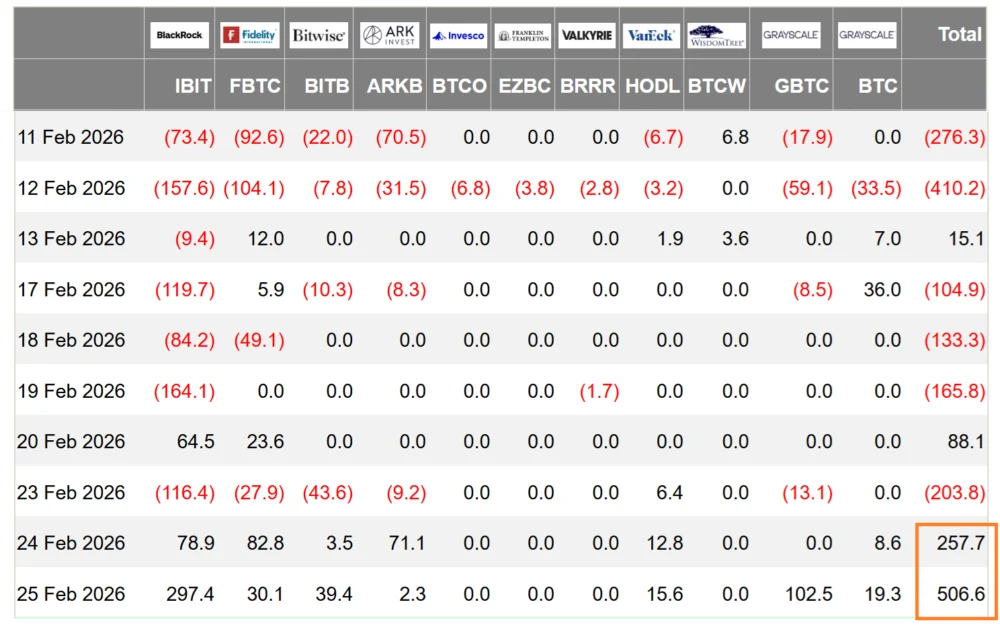
The resilience demonstrated by Bitcoin’s price, particularly its swift rebound from the $62,500 mark, underscores a robust demand at lower price points. This recovery was significantly bolstered by a surge in capital flowing into US-listed Bitcoin ETFs, which collectively registered an impressive $764 million in net inflows over a mere two-day period. This substantial influx served as a vital counterbalance, partially mitigating the considerable $1.2 billion in outflows that had plagued these investment vehicles during the preceding eight trading days. Such large-scale movements of capital are typically indicative of significant institutional participation, signaling that major players in the financial world are actively accumulating Bitcoin, particularly when its price dips below the $65,000 threshold. This behavior suggests a strategic long-term view among these institutional entities, who appear to view price corrections as opportune moments for accumulation rather than signals for capitulation. The relatively recent introduction of spot Bitcoin ETFs in the US has opened new avenues for traditional finance to access the cryptocurrency market, leading to more transparent and trackable institutional demand, which, as evidenced by these inflows, can exert a powerful stabilizing influence during periods of volatility.

However, a stark divergence emerges when examining the activity within the derivatives markets, where the appetite for leveraged bullish positions in Bitcoin futures has plummeted dramatically. The annualized premium for Bitcoin futures contracts, when measured against the prevailing spot market prices, registered a modest 2% on Thursday. This figure stands notably below the crucial 5% neutral threshold, a level traditionally indicative of a balanced market where traders are neither excessively bullish nor bearish, and are willing to pay a reasonable premium for future exposure. The persistent low premium suggests a distinct lack of conviction among futures traders regarding Bitcoin’s near-term upside potential. Indeed, robust bullish momentum, typically characterized by higher futures premiums, has been conspicuously absent since January 31, a date that marked a significant turning point when Bitcoin notably surrendered the $85,000 support level, a price point it had maintained for over nine months within the article’s implied timeline. This loss of a long-held psychological and technical support level appears to have instilled a lasting sense of caution, preventing the re-establishment of a strong contango structure in the futures market, which would otherwise signal widespread expectation of future price appreciation.
Further corroborating this cautious outlook is the data emanating from the Bitcoin options market, which unequivocally indicates that professional traders are prioritizing the avoidance of downside exposure over speculating on upward price movements. On Thursday, Bitcoin put options, which grant the holder the right to sell the asset at a predetermined price, were trading at a substantial 14% premium compared to equivalent call options, which provide the right to buy. In a truly neutral market environment, this indicator, known as the delta skew, typically oscillates within a tighter range of -6% to +6%, reflecting a balanced distribution of bullish and bearish bets. The elevated put premium clearly signals that fear remains a dominant force, as traders are willing to pay significantly more to protect against potential price declines. Although this skew metric has shown some improvement from the more extreme 28% "panic" levels recorded earlier in the week on Tuesday, the subsequent recovery to $70,000 has done little to fundamentally alter the ingrained cautious outlook prevalent among derivatives traders. This suggests that while spot market buying might be reacting to immediate price action, sophisticated options traders are looking beyond short-term bounces, hedging against broader uncertainties.

The market’s struggle to sustain upward momentum and the persistent derivatives caution have led to a proliferation of unproven theories attempting to explain Bitcoin’s significant 32% decline over a seven-week period, a downturn that commenced following the pivotal October 10, 2025, market crash. This event was particularly disruptive, liquidating an estimated $19 billion in leveraged positions across the entire cryptocurrency sector, highlighting the extreme fragility introduced by excessive leverage. The timing of this severe market volatility coincidentally aligned with a major geopolitical announcement: US President Donald Trump’s declaration of a staggering 100% increase in import tariffs on Chinese goods. Such a drastic escalation in trade tensions could have sent shockwaves through global financial markets, prompting a flight from risk assets like cryptocurrencies and contributing to the initial downturn.
In the aftermath of the October 2025 crash, Binance, one of the world’s largest cryptocurrency exchanges, reportedly extended $283 million in compensation to users who were adversely affected by liquidations. These liquidations were attributed to a confluence of internal technical issues, including oracle pricing errors, system latency, and degradation in asset transfer mechanisms, all of which can severely impact trading conditions and lead to unfair liquidations. However, Binance co-founder and former CEO Changpeng "CZ" Zhao has since vehemently refuted allegations that the exchange intentionally triggered the October 2025 crash, emphasizing that such events are often complex and multifactorial, rather than the result of deliberate manipulation.

Beyond market mechanics and geopolitical events, other market participants have attributed the recent bearish sentiment to a resurgence of concerns surrounding the existential threat of quantum computing to cryptographic security. These fears intensified significantly after Jefferies strategist Christopher Wood, a notable voice in financial analysis, made the consequential decision in January to remove Bitcoin from his widely followed "Greed & Fear" model portfolio. Wood explicitly cited "potential risks to long-term security" stemming from quantum advancements as his primary rationale. The theoretical ability of quantum computers to break current cryptographic algorithms, including those underpinning Bitcoin’s security, has long been a subject of academic discussion. In response to these escalating fears and to proactively address potential future vulnerabilities, developers within the Bitcoin community drafted a comprehensive proposal, BIP-360, specifically focused on advancing the integration of post-quantum cryptography on-chain. This initiative demonstrates the community’s commitment to ensuring Bitcoin’s long-term viability and security against evolving technological threats.
The most recent explanation circulating for Bitcoin’s lackluster performance involves the quantitative trading firm Jane Street. These claims gained considerable momentum after a lawsuit was filed by Terraform Labs’ court-appointed administrator, alleging insider trading related to transactions that purportedly accelerated the catastrophic collapse of the Terra Luna ecosystem in May 2022. The Terra Luna collapse was one of the most significant and devastating events in cryptocurrency history, wiping out billions in market value and trust. Jane Street’s recent 13-F filing, a mandatory disclosure for institutional investment managers, revealed significant holdings in BlackRock’s iShares Bitcoin Trust ETF (IBIT) and various Bitcoin mining companies. These disclosures, combined with the context of the Terraform Labs lawsuit and the ongoing price weakness, fueled speculation about the firm’s potential influence. However, Julio Moreno, head of research at CryptoQuant, offered a crucial counter-perspective, noting that such activity, including holdings in both spot ETFs and mining stocks, is entirely typical for sophisticated delta-neutral strategies. Delta-neutral strategies aim to profit from market inefficiencies or premiums while minimizing exposure to the underlying asset’s price direction, often involving complex hedging across various instruments, including options, futures, and related equities. This explanation suggests that Jane Street’s activities might be less about directional market manipulation and more about executing intricate, risk-managed trading strategies.

Ultimately, the broader financial market environment also plays a critical role in shaping investor sentiment towards risk assets like Bitcoin. The recent 5% decline in Nvidia (NVDA US) shares on Thursday, despite the company reporting robust earnings, serves as a poignant indicator of a growing risk-averse sentiment among investors across traditional markets. Nvidia, a bellwether for technological innovation and market growth, often reflects the overall health and confidence in the tech sector. Its dip, even in the face of positive news, suggests that investors might be paring back risk exposure, perhaps due to broader macroeconomic uncertainties, tightening monetary policies, or a general re-evaluation of high-growth assets. This cautious approach in traditional equities inevitably spills over into the cryptocurrency market, making it challenging for Bitcoin to reclaim and firmly hold the $75,000 level, as investors remain hesitant to allocate significant capital to speculative assets in an increasingly risk-off environment. The confluence of specific crypto-market dynamics, geopolitical shifts, technological fears, and broader macroeconomic headwinds creates a complex landscape where even strong institutional inflows are battling against entrenched caution and a myriad of speculative theories regarding market weakness.