isnaini azizah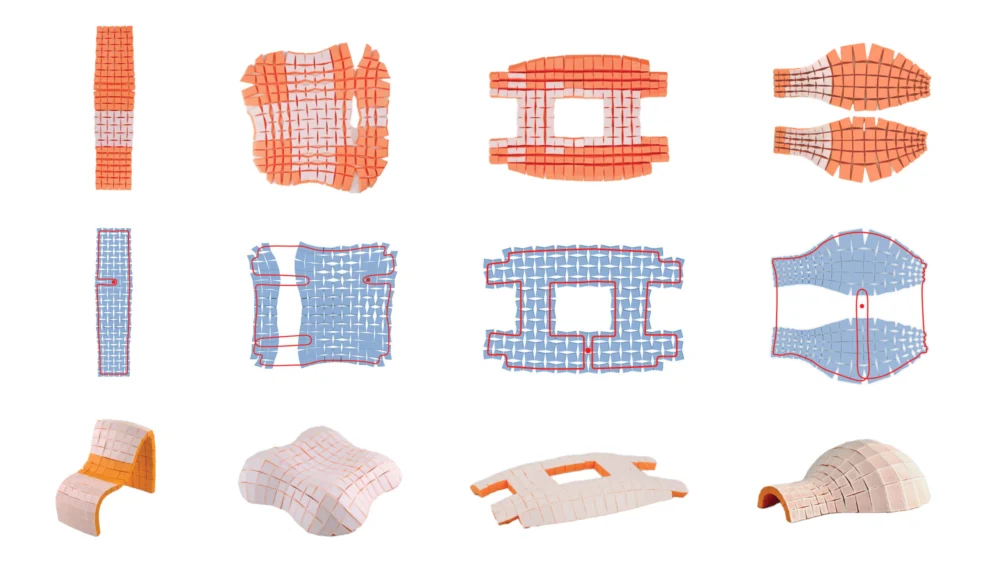
At the heart of this transformative technology lies a sophisticated algorithm, meticulously crafted by a team at the Computer Science and Artificial Intelligence Laboratory (CSAIL) at MIT, led by Mina Konaković Luković, head of the Algorithmic Design Group. Their inspiration draws from the ancient Japanese art of kirigami, which involves both cutting and folding paper to create dynamic forms. By adapting kirigami’s principles to a digital realm, the researchers have devised a way to translate any user-specified 3D structure into a flattened, tessellated pattern. This pattern consists of individual tiles connected by precisely engineered rotating hinges at their corners, acting as the skeletal framework for the subsequent transformation.
The true ingenuity of the MIT team’s approach lies in the algorithm’s ability to determine the optimal path for a string that, when tightened, will seamlessly actuate the structure into its intended three-dimensional form. This complex optimization process unfolds in two critical steps. Firstly, the algorithm calculates the absolute minimum number of points within the tile pattern that the string must engage – or "lift" – to coax the structure into its desired shape. This minimizes the effort required for actuation. Secondly, it identifies the shortest possible path that connects these essential lift points, while crucially ensuring that all necessary boundary segments of the structure are incorporated. This comprehensive path guides the transformation, preventing any misconfiguration and guaranteeing a smooth, predictable deployment. The calculations are further refined to minimize friction along the string’s path, ensuring that a single, gentle pull is sufficient to achieve the full 3D configuration.
The reversibility of this actuation method is another significant advantage. Once deployed, the structure can be just as easily returned to its flat, storable state by releasing the tension on the string. This ease of deployment and retraction opens up a vast array of practical applications. The flat patterns themselves can be manufactured using a variety of readily available techniques, including advanced 3D printing, precise CNC milling, and efficient molding processes, making the technology scalable and accessible.
The implications of this research are far-reaching, promising substantial improvements in the efficiency and cost-effectiveness of storing and transporting complex 3D objects. Imagine medical devices that can be flattened for compact storage and then instantly deployed when needed, or foldable robots capable of navigating confined spaces by flattening themselves to enter narrow apertures. The potential for emergency response is particularly profound; the ability to rapidly deploy large, robust structures like shelters and field hospitals from compact, flat-packed units could be a game-changer in disaster zones, saving precious time and resources.
Akib Zaman, a graduate student in electrical engineering and computer science and the lead author of the research paper published on this work, highlights the core benefit: "The simplicity of the whole actuation mechanism is a real benefit of our approach." He elaborates, "The user just needs to provide their intended design, and then our method optimizes it in such a way that it holds the shape after just one pull on the string, so the structure can be deployed very easily. I hope people will be able to use this method to create a wide variety of different, deployable structures." This user-centric design philosophy ensures that the technology is not only powerful but also intuitive and broadly applicable.
To demonstrate the versatility of their method, the researchers have already designed and fabricated a range of objects. These include personalized medical items such as a supportive splint and a posture corrector, showcasing the potential for bespoke healthcare solutions. They also created an igloo-like portable structure, illustrating the viability of rapid shelter deployment. Furthermore, they successfully designed and built a human-scale chair, proving the method’s capability to produce larger, functional objects. The scalability of this technique is truly remarkable, with the potential to create items ranging from microscopic devices actuated within the human body for minimally invasive surgery to vast architectural structures, such as the framework of a building, which could be fabricated in a flat state and then deployed on-site with the assistance of cranes.
Looking ahead, the research team is keen to push the boundaries of their invention even further. They aim to explore the design of structures at both extremes of the scale spectrum – from incredibly small, intricate mechanisms to monumental architectural components. A particularly exciting future direction is the development of self-deploying mechanisms. This would eliminate the need for external actuation by a human or robot, enabling structures to unfold autonomously upon sensing specific environmental cues or pre-programmed triggers. This could lead to even more advanced applications, such as self-assembling habitats on other planets or responsive infrastructure that adapts to changing conditions. The ability to transform simple, flat materials into complex, functional 3D forms with minimal effort represents a significant leap forward in design, manufacturing, and deployment, promising a future where complex structures are more accessible, adaptable, and efficient than ever before. The underlying algorithm, by intelligently orchestrating the intricate interplay of hinges and string tension, unlocks a new paradigm of dynamic physical object creation, moving beyond static designs to embrace a world of deployable and transformable structures. This breakthrough has the potential to democratize the creation of complex geometries, making them readily achievable for a wide range of users and applications. The fusion of ancient craft inspiration with cutting-edge computational design underscores the interdisciplinary nature of innovation, proving that even the simplest of actions, like pulling a string, can be the catalyst for extraordinary transformations.