isnaini azizah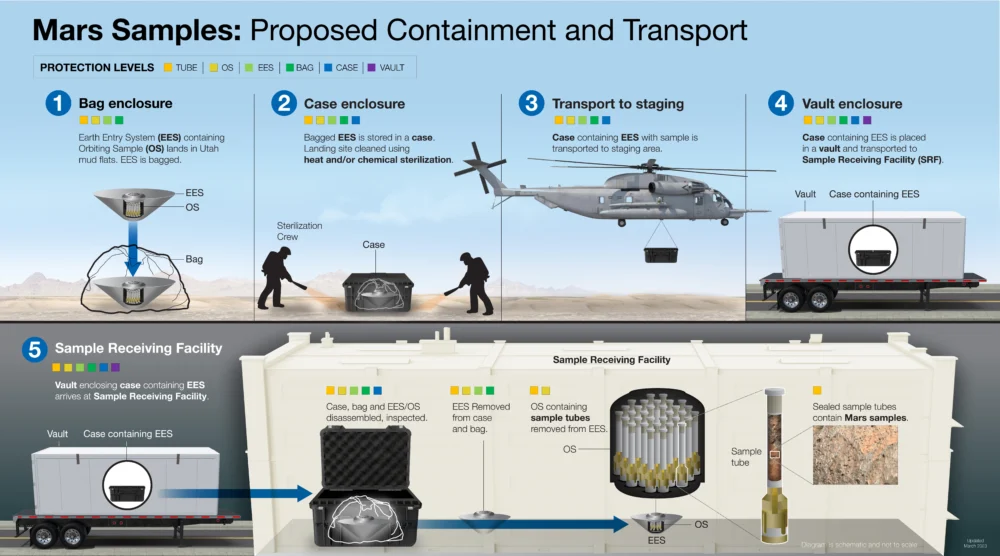
In a stunning turn of events that could redefine humanity’s place in the cosmos, the United States, long considered the frontrunner in the quest for extraterrestrial life on Mars, appears to have ceded its lead to China. What began as a meticulous, decades-long scientific endeavor by NASA has unraveled due to a confluence of budgetary woes, strategic missteps, and bureaucratic inertia, allowing China to surge ahead with its ambitious Mars Sample Return (MSR) mission, potentially answering the age-old question: "Are we alone?"

For years, NASA’s rovers have traversed the desolate Martian landscape, seeking clues to a potentially vibrant past. These robotic pioneers, akin to geologists sifting through crystal-filled time capsules, have explored ancient riverbeds and lakebeds, searching for evidence of microbial life that may have once thrived billions of years ago. The Perseverance rover, after a dedicated three-year search, discovered an intriguing rocky outcrop in July 2024. This formation, marked by peculiar "poppy seed" and "leopard spot" features, bears a striking resemblance to terrestrial rocks formed by microbial life. While not definitive proof, these specks represent the most compelling hint yet that life may not be an exclusive Earthly phenomenon.
The logical next step, and the ultimate goal of NASA’s MSR initiative, was to bring these promising samples back to Earth for in-depth analysis. This ambitious "space heist" involved a complex, multi-stage plan where Perseverance would collect and cache samples, which would then be retrieved by another robotic lander and launched into Martian orbit, ultimately rendezvoused with by a European orbiter for a journey back home. This intricate ballet of robotic ingenuity was designed to provide definitive answers to one of humanity’s most profound questions.

However, the MSR project, a joint effort between the U.S. and its European partners, has been plagued by escalating costs and significant funding uncertainties. With zero funding allocated for 2026 and dwindling congressional support, the project is effectively on life support, jeopardizing the retrieval of these potentially life-bearing samples. "We’ve spent 50 years preparing to get these samples back. We’re ready to do that," laments Philip Christensen, a planetary scientist at Arizona State University. "Now we’re two feet from the finish line—Oh, sorry, we’re not going to complete the job."
This predicament has dramatically shifted the landscape of the Martian exploration race. China, a nation that has rapidly ascended in space exploration capabilities, is now poised to achieve a historic first. While its own sample return mission may be leaner and potentially yield less diverse samples than the U.S. plan, the sheer act of returning Martian samples before its American counterpart will undoubtedly dominate scientific discourse and historical records. "At the rate we’re going, there’s a very good chance they’ll do it before we do," expresses Christensen, underscoring the critical importance of being first.

The implications extend beyond scientific prestige. For many in the U.S., the prospect of a rival nation being the first to discover alien life carries significant nationalistic and geopolitical weight. Moreover, the MSR and its Chinese counterpart are seen as crucial technological stepping stones towards the long-held dream of human missions to Mars and eventual colonization. The idea of arriving on the Red Planet only to find a competitor already established, or worse, not getting there at all, is a sobering thought for many involved in space exploration. Victoria Hamilton, a planetary geologist, emphasizes, "If we can’t do this, how do we think we’re gonna send humans there and get back safely?" Paul Byrne, a planetary scientist, echoes this sentiment: "If you’re going to bring humans back from Mars, you sure as shit have to figure out how to bring the samples back first."
The story of America’s faltering lead is a narrative woven with ambitious dreams, groundbreaking discoveries, and, unfortunately, mismanagement and escalating costs. For decades, scientists like Christensen have been captivated by Mars, believing its study holds keys to understanding the origins of life itself. The planet, once a warmer, wetter world, now presents a stark contrast, but the possibility of subsurface microbial life remains. While Martian meteorites have been found on Earth, they are often damaged by radiation and lack the crucial sedimentary rock types likely to preserve fossils. Direct exploration and sample return were deemed essential.

NASA’s journey to Mars began in earnest with the Viking landers in 1976, which yielded tantalizing but inconclusive hints of microbial activity. Over the ensuing decades, a steady stream of orbiters, landers, and rovers expanded our knowledge, but none were designed for definitive life detection or sample return. The scientific community recognized the need for this capability, culminating in the establishment of the MSR program in 2003. The mission was designed to be meticulous, involving Perseverance collecting the most promising samples, followed by subsequent missions to retrieve and transport them to Earth.
The launch of Perseverance in July 2020 was a moment of triumph, especially amidst the global pandemic. However, just weeks prior, China had signaled its own intentions, preparing its sample return spacecraft. This development marked a critical juncture, and as the MSR project’s costs ballooned from an estimated $5.3 billion to $7 billion, its future became increasingly precarious. The complex engineering challenges of landing on Mars and retrieving samples, while successfully navigated by Perseverance, added to the program’s inherent risks and expenses.

Meanwhile, China’s space program, though a later entrant, has demonstrated remarkable efficiency and ambition. Following the successful Chang’e lunar sample return missions, which returned moon rocks for the first time in decades with seamless execution, China turned its attention to Mars. The Tianwen-1 mission, launched in 2020, achieved the unprecedented feat of deploying both an orbiter and a rover on its first attempt, a feat that garnered applause even from NASA.
Despite Perseverance’s successful landing in February 2021 and its ongoing collection of scientifically significant samples, the MSR program faced a critical turning point. An independent review board in September 2023 delivered a scathing assessment, highlighting a decentralized structure, unrealistic budget projections, and a schedule that pushed sample return to the 2040s, with costs potentially reaching $11 billion. This report sparked congressional scrutiny and calls for cancellation, leaving the scientific community divided and demoralized.

In response to these challenges, NASA sought industry partnerships to find a more cost-effective and streamlined approach. The discovery of the intriguing "leopard-spotted" rocks by Perseverance in July 2024 intensified the urgency. While potential solutions, including leveraging existing sky crane technology and commercial launch services, were proposed, the estimated cost remained substantial, around $8 billion.
During this period of American introspection and financial uncertainty, China continued its relentless march forward. The Chang’e-6 mission successfully returned samples from the far side of the moon in June 2024, further solidifying its lunar exploration prowess. Then, in May 2025, Tianwen-2 embarked on a mission to an asteroid, with sample return planned for 2027. The most significant development, however, came in June 2025, when Chinese researchers published their detailed plans for Tianwen-3, a Mars sample return mission aiming to bring back at least 500 grams of Martian material by 2031. This ambitious timeline significantly outpaces even the most optimistic revised schedules for the U.S. MSR.

The Tianwen-3 architecture, building on lunar return successes, involves a duet of rockets launching in 2028. A lander-ascender combination (LAC) will deploy a lander and a helicopter for sample collection, drilling up to seven feet below the surface to maximize the chances of finding signs of past life. A separate orbiter-returner combination (ORC) will rendezvous with the returned samples and bring them back to Earth. This streamlined approach, while potentially yielding less diverse samples than the U.S. plan, is perceived as more achievable and faster.
The stark contrast between China’s decisive progress and the U.S. MSR’s precarious state was further emphasized by the proposed NASA budget for fiscal year 2026. While Congress partially shielded ongoing missions from draconian cuts, MSR received no funding, effectively marking its demise. This outcome, a "coup de grâce" delivered in January, leaves Perseverance as a solitary explorer on the Red Planet, its precious samples destined to remain on Mars.

The implications of this loss are profound. For many scientists, it represents an "own goal" of monumental proportions, squandering decades of investment and expertise. The failure to execute MSR not only jeopardizes the search for Martian life but also casts a shadow over future ambitious endeavors, including human missions to Mars. "If we don’t pull this off, what does that mean? Are we not going to do big, expensive, difficult things?" questions Byrne.
From China’s perspective, the U.S. struggles are seen with a mixture of learning and perhaps a touch of regret that victory may come through self-inflicted wounds. While Chinese scientists express that they would not be "that happy to win the race in this way," the reality of being first to answer the question of Martian life is a powerful motivator.

As Perseverance continues its lonely vigil, its cameras may one day look up to see the faint glimmer of Tianwen-3’s orbiter returning samples to Earth. The tantalizing specks of potential alien life, collected by Perseverance, may forever remain trapped on the Martian surface, a poignant symbol of a race lost not to a superior competitor, but to internal challenges. The sobering question remains: How did America, so close to a monumental discovery, let this happen? The answer lies in a complex interplay of ambition, cost, and strategic execution, a narrative that underscores the ever-evolving dynamics of the new space race.