anjir abdul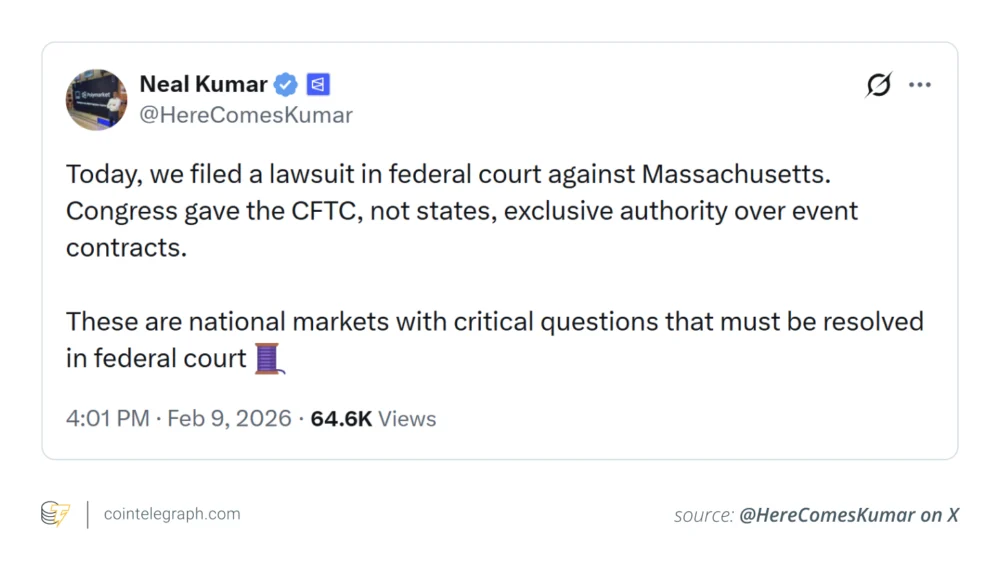
Prediction markets, innovative platforms where individuals trade contracts based on the outcomes of future events, have recently captured headlines due to a pivotal legal battle unfolding in the United States. This dispute centers on regulatory authority, specifically Polymarket’s federal lawsuit against the Commonwealth of Massachusetts. The outcome of this landmark case carries profound implications, potentially dictating whether these burgeoning markets fall under the exclusive purview of federal regulators or if individual states retain the power to impose their own diverse rules and prohibitions. This article delves into the intricacies of Polymarket’s challenge against Massachusetts, scrutinizing the broader legal confrontation over whether prediction markets are exclusively governed by the U.S. Commodity Futures Trading Commission (CFTC) under the Commodity Exchange Act, or if they remain susceptible to state gambling statutes. It further analyzes how this decision could fundamentally reshape the landscape of regulatory control, influence market access for participants, and ultimately determine the future trajectory of event-based trading platforms across the United States.
A Federal Lawsuit with Broad Implications
In February 2026, Polymarket initiated legal proceedings in the U.S. District Court for the District of Massachusetts, filing a preemptive lawsuit aimed at preventing state regulators from enforcing Massachusetts gambling laws against its operations. The company’s core contention is that Congress, through the Commodity Exchange Act (CEA), has granted exclusive authority over "event contracts"—the fundamental products offered by prediction markets—to the CFTC. Polymarket argues that this federal preemption renders any state-level efforts to halt or restrict its operations unlawful and unenforceable.
Neal Kumar, Polymarket’s chief legal officer, has vocally asserted that the nature of the dispute, involving national markets and cross-state participation, necessitates resolution within the federal court system. He emphasizes the company’s strong opposition to what it describes as "piecemeal enforcement" by individual states, which could lead to a fragmented and unworkable regulatory environment. Kumar stressed that attempts by states like Massachusetts and Nevada to shut down or heavily restrict these markets represent a missed opportunity to foster innovation and contribute to the development of the "markets of tomorrow," which hold significant potential for information aggregation and economic utility. The preemptive nature of the lawsuit indicates Polymarket’s strategic effort to establish a definitive legal precedent that would shield it from the patchwork of state regulations, aiming for a singular, federal regulatory framework.
Where It All Started: State Actions Against Kalshi
The timing of Polymarket’s lawsuit was anything but coincidental; it was strategically launched shortly after Massachusetts courts had taken significant action against a rival platform, Kalshi. In that instance, Massachusetts successfully blocked Kalshi from offering sports-related contracts to its residents, deeming them to fall under state gambling laws. A judge upheld a preliminary injunction, mandating that Kalshi prevent Massachusetts residents from accessing certain markets without first obtaining a proper gaming license. The court specifically directed that these markets be treated as unlicensed sports wagers, underscoring the state’s determination to apply its established gambling framework to these new financial instruments.
Massachusetts’ assertive approach to regulating prediction markets has found resonance and support from similar state-level actions in other jurisdictions. In Nevada, for example, regulators secured a temporary restraining order specifically targeting Polymarket’s sports-related offerings. Nevada authorities argued that these offerings directly violated the state’s comprehensive sports betting regulatory framework, highlighting a consistent concern among states regarding consumer protection and the integrity of their licensed gambling industries. While Kalshi operates as a CFTC-regulated Designated Contract Market (DCM), a crucial distinction from Polymarket, the state’s willingness to challenge even a federally recognized entity demonstrates the deep-seated conviction among state authorities regarding their traditional powers over gambling.
- Did you know? Corporations have historically leveraged prediction markets to forecast critical business metrics such as product launch success rates and internal project completion deadlines. Some companies discreetly rely on employee-based markets because the aggregated opinions and insights from a diverse crowd often demonstrate superior accuracy compared to traditional executive forecasts or expert analyses. This highlights their utility beyond speculative trading.
What Is At Stake: Federal vs. State Authority
The heart of Polymarket’s lawsuit lies in a fundamental jurisdictional dispute. Polymarket asserts that its event contracts, irrespective of whether they pertain to elections, economic indicators, or sports outcomes, are properly classified as financial derivatives under the purview of the CFTC’s Commodity Exchange Act (CEA). Under this interpretation, federal law, specifically the CEA’s "exclusive jurisdiction" clause (Section 2(a)(1)(A)), would supersede and preempt state gambling statutes, effectively preventing states from independently banning or regulating these markets. Polymarket’s argument hinges on the idea that Congress intended for the CFTC to be the sole arbiter of such instruments, ensuring a uniform national approach.

Conversely, Massachusetts and other states vehemently argue that when prediction markets bear a strong resemblance to traditional gambling, particularly in the context of sports or other leisure activities, they must adhere to existing state gambling frameworks. Their primary justifications revolve around safeguarding consumers, preventing problem gambling, and maintaining local licensing requirements and age restrictions that are meticulously designed to protect vulnerable populations. States emphasize their inherent "police powers" to regulate matters of public welfare and morality within their borders, arguing that these new platforms, if unregulated at the state level, could undermine established protections.
Should federal courts ultimately side with Polymarket, it would significantly bolster the argument for uniform national oversight, effectively preventing the emergence of a detrimental "patchwork" of varying state-level rules, outright prohibitions, or conflicting regulatory demands. This outcome could foster a more predictable and scalable environment for prediction market platforms, potentially accelerating innovation and market growth. Conversely, an affirmation of state authority would empower individual states to continue applying their distinct gambling laws to platforms operating nationwide. This could lead to market fragmentation, forcing platforms to navigate a complex labyrinth of differing state-by-state regulations, or even to withdraw from certain states altogether, thereby limiting access for U.S. consumers and potentially stifling the industry’s development.
- Did you know? Prediction markets have, on numerous occasions, demonstrated their capacity to rival or even outperform traditional opinion polls in accurately forecasting election outcomes. Universities and research institutions have studied these markets for decades, recognizing their potential as sophisticated tools for measuring collective intelligence and assessing information efficiency within diverse groups.
Why Polymarket’s Lawsuit Matters
Prediction markets have been experiencing a remarkable surge in growth, marked by escalating trading volumes and increasing public visibility. Data meticulously tracked by Dune Analytics revealed that prediction markets collectively recorded an astonishing $3.7 billion in trading volume during a single week in January 2026, an all-time high that underscored their rapidly expanding appeal and economic significance. This explosive growth encompasses a wide array of event types, from political elections and economic indicators to sports outcomes and even scientific breakthroughs.
As platforms such as Polymarket and Kalshi continue to gain mainstream traction and attract a broader user base, states are increasingly compelled to apply regulatory protections comparable to those governing traditional gambling industries. This dynamic tension between innovation and existing legal frameworks has spurred decisive action by multiple states, all seeking to assert their regulatory authority over what they perceive as unregulated gambling.
The Commodity Futures Trading Commission’s (CFTC) historical stance has further complicated this intricate issue. While the federal agency possesses a long-standing mandate to regulate derivatives markets, including certain types of event contracts, it has faced considerable pressure, both internally and externally, to either refrain from intervening in specific disputes or to outright restrict prediction contracts involving highly sensitive topics like war or terrorism. The CFTC has approved some event contracts for regulated entities (like Kalshi’s economic markets) while rejecting others (like Kalshi’s sports markets), illustrating the ongoing internal debate about where the line should be drawn between a legitimate financial derivative and an illicit wager. This ambiguity at the federal level has, in part, created the vacuum that states are now attempting to fill.
- Did you know? Many modern prediction markets are meticulously structured using blockchain technology and self-executing smart contracts. These smart contracts are designed to automatically settle trades once a predetermined outcome is verified by reliable external data sources, known as oracles. While this automation significantly enhances transparency and reduces counterparty risk, it simultaneously introduces a new layer of regulatory and technical challenges, particularly concerning the reliability and decentralization of the oracles themselves.
How Jurisdictional Disputes Are Reshaping Event Contracts
Polymarket’s bold legal action is not an isolated incident but rather a prominent manifestation of the broader legal and regulatory disputes currently enveloping prediction markets across the United States. Courts in various jurisdictions, including Massachusetts and Nevada, are actively examining the precise limits of state authority in regulating these novel financial instruments. Simultaneously, federal officials and legislators are grappling with the complex task of deliberating and potentially crafting comprehensive national guidelines that can adequately address the unique characteristics and challenges posed by prediction markets. The eventual outcomes of these multifaceted proceedings will undoubtedly exert a profound influence on how companies conceptualize, structure, and ultimately offer event contracts to the American public.
Whether courts ultimately uphold Polymarket’s argument for exclusive federal jurisdiction or, conversely, affirm the long-standing authority of states to regulate activities within their borders, the resulting decision will have far-reaching and long-lasting implications for the trajectory and sustainable growth of prediction markets. It will not only shape user access to these increasingly popular platforms but also critically influence the delicate balance that regulators must strike between fostering technological innovation and ensuring robust consumer protection in this rapidly evolving financial landscape. The resolution of this jurisdictional battle will be a defining moment for the future of information aggregation and event-based trading in the U.S.