isnaini azizah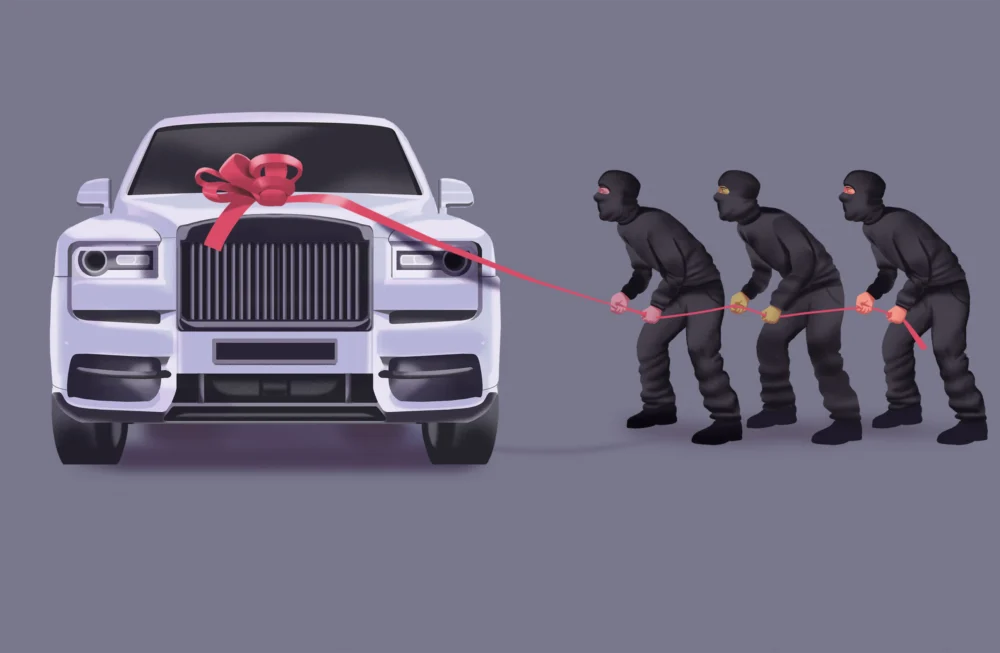
A sophisticated wave of vehicle transport fraud and theft is wreaking havoc across the nation, leaving luxury car owners and rental companies like Dream Luxury Rental bewildered as their high-end vehicles vanish during transit. Sam Zahr, director of operations at Dream Luxury Rental in Detroit, experienced this firsthand when a meticulously chosen gray Rolls-Royce Dawn convertible, destined for his discerning clientele, disappeared en route from Miami. The incident, which occurred after Zahr used Central Dispatch, a popular online marketplace for vehicle shipments, highlights a growing problem where criminals exploit digital platforms and lax regulations to orchestrate elaborate heists.
The scheme typically begins with fraudsters impersonating legitimate transport companies through phishing emails, fraudulent paperwork, and compromised accounts on load boards. These criminals then secure lucrative contracts to transport luxury vehicles, only to divert them from their intended destinations. Once in their possession, the vehicles are often retitled and resold domestically or quickly shipped overseas. In many cases, the rightful owner only realizes the car is missing when it’s already out of the country or has been resold.
Steven Yariv, CEO of Dealers Choice Auto Transport, describes the ease with which criminals now operate online: "Criminals have learned that stealing cars via the web portals has become extremely easy, and when I say easy—it’s become seamless." This burgeoning criminal enterprise has gained notoriety through high-profile cases involving celebrities and professional athletes. In late 2024, a Lamborghini Huracán belonging to Colorado Rockies third baseman Kris Bryant vanished while en route to his Las Vegas home. Similarly, R&B singer Ray J reported two Mercedes Maybachs missing, and NBA Hall of Famer Shaquille O’Neal had a custom Range Rover stolen when the transport company he hired was hacked.
Despite these widely publicized incidents, the full scale of vehicle transport fraud and theft has largely remained under the radar. An investigation by MIT Technology Review, which involved analyzing court records and speaking with law enforcement officials, brokers, drivers, and victims across multiple states, reveals the systemic nature of this crime wave. While precise figures are elusive due to the lack of a central tracking entity, industry insiders and law enforcement acknowledge a significant increase in such incidents over the past two years. Yariv estimates that as of August, approximately 8,000 exotic and high-end cars had been stolen since the spring of 2024, resulting in over $1 billion in losses, equating to roughly 30 cars disappearing daily. Multiple state and local law enforcement officials have corroborated the plausibility of these numbers.
Further evidence of this escalating problem comes from the National Insurance Crime Bureau (NICB). While overall car theft has seen a decline following a pandemic-era surge, cargo theft—a broad category that includes the theft of vehicles during commercial shipments—has dramatically increased, now estimated at $35 billion annually. The NICB projected a 22% rise in cargo theft for 2025. Although NICB data doesn’t isolate vehicle-specific cargo theft, a regional director noted a 200% increase in stolen vehicle recoveries at the Port of Baltimore between 2023 and 2024, with high-end stolen vehicles frequently found en route to overseas destinations.
The speed at which these vehicles disappear is staggering. Exotic car dealer Travis Payne notes that transport thieves often have buyers lined up before they even steal a car, stating, "When they steal them, they have a plan." Payne himself spent months trying to locate a stolen Rolls-Royce, which eventually surfaced on the Instagram feed of a Mexican pop star, but he never recovered the vehicle. "They’re going to keep doing it," Payne laments, "because they make a couple phone calls, make a couple email accounts, and they get a $400,000 car for free. I mean, it makes them God, you know?"

This surge in vehicle transport fraud is a consequence of the industry’s shift from phone and fax-based operations to online marketplaces. While these platforms increase efficiency and reduce costs, they have also introduced security vulnerabilities exploited by organized, often international, criminal syndicates. Online "load boards" like Central Dispatch, which hosts thousands of vehicle shipment listings daily, have become prime targets. The system, which previously functioned effectively, began to unravel approximately two years ago when organized fraud rings started compromising broker and carrier accounts.
Phishing emails are a common entry point, tricking brokers and carriers into revealing their login credentials. Once compromised, fraudsters alter account details to reroute communications and claim high-value loads. Cox Automotive, the parent company of Central Dispatch, maintains that its platform is secure and that fraud impacts a "very small portion" of listings, despite ongoing efforts to enhance security.
Compounding the issue is a lax regulatory environment. While a valid U.S. Department of Transportation (USDOT) registration is required, criminals can readily obtain USDOT numbers for sham transport companies. In other instances, they compromise legitimate companies’ USDOT accounts to impersonate them. Bek Abdullayev, founder of Super Dispatch, a competitor to Central Dispatch, highlights this vulnerability, stating that the Federal Motor Carrier Safety Administration (FMCSA) is "authorizing people that are fraudulent companies—people that are not who they say they are." This allows criminals to "game the system and obtain paperwork that makes [them] look like a legitimate company," often by quickly securing temporary vehicle carrier insurance with fraudulent credentials.
The practice of "double-brokering," where a legitimate load is subcontracted, is frequently used by criminals. They claim a load, then repost it to find an unwitting accomplice to deliver the stolen vehicle to their designated location. "They’re booking cars and then they’re just reposting them and dispatching them out to different routes," explains Yariv. J.D. Decker, chief of the Nevada Department of Motor Vehicles’ police division, points out the organized nature of these operations, suggesting that "a lot of this is cartel operated. There’s so much money in it that it rivals selling drugs."
Despite growing awareness, fraudsters continue to operate with relative impunity. Critics argue that load boards and the USDOT have been too slow to identify and ban malicious actors. Jake MacDonald of Super Dispatch bluntly states that fraud is outpacing the industry’s technological advancements, noting that "the industry is slowly moving over to a more technologically advanced position, but it’s so slow that fraud is actually [out-]innovating the industry."
A striking example of this modus operandi unfolded in Florida, where Sam Zahr’s stolen Rolls-Royce was a key piece of evidence. The fraudster who secured the job on Central Dispatch reposted the Rolls-Royce with a fraudulent destination in Hallandale Beach, Florida. A legitimate driver, unaware of the deception, picked up the car. Detective Ryan Chin of the Miami Police Department, investigating Zahr’s report, identified the truck and driver involved. By the time police located the driver, the Rolls-Royce had been delivered, along with a black Lamborghini Urus and a white Audi R8, all stolen via double-brokering transport fraud.
The cooperative driver revealed he had another load scheduled for a dealership in Naples, Florida – an orange Lamborghini Urus destined for California but rerouted to a mall in Aventura. This led Chin and Detective Orlando Rodriguez to set up a sting operation. They observed the cooperative driver deliver the Lamborghini Urus, only for it to be met by individuals arriving in a Rolls-Royce Cullinan and a Bentley Continental GT. The exchange involved the Bentley driver handing cash to the men from the Rolls-Royce and then taking possession of the Lamborghini. Law enforcement intervened, arresting Arman Gevorgyan, Hrant Nazarian, and Yuriy Korotovskyy on charges including dealing in stolen property and organized fraud.

The term "flip-flop mafia" has emerged in the industry to describe individuals engaged in transport fraud. This term refers both to the casual attire of those involved in the illicit transactions and to their practice of "flipping" from one carrier registration to another to evade detection. Fraudsters often use a USDOT number for a limited period, accumulating violations, before replacing it with a new one, engaging in a cycle of "wash, rinse, and repeat," as described by Fred Mills, owner of Advantage Auto Transport. Decker of the Nevada DMV emphasizes that the ease with which these operations are conducted stems from a lack of thorough vetting by dealerships and customers.
Among the items confiscated from the arrested individuals in Florida was a GPS jammer, a crucial tool for modern car thieves. These devices disable the tracking capabilities of GPS navigation systems, providing thieves with valuable time to swap Vehicle Identification Numbers (VINs), wipe vehicle computers, and reprogram fobs to erase all traces of the car’s origin. Bill Woolf of the NICB explains that criminals are adept at finding and altering VINs, making it increasingly difficult for law enforcement to identify stolen vehicles. "Every time we come up with a security measure to prevent the fraudster, they come up with a countermeasure," Woolf states. The speed at which these vehicles can be manipulated is alarming, with a complete reprogramming possible within an hour of theft, often before an owner can even file a police report.
The case of Kris Bryant’s stolen Lamborghini Huracán exemplifies this rapid criminal activity. The car, picked up via a load board, vanished en route to Las Vegas. Detective Justin Smith of the Cherry Hills Village Police Department tracked the transport truck to Nevada, where a Las Vegas officer eventually located the Lamborghini. The driver identified Dat Viet Tieu as the broker responsible for the vehicle. Tieu, who claimed to be a car broker unaware the car was stolen, was found to be in possession of a stolen Jeep Wrangler that had been re-VINed and retitled to his wife. Inside the Jeep, police discovered fraudulent VIN stickers, key fobs for other stolen vehicles, and fictitious placards, one matching Bryant’s Lamborghini.
Further surveillance of Tieu led police to witness the reprogramming of a key fob for a GMC Sierra in a casino parking garage, suggesting a sophisticated operation involving the manipulation of vehicle security systems. Tieu and his wife were eventually arrested. Tieu pleaded guilty to felony counts of possession of a stolen vehicle and defacing a VIN, receiving a probationary sentence. His attorneys maintain his innocence, suggesting he pleaded guilty to expedite his release and return home.
Many vehicles stolen through transport fraud are never recovered. Experts believe the most effective way to combat this cycle is to disrupt it at its inception, which necessitates significant changes to how load boards operate. Brokers and shippers criticize Central Dispatch for what they perceive as insufficient oversight. Fred Mills of Advantage Auto Transport laments, "If the crap hits the fan, it’s on us as a broker, or it’s on the trucking company… they have no liability in the whole transaction process. So it definitely frosted a lot of people’s feathers."
In response to these concerns, Central Dispatch has implemented measures such as two-factor authentication for user accounts and real-time load tracking. They have also launched an awareness campaign and removed over 500 fraudulent accounts in 2025, with plans for continued aggressive action. Lainey Sibble, Central Dispatch’s head of business, acknowledges that combating this issue requires a collective effort. Mills likens the task of detoxifying the system to overcoming a long-term addiction, stating it will take time. Frustrated by the pervasive fraud, Yariv has ceased using Central Dispatch and other load boards altogether, reverting to traditional phone-based operations, as the "dispatch boards have to be shut down—and that’ll never happen." The accountability for the alleged perpetrators in the Florida sting operation remains an ongoing legal process, with some defendants pleading not guilty and their trials pending.
The battle against vehicle transport fraud is a complex and evolving one, requiring a multi-faceted approach involving enhanced platform security, stricter regulatory oversight, and greater vigilance from all parties involved in the vehicle shipping process. The disappearing Lamborghinis are a stark reminder of the vulnerabilities within the digital logistics landscape and the sophisticated tactics employed by modern criminal enterprises.