Faris Adani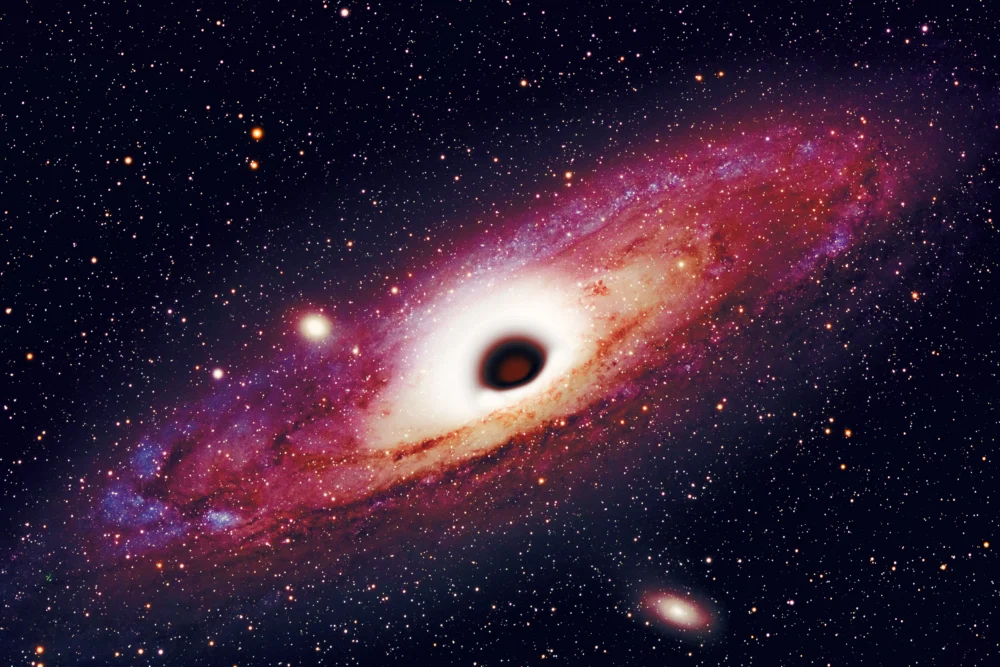
For decades, the prevailing scientific consensus has held that the heart of our own Milky Way galaxy, like many others across the cosmos, is dominated by a supermassive black hole, an enigmatic entity so dense that not even light can escape its gravitational pull. This colossal cosmic devourer, known as Sagittarius A (Sgr A), is estimated to possess a mass equivalent to approximately four million Suns, anchoring the galactic spiral with its immense gravitational influence. However, a revolutionary new study published in the prestigious journal Monthly Notices of the Royal Astronomical Society presents a compelling alternative, suggesting that the enigmatic object at the galactic center might not be a black hole at all, but rather an extraordinarily dense and massive clump of dark matter – the mysterious, invisible substance believed to constitute the vast majority of matter in the universe. This audacious hypothesis challenges a cornerstone of modern astrophysics and opens new avenues for understanding the fundamental nature of galactic cores and dark matter itself.
The traditional view of Sagittarius A as a supermassive black hole is not merely an assumption; it is supported by a wealth of observational evidence accumulated over many years. Astronomers have meticulously tracked the dizzying orbits of stars, particularly a group known as S-stars, that zip around the galactic center at speeds reaching thousands of kilometers per second. The extreme gravitational forces required to keep these stars in such tight, rapid orbits strongly point to the presence of an incredibly compact and massive object. This evidence was so compelling that it earned Reinhard Genzel and Andrea Ghez a share of the Nobel Prize in Physics in 2020 for their groundbreaking work on Sgr A. Further bolstering this understanding was the groundbreaking image released by the Event Horizon Telescope (EHT) collaboration in 2022, which revealed a glowing ring of superheated gas swirling around a central darkness – the telltale "shadow" of Sgr A*, consistent with theoretical predictions for a black hole.
Yet, despite this robust evidence, the nature of dark matter continues to pose one of the most profound mysteries in cosmology. Though it remains unseen and undetectable by conventional means, its existence is inferred from its gravitational effects on visible matter. The initial evidence for dark matter emerged from observations of galaxy rotation curves in the 1930s by Fritz Zwicky, and later refined by Vera Rubin in the 1970s. These studies showed that galaxies rotate much faster than the visible matter alone could account for, implying a vast, invisible "halo" of dark matter providing the extra gravitational "glue" needed to prevent them from flying apart. Modern cosmological models, such as the Lambda-CDM model, posit that dark matter accounts for roughly 27% of the total mass-energy content of the universe, compared to only 5% for ordinary baryonic matter.
The new research, led by Valentina Crespi and co-authored by Carlos Argüelles of the Institute of Astrophysics La Plata, delves into a specific type of dark matter candidate: fermionic dark matter. Unlike the more diffuse blobs or "halos" typically envisioned for dark matter, fermionic particles obey the Pauli Exclusion Principle, which dictates that no two identical fermions can occupy the same quantum state. This fundamental quantum mechanical property implies that if dark matter particles were fermions, they could be packed together much more tightly under extreme gravitational pressure than bosonic particles. This "degeneracy pressure" could prevent a gravitational collapse into a singularity, allowing them to form a stable, incredibly dense core instead of a black hole. This concept of a "fermionic dark matter soliton" or "dark matter core" presents a fascinating departure from conventional dark matter models, which often favor weakly interacting massive particles (WIMPs) or axions, typically considered bosonic.
The study’s central claim is that such a colossal clump of fermionic dark matter could precisely mimic the gravitational effects attributed to Sgr A. Through sophisticated simulations, the research team demonstrated that a sufficiently dense fermionic core could accurately reproduce the observed orbits of the S-stars near the galactic center. This is a crucial point, as the precision of these stellar orbits has long been considered one of the strongest pieces of evidence for Sgr A‘s existence as a black hole. If a dark matter configuration can generate the same gravitational landscape, it opens the door to a radical reinterpretation of our galactic core.
Moreover, the fermionic dark matter theory offers an elegant solution to another long-standing galactic enigma: the "Keplerian decline" problem. Observations show that stars at the outer regions of many galaxies, including the Milky Way, do not exhibit the expected drop-off in speed predicted by Kepler’s laws based on visible matter alone. Instead, their rotation curves tend to flatten out. This discrepancy is conventionally explained by the presence of a vast, extended dark matter halo surrounding the galaxy. The new study posits that the dense fermionic core at the galactic center and the expansive dark matter halo are not separate phenomena but rather two manifestations of the same continuous substance. As Carlos Argüelles eloquently stated, "We are not just replacing the black hole with a dark object; we are proposing that the supermassive central object and the galaxy’s dark matter halo are two manifestations of the same, continuous substance." This unified picture of dark matter, forming both the central anchor and the extended gravitational scaffold of a galaxy, offers a conceptually appealing simplicity.
Perhaps the most significant challenge to any alternative theory for Sgr A* is the iconic EHT image. The "shadow" observed is a direct consequence of light bending around an event horizon, a defining feature of a black hole. However, the researchers contend that a dense fermionic dark matter core, while lacking an event horizon, could still produce a similar visual phenomenon. As lead author Valentina Crespi explained, "The dense dark matter core can mimic the shadow because it bends light so strongly, creating a central darkness surrounded by a bright ring." The extreme gravity of such a compact dark matter object would distort spacetime significantly, causing light rays to be bent and focused in a way that creates a central region of darkness surrounded by a luminous ring of superheated gas, analogous to the accretion disk around a black hole. This argument is critical, as it attempts to reconcile the most direct visual evidence with the dark matter hypothesis.
While undoubtedly provocative and intellectually stimulating, this theory is not yet compelling enough to dislodge the well-established black hole consensus. The scientific community will require further theoretical development and, crucially, new observational evidence to differentiate definitively between these two scenarios. Future astronomical observations could look for specific "telltales" unique to black holes, such as the precise dynamics of matter falling into an event horizon, the generation of gravitational waves from black hole mergers, or unique relativistic effects that might not be replicated by a dark matter core. For instance, the exact profile of the "photon ring" (the bright ring of light around the shadow) or the polarization patterns of the emitted light might hold subtle differences that could distinguish a black hole from a dark matter soliton.
If ultimately validated, this research would have profound implications, not only for our understanding of galactic centers but also for the nature of dark matter itself. It could provide a novel pathway to directly detect or characterize dark matter, which has eluded scientists for nearly a century. The idea that the most massive and enigmatic objects in the universe might be vast concentrations of this elusive substance rather than singularities of spacetime represents a truly paradigm-shifting concept. As the pursuit of cosmic truths continues, this new hypothesis underscores the dynamic and evolving nature of astrophysics, where even the most deeply held beliefs can be challenged by innovative thought and the persistent quest for deeper understanding.