anjir abdul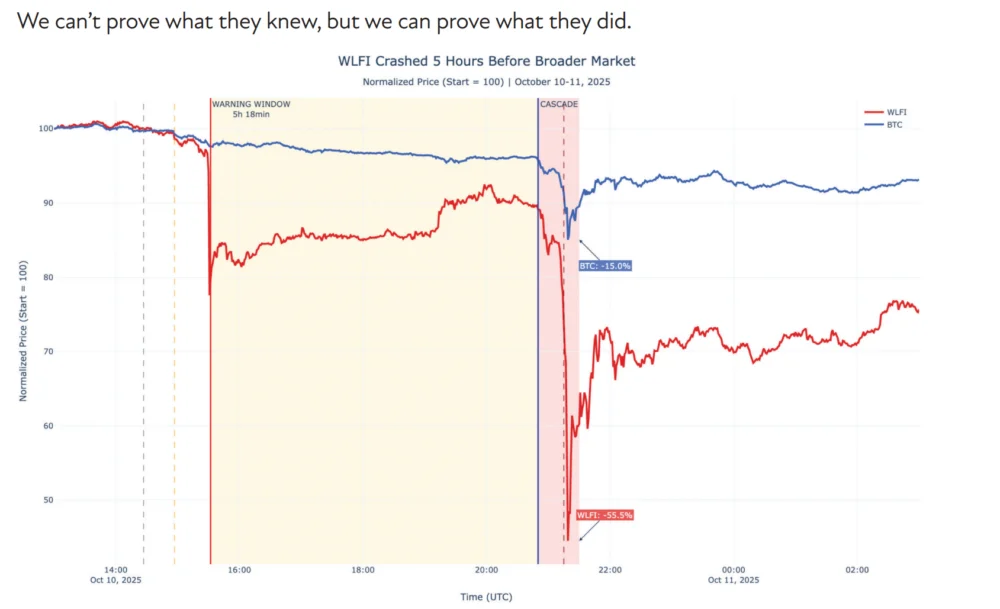
World Liberty Financial Token (WLFI), a DeFi governance token notably affiliated with the Trump family, may have provided a critical early warning sign of a significant market breakdown, preceding a dramatic Bitcoin price movement by several hours, according to a compelling new analysis from the prominent data provider Amberdata. This revelation challenges conventional wisdom about market leadership and information flow within the often-opaque cryptocurrency ecosystem, suggesting that smaller, politically connected, and highly leveraged assets can, under specific conditions, act as unexpected harbingers of broader market distress.
The comprehensive report from Amberdata delves into the trading dynamics of October 10, 2025, a date etched into the memories of many crypto participants as one of sudden and severe market turmoil. On this day, an estimated $6.93 billion worth of leveraged crypto positions were violently liquidated in a staggeringly short period – under an hour. The cascade of forced selling sent shockwaves across the market, with Bitcoin (BTC), the industry’s flagship cryptocurrency, plummeting by approximately 15%, while Ether (ETH) saw an even steeper decline of roughly 20%. Smaller altcoins, particularly those with less liquidity and greater speculative interest, experienced catastrophic losses, with some shedding as much as 70% of their value in the ensuing chaos.
What makes Amberdata’s findings particularly intriguing is the precise timing of WLFI’s initial decline. The study meticulously documents that WLFI began its sharp downward trajectory more than five hours before the broader crypto market, including Bitcoin, showed any significant signs of stress. At the precise moment WLFI was undergoing its initial plunge, Bitcoin remained steadfastly trading near the $121,000 mark, exhibiting little to no immediate indication of the impending storm. This significant lead time is what elevates the observation from a mere correlation to a potential signal.
Mike Marshall, the astute author behind the Amberdata report, underscored the importance of this temporal disparity in an interview with Cointelegraph. “A five-hour lead time is hard to dismiss as coincidence,” Marshall stated, emphasizing the duration as a key factor. He further elaborated on the distinction, adding, “That duration is what separates a genuinely actionable warning from a statistical artefact.” In the fast-paced and often volatile world of cryptocurrency trading, a five-hour window represents an eternity, providing ample time for sophisticated players to react, rebalance portfolios, or even front-run the broader market movement, if such a signal were widely recognized and acted upon.
The report didn’t just point to a temporal lead; it meticulously examined three distinct, unusual trading patterns observed in WLFI leading up to the market-wide selloff. These anomalies collectively painted a picture of an asset under immense, localized pressure, suggesting that the underlying stress was brewing long before it became apparent in the larger, more liquid cryptocurrencies. The patterns included an extraordinary surge in trading activity, a marked and sudden divergence of WLFI’s price action from that of Bitcoin, and the presence of extreme leverage within WLFI’s derivatives markets.

Specifically, WLFI’s hourly trading volume experienced an astonishing spike, rocketing to approximately $474 million. This figure represented an increase of about 21.7 times its normal, average hourly volume, and crucially, this dramatic surge occurred within mere minutes of the public dissemination of tariff-related political news. The rapid response time suggests a highly efficient, or perhaps pre-programmed, reaction from certain market participants. Concurrently, the funding rates on WLFI perpetual futures contracts, which are payments exchanged between long and short positions to keep the futures price tethered to the spot price, reached an astronomical approximately 2.87% every eight hours. This rate translates to an annualized borrowing cost hovering near an eye-watering 131%, indicative of an extremely lopsided market where demand for leveraged long positions on WLFI was extraordinarily high, signaling both immense speculation and underlying fragility. Such exorbitant funding rates typically precede significant price corrections as the cost of maintaining leveraged positions becomes unsustainable.
It’s important to note that the Amberdata study does not posit or claim that insider trading was at play. Rather, it argues for a more nuanced understanding of market mechanics, positing that the unique structural characteristics of crypto markets can empower certain assets to exert an influence far disproportionate to their actual market capitalization. This argument hinges on the observation that the holder base of WLFI is notably concentrated among politically connected participants, a stark contrast to Bitcoin’s widely distributed ownership. This concentration means that a smaller group of influential individuals or entities could potentially possess or react to information more rapidly, or collectively hold positions that, when unwound, have a magnified effect.
Marshall highlighted the "instrument-specific" nature of the observed trading activity, meaning the intense focus of selling pressure and volume was primarily concentrated on WLFI itself, rather than being broadly dispersed across the entire crypto complex. He elaborated on this crucial distinction: “If this were superior analysis (sophisticated participants reading the tariff headlines faster and drawing better conclusions) you’d expect to see that reflected more broadly,” Marshall explained. “What we actually saw was concentrated activity in WLFI first.” This suggests that the signal originated from within the specific dynamics of WLFI, rather than being a generalized market-wide insight.
The timing of the volume acceleration is particularly telling. The surge in trading activity for WLFI occurred roughly three minutes after the public release of the tariff news. Such a rapid and aggressive response implies a level of preparedness and automated execution that goes beyond typical retail traders interpreting headlines in real-time. It hints at institutional-grade setups, algorithmic trading strategies, or highly networked participants who could process and act upon information almost instantaneously.
The fundamental link connecting WLFI’s specific distress to the broader market downturn, as the report meticulously details, boils down to the pervasive use of leverage within the crypto ecosystem. Many cryptocurrency trading platforms allow traders to use a diverse array of assets, including smaller tokens like WLFI, as collateral for borrowed positions. When WLFI experienced its precipitous decline, the underlying value of this collateral diminished sharply. This reduction in collateral value triggered margin calls, forcing traders to either deposit more funds or, more commonly, sell off other liquid assets in their portfolios, such as Bitcoin and Ether, to meet their margin requirements and cover their leveraged positions. These forced sales, originating from WLFI-linked collateral, injected significant selling pressure into the broader market. As Bitcoin and Ether prices began to fall due to these sales, it triggered further liquidations across the market, creating a dangerous feedback loop and a cascading effect that ultimately led to the multi-billion-dollar market meltdown.
Amberdata’s data further underscored WLFI’s inherent sensitivity to market stress. During the observed episode, WLFI’s realized volatility, a measure of how much an asset’s price fluctuates, reached nearly eight times that of Bitcoin. This extreme volatility made WLFI particularly susceptible to rapid and dramatic price movements, especially under pressure. The researchers convincingly argue that structurally fragile, highly leveraged assets, precisely like WLFI in this scenario, are often the first to react and move during moments of significant market shocks, acting as leading indicators of broader instability.

Despite the compelling nature of these findings, Marshall prudently advised against interpreting them as definitive proof that WLFI can reliably predict future market downturns. He stressed that the analysis covers a singular, albeit highly significant, event. To establish statistical consistency and predictive reliability, a much larger dataset and a series of similar observations would be required. Nonetheless, Marshall firmly believes that the observed behavior is profoundly significant for understanding market dynamics.
He also offered a pragmatic view on the transient nature of such market signals. “So the useful life of this signal is finite. It’s valuable now because it’s under-monitored,” Marshall commented. “The moment it becomes consensus, the alpha gets arbitraged away. That’s how all market signals work. The ones that persist are the ones nobody’s paying attention to.” This speaks to the dynamic and adaptive nature of financial markets; once an anomaly or pattern is widely recognized, market participants adjust their strategies, thereby diminishing its predictive power.
The context surrounding WLFI also adds layers to its potential role as a market bellwether. Earlier reports, such as the one detailing senators urging a CFIUS probe into a $500 million UAE stake in the Trump-linked WLFI, highlight the token’s connections to significant political and financial interests. Furthermore, news about the Trump family’s WLFI planning an FX and remittance platform indicates ambitions that extend beyond a mere governance token, suggesting a growing ecosystem and increasing integration into broader financial services. These connections could amplify the impact of WLFI’s price movements, especially if large, politically sensitive stakeholders are involved, potentially making it a unique, albeit perhaps short-lived, indicator of macro-level financial and political sentiment within the crypto space.
In conclusion, Amberdata’s study on WLFI provides a fascinating and potentially groundbreaking case study. It suggests that in the complex, interconnected, and highly leveraged world of cryptocurrency, a seemingly smaller, niche asset with specific political affiliations and concentrated ownership can, under certain conditions, precede and even contribute to a massive market downturn. While further research is undoubtedly needed to confirm WLFI’s consistent predictive power, this single event offers a powerful lesson on market fragility, the dynamics of information flow, and the unexpected places from which critical market signals can emerge. It underscores the ongoing evolution of crypto market analysis and the constant search for novel insights in an ever-maturing, yet still highly volatile, financial frontier.