Faris Adani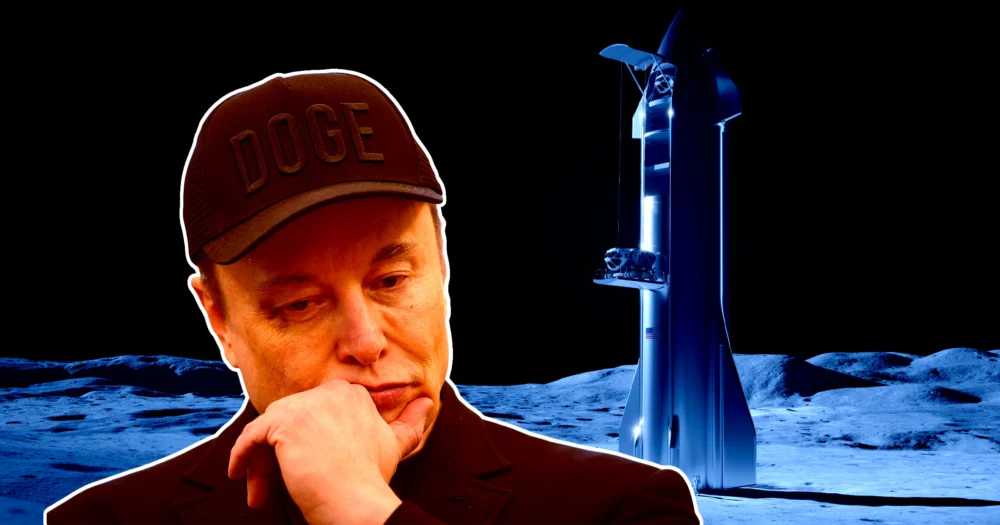
Elon Musk Announces Huge Change: Self-Growing City on Moon Now Top Priority at SpaceX
Just over a year ago, the visionary yet often contradictory CEO of SpaceX, Elon Musk, had made his stance on lunar exploration abundantly clear: he was not interested. In January 2025, amidst what was widely characterized as the height of his “bromance” with then-President Donald Trump, Musk took to X (formerly Twitter) to declare the Moon a mere “distraction,” asserting with characteristic defiance that humanity’s true destiny lay on a direct trajectory to Mars. His criticism of NASA’s ambitious Artemis program, aimed at returning humans to the lunar surface after more than half a century, was scathing. He lambasted it as “extremely inefficient,” a “jobs-maximizing program, not a results-maximizing program.” For years, establishing a self-sustaining city on Mars had been Musk’s declared number one goal, a monumental endeavor he envisioned requiring a fleet of 1,000 Starship rockets for an interstellar colonization effort initially slated to commence as early as 2024.
However, having completely missed that ambitious timeline, the mercurial entrepreneur appears to have undergone a significant change of heart, a dramatic pivot that directly contradicts his previous pronouncements. In a recent tweet, Musk revealed a startling shift in strategy: the immediate plan is now to go to the Moon and, against all his prior dismissals, build a city there after all. This abrupt reversal, coming from a figure renowned for his unyielding long-term visions, marks a profound recalibration of SpaceX’s near-term space colonization priorities.
The rationale for this dramatic shift, as articulated by Musk, centers on pragmatism and speed. As it turns out, the Moon is “far easier to settle” than Mars, a realization that likely makes the ambitious space colonization plan a much easier pill for his investors to swallow. This move is yet another instance of Musk significantly moving the goalposts after years of fervent bluster and grand, often unattainable, hype. “For those unaware, SpaceX has already shifted focus to building a self-growing city on the Moon, as we can potentially achieve that in less than ten years, whereas Mars would take 20+ years,” he tweeted on a recent Sunday. This statement lays bare the fundamental driver behind the change: time. The Moon’s proximity and relative accessibility offer a quicker pathway to establishing a permanent human presence beyond Earth.
The richest man in the world now sees a lunar colony as priority number one. His overarching justification remains consistent with his long-held beliefs about humanity’s future: securing the “future of civilization.” However, the path to that security has been redefined. Getting to the Moon, which is orders of magnitude closer to Earth than Mars, is simply “faster.” The average distance to the Moon is approximately 384,400 kilometers, a journey that can take as little as three days. In stark contrast, Mars, at its closest approach, is about 54.6 million kilometers away, with a typical transit time ranging from six to nine months. This vast difference in travel time not only reduces mission complexity and cost but also significantly lowers the risks associated with prolonged deep-space exposure for astronauts, such as radiation. Furthermore, the Moon offers potential resources like water ice at its poles, crucial for life support and propellant production, which could be more readily accessible than on Mars, where water is primarily locked away as permafrost or in atmospheric traces.
The timing of this admission is particularly noteworthy, adding a layer of strategic calculation to the shift. It follows closely on the heels of a significant corporate maneuver: SpaceX’s acquisition of Musk’s AI startup, xAI, earlier this month. This consolidation positions SpaceX for an anticipated initial public offering (IPO) at an eye-watering and potentially record-breaking valuation of $1.25 trillion. Such a monumental financial event places immense pressure on the company to demonstrate a clear, achievable path to its ambitious goals. It’s unclear whether Musk’s abrupt reversal was directly related to potential investor pressure ahead of this colossal IPO, but given his enormous personal interest in an all-in strategy for Mars — the Moon be damned — it represents a tectonic shift in priorities that cannot be divorced from the broader financial context. A lunar base, with its shorter development timeline and lower logistical hurdles, might present a more tangible and thus more attractive investment proposition than the decades-long, incredibly complex endeavor of Martian colonization. Investors often prefer projects with clearer milestones and a quicker return on investment, which the Moon, in this new narrative, appears to offer.
Despite Musk’s newfound enthusiasm for the Moon, SpaceX’s existing role in NASA’s efforts to return to the lunar surface remains complex and somewhat uncertain. The space agency had initially tapped Musk’s company and its colossal Starship rocket to deliver astronauts to the lunar South Pole from orbit as part of the Artemis program. However, in October, NASA officials signaled a potential reevaluation, suggesting the agency might opt for SpaceX’s competitor, Blue Origin, instead. This consideration stems from ongoing technical issues that have hampered Starship’s development, raising concerns about its readiness to meet NASA’s stringent timelines.
NASA’s Artemis III mission, which aims to be the first crewed Moon landing in over half a century, is currently scheduled for 2028. Whether SpaceX can get Starship fully functional and certified for human spaceflight by then remains a significant unknown. The company has yet to successfully launch the mammoth rocket to space and then execute a controlled landing, let alone demonstrate the critical in-orbit refueling capabilities that will be absolutely essential for Starship to visit the Moon and, eventually, Mars. In-orbit refueling, a technology that has never been fully demonstrated at the scale required for Starship, is paramount because the rocket cannot carry enough fuel to reach the Moon or Mars and return without multiple refueling missions in Earth orbit. Each refueling operation adds complexity and potential points of failure, making Starship’s development a multi-faceted challenge.
In his latest tweet, Musk clarified that SpaceX hadn’t entirely given up on Mars but indicated that serious work on plans for a city there would be deferred for another “five to seven years.” This postponement effectively re-prioritizes the Moon as the immediate stepping stone, pushing the Mars dream further into the future, at least in terms of active colonization efforts. This pragmatic delay reflects a more realistic assessment of the technological and logistical challenges, acknowledging that establishing a self-sustaining presence on the Moon first could provide invaluable experience and technological advancements applicable to Mars.
Even on his social media platform X, which often functions as an echo chamber of his most vocal supporters, Musk’s latest missive regarding the shift in focus appeared to fall on some flat ears. The constant shifting of goals, coupled with the immense resources dedicated to space, often draws criticism from those who believe the wealth could be better utilized for terrestrial challenges. “You could actually use some of those obscene billions of dollars of money to improve life here on Earth,” reads one pointed reply to Musk’s tweet, which garnered over 200 likes. The commenter added, “You know, reclaim desserts [sic] since you seem to love inhabitable places so much.” This sentiment encapsulates a recurring ethical debate surrounding space exploration, especially when championed by individuals with vast fortunes. Critics argue that while the ambition is grand, the pressing issues of poverty, climate change, disease, and environmental degradation on Earth demand more immediate attention and investment. The desire to colonize other planets, while inspiring to some, can appear tone-deaf to others facing dire circumstances on their home world.
This strategic pivot by Elon Musk and SpaceX highlights the dynamic and often unpredictable nature of long-term space exploration goals. While the dream of Mars still looms, the immediate future, at least for SpaceX, appears to be firmly planted on the lunar surface, a significant departure from previous rhetoric and a testament to the ever-evolving challenges and opportunities of humanity’s reach for the stars.
More on SpaceX: *SpaceX Just Bought Elon Musk’s CSAM Company*