anjir abdul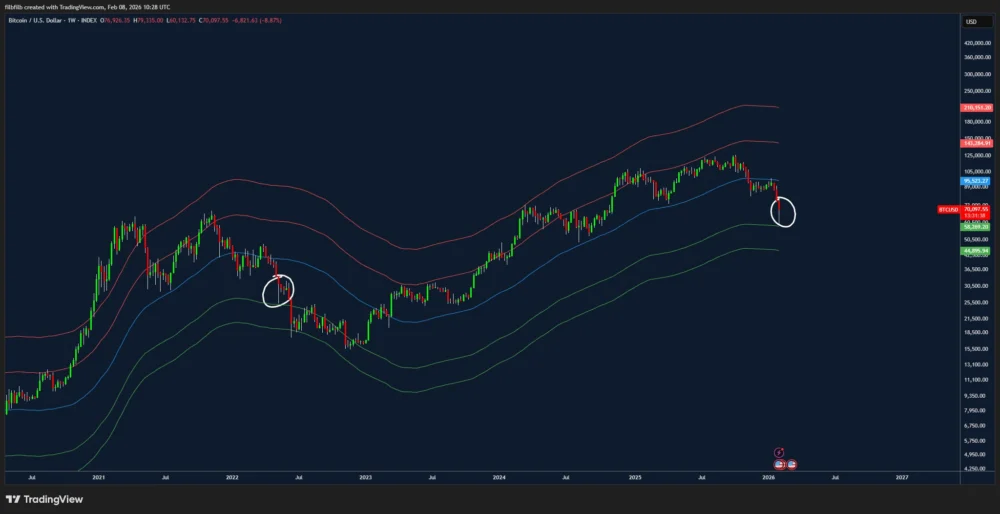
Despite a fleeting Sunday rally that saw Bitcoin (BTC) gain up to 3% and momentarily cross the $71,000 mark, climbing 20% from its recent 15-month lows observed on Friday, a pervasive sense of skepticism has gripped the cryptocurrency market, with numerous analysts warning that the worst of the current downturn may be yet to come, potentially leading to a capitulation event that could drive BTC price below $50,000. This bearish outlook is largely fueled by striking technical parallels to the 2022 bear market, prompting seasoned traders to brace for further declines rather than celebrate the recent rebound.
The cryptocurrency market has been a rollercoaster of emotions, particularly following Friday’s sharp downturn that pushed Bitcoin to its lowest point in over a year. While the subsequent bounce provided some relief, it was met with considerable doubt among market participants, who view it as a potential "dead cat bounce" – a temporary recovery after a significant fall, often followed by a continuation of the downtrend. This skepticism is not unfounded, as historical market cycles frequently exhibit such fleeting rallies during periods of sustained bearish pressure. The current price action, while showing resilience in the short term, is being scrutinized through the lens of past bear markets, raising concerns about the sustainability of any upward momentum.

A key voice in this bearish chorus is independent analyst Filbfilb, who uploaded a compelling chart comparison to X (formerly Twitter), highlighting the stark similarities between current BTC price action and the protracted bear market of 2022. Filbfilb’s analysis centers on Bitcoin’s struggle against its 50-week Exponential Moving Average (EMA), a crucial long-term trend indicator. In his assessment, Bitcoin’s inability to firmly reclaim and hold above this EMA, currently positioned around $95,300, is a worrying sign. "I’m not going to try to dress it up any way other than how it looks," he commented, suggesting an undeniable pattern of resistance that historically precedes further depreciation. The 50-week EMA serves as a dynamic threshold; sustained rejection from it often signals a lack of underlying buying strength and a prevailing bearish sentiment, echoing the challenges faced by Bitcoin during the extended downturn two years prior.
Further amplifying these concerns, analyst Tony Severino, CMT, contributed his own array of price indicators, collectively reinforcing the grim prognosis. While the specific indicators were not detailed, Severino’s conclusions pointed towards an almost inevitable scenario of new lows for Bitcoin. Technical analysts like Severino typically employ a suite of tools – including volume profiles, Relative Strength Index (RSI), Moving Average Convergence Divergence (MACD), and various chart patterns – to gauge market strength and predict future movements. His collective findings suggest that the current market structure lacks the fundamental support needed for a sustainable recovery, making further price depreciation highly probable.
Perhaps the most stark and widely discussed prediction comes from trader BitBull, who unequivocally stated, "$BTC final capitulation hasn’t happened yet," drawing a direct parallel to the 2022 market bottoming process. Capitulation, in financial markets, refers to a point where investors give up on a declining asset and sell their holdings en masse, often at a significant loss, leading to a dramatic price crash. This event is typically characterized by high volume and extreme fear, and historically, it often marks the ultimate bottom before a new bull cycle begins. BitBull’s analysis goes further, pinpointing a critical price level: "A real bottom will form below $50,000 level where most of the ETF buyers will be underwater." This prediction introduces a crucial new dimension to the bear market thesis – the impact of institutional investment via US spot Bitcoin Exchange-Traded Funds (ETFs).

The introduction of spot Bitcoin ETFs in early 2024 was heralded as a monumental step for mainstream adoption, attracting billions of dollars from traditional finance. However, data from monitoring resource Checkonchain reveals that the average buy-in cost for these US spot Bitcoin ETFs currently stands at a substantial $82,000. This figure is critical because if Bitcoin’s price were to drop significantly below this average, especially towards the $50,000 mark, a vast number of these institutional buyers would find their investments "underwater" – meaning the market value of their holdings would be less than their purchase price. This scenario could trigger a cascade of events: institutional investors might face pressure to sell to mitigate further losses, leading to increased selling pressure on the market. Furthermore, the psychological impact of major institutional players holding underwater positions could erode broader market confidence, potentially accelerating the very capitulation event BitBull predicts. The $50,000 threshold, therefore, isn’t just a round number; it represents a psychological and financial breaking point for a significant segment of the market, particularly the newer, institutional capital that entered at higher valuations.
The feeling of "déjà vu" continues to permeate market discussions, especially when examining Bitcoin’s interaction with its long-term moving averages. Cointelegraph previously highlighted a key bear market feature related to the 200-week Simple Moving Average (SMA) and Exponential Moving Average (EMA). These two trend lines often form a "cloud" of significant support or resistance, currently situated between $58,000 and $68,000. Caleb Franzen, creator of Cubic Analytics, elaborated on this phenomenon, drawing direct comparisons to the 2022 bear market.
In one of his latest weekend market takes, Franzen meticulously detailed the historical parallels: "In May 2022, Bitcoin retested its 200-week MA cloud. Bulls said ‘that’s it, we’ve retested the long-term moving average & can continue higher now.’ Price immediately rebounded on that zone, produced a long wick, & closed above the midpoint of the weekly range." He explained that a "long wick" on a candlestick chart indicates that prices briefly touched a low point but were quickly bought back up, suggesting underlying demand. However, this initial rebound proved deceptive. Franzen continued, "But then that rally faded… Price came back into the 200W MA cloud a few weeks later, failed to rebound, then sliced through the cloud in June 2022." This historical account serves as a potent warning for the current market. Franzen concluded, "What are we seeing right now? The first retest of the 200W MA cloud with a long wick." The striking similarity between the current price action and the initial stages of the 2022 bear market’s interaction with this critical support cloud suggests that the recent bounce could be a temporary reprieve, a false dawn before a deeper downturn, mirroring the previous cycle’s trajectory.

The 200-week SMA and EMA are among the most respected long-term indicators in Bitcoin analysis. The 200-week SMA, in particular, has historically acted as a reliable bottoming indicator during previous bear markets, with prices often finding strong support or capitulating below it before a recovery. The "cloud" formed by both the SMA and EMA provides a broader zone of confluence for these long-term trends, making its breach or successful defense a highly significant event. Franzen’s analysis underscores that simply touching or briefly rebounding from this zone might not be sufficient to signal a definitive end to the bearish trend; a sustained hold or a convincing break above it would be required for a change in sentiment.
While the technical analysis and historical comparisons paint a concerning picture, it is crucial to remember Franzen’s own caveat: "The market may not replicate the previous bear market perfectly." He wisely acknowledged, "The reality is that no one knows what happens next." Bitcoin’s market is dynamic and influenced by a myriad of factors, including global macroeconomic conditions, regulatory developments, technological advancements, and unpredictable geopolitical events. While historical patterns offer valuable insights and probabilistic scenarios, they are not infallible predictors of future performance. The influx of institutional capital, the evolving regulatory landscape, and the increasing mainstream awareness of Bitcoin could introduce new variables that deviate from past cycles.
Ultimately, the confluence of skeptical analyst commentary, striking technical parallels to past bear markets, and the looming threat of institutional ETF buyers going "underwater" below $50,000 has ignited a fervent debate about Bitcoin’s immediate future. The recent rebound, while offering temporary relief, is widely perceived by these analysts as a potential trap, a characteristic "fakeout" before a more profound correction or capitulation event. As the market navigates this period of heightened uncertainty, investors are urged to conduct their own thorough research and exercise caution, recognizing the inherent risks involved in such a volatile asset. The coming weeks will be critical in determining whether Bitcoin can defy these bearish predictions or if it is indeed headed for a final, painful capitulation towards the $50,000 mark.

This article does not contain investment advice or recommendations. Every investment and trading move involves risk, and readers should conduct their own research when making a decision. While we strive to provide accurate and timely information, Cointelegraph does not guarantee the accuracy, completeness, or reliability of any information in this article. This article may contain forward-looking statements that are subject to risks and uncertainties. Cointelegraph will not be liable for any loss or damage arising from your reliance on this information.