Faris Adani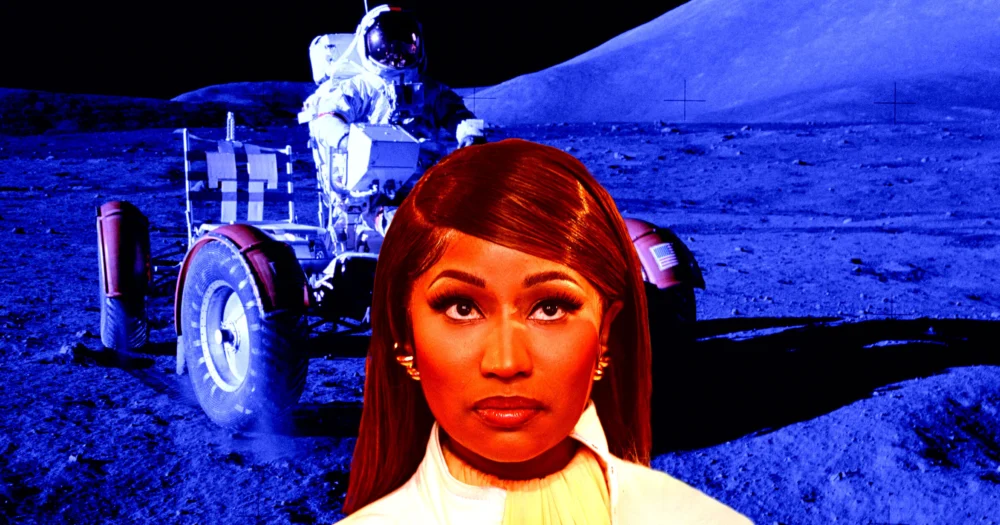
In a surprising turn that has ignited a fresh wave of discussion around celebrity influence and the spread of misinformation, global music icon Nicki Minaj recently declared her belief that humanity never actually landed on the Moon, aligning herself with a long-standing conspiracy theory and adding another layer to her increasingly polarizing public persona. The revelation came during a casual segment on the Katie Miller podcast, where the host, after briefly touching upon the classic Moon landing hoax as one of several popular conspiracy theories, was interrupted by Minaj’s definitive interjection: "No… No, I don’t think we landed on the Moon." Miller, visibly taken aback, pressed for confirmation, to which Minaj unequivocally responded, "No." The podcast host then shared a previous conversation with Elon Musk, her former boss as communications director for his Department of Government Efficiency, where he had affirmed the Moon landing’s authenticity. However, neither Minaj nor Miller chose to elaborate further on the rapper’s stance, leaving the statement to hang in the air and rapidly circulate across social media and news outlets, drawing both support from fellow "truthers" and sharp criticism from scientists, historians, and former astronauts.
The assertion by Minaj reignites a conspiracy theory that has persisted for decades despite overwhelming scientific and historical evidence to the contrary. The claim that NASA faked the Apollo Moon landings, particularly the historic Apollo 11 mission in 1969, has been a fringe belief since shortly after the event itself. Proponents of the Moon landing hoax theory often cite a series of seemingly anomalous details in photographs and videos from the missions. Common arguments include the American flag appearing to wave in the vacuum of space, the absence of stars in lunar photographs, parallel shadows suggesting multiple light sources, and the letter "C" supposedly etched onto a rock. Each of these claims, however, has been thoroughly debunked by experts. The "waving flag" effect is due to a telescoping pole and a horizontal bar designed to make the flag fly on the airless Moon. The lack of visible stars is a result of the bright lunar surface and astronauts’ spacesuits being illuminated by direct sunlight, requiring fast shutter speeds and small apertures on cameras, which prevent fainter objects like stars from being captured. Shadows on the Moon can appear non-parallel due to perspective, wide-angle lenses, and the undulating lunar terrain, not multiple light sources. The "C" rock has been attributed to a stray hair or fiber on a print, or a photographic anomaly, not a prop department error.
Beyond these specific visual "anomalies," some conspiracy theorists have also pointed to the supposed technological limitations of the 1960s, suggesting that NASA lacked the capability to pull off such a feat. Others have implicated famed director Stanley Kubrick, alleging he was hired by the U.S. government to film the fake landings, a notion often linked to the visual style of his film "2001: A Space Odyssey." However, the sheer volume of evidence supporting the Moon landings is staggering. Twelve astronauts walked on the Moon across six successful Apollo missions between 1969 and 1972. They brought back 382 kilograms (842 pounds) of lunar rocks, which have been analyzed by scientists worldwide and found to be geologically distinct from Earth rocks and consistent with formation in a lunar environment. Independent tracking stations around the world, including those in the Soviet Union—America’s Cold War rival—monitored the Apollo missions and confirmed their trajectory to and from the Moon. Furthermore, modern lunar orbiters, such as NASA’s Lunar Reconnaissance Orbiter (LRO), have captured high-resolution images showing the discarded lower stages of the lunar modules, astronaut footprints, rover tracks, and scientific equipment left behind by the Apollo missions, providing undeniable photographic proof of humanity’s presence on the lunar surface. The psychological roots of such conspiracy theories often lie in a deep-seated distrust of authority, a desire for simple explanations for complex events, and the appeal of feeling privy to "secret knowledge" that the masses are unaware of.
Minaj’s embrace of the Moon landing conspiracy theory, while a standalone controversial statement, does not occur in a vacuum. It is the latest in a series of increasingly bizarre and politically charged pronouncements from the "Super Bass" rapper, signaling a dramatic shift in her public and political allegiances over the past few months. Once a vocal critic of former President Donald Trump’s immigration policies, as evidenced by a Facebook post where she attacked his stance, Minaj has since performed a significant ideological pivot, now openly expressing staunch support for Trump and aligning herself with prominent figures on the far right. This transformation has left many fans and observers bewildered, given her past progressive leanings and her substantial platform within the hip-hop community, which traditionally leans left.
One of the most striking examples of this shift occurred in December, when Minaj made an appearance at Turning Point USA’s AmericaFest in Phoenix. Sharing the stage with Erika Kirk, whose husband, Charlie Kirk, the conservative activist and founder of Turning Point USA, had been the subject of various conspiracy theories surrounding his death earlier that year, Minaj’s presence itself was a spectacle. However, it was her attempt to praise former Vice President JD Vance that truly stunned the audience. In a moment of bewildering misstatement, Minaj referred to Vance as "the assassin," rather than his actual title or a term of praise, causing a ripple of confusion and an audible gasp from the crowd. The gaffe was widely circulated, underscoring a perceived lack of familiarity with the political figures she was publicly endorsing, even as she lavished praise upon the Trump administration.
Her public alignment with Trump escalated further in late January, when she attended a Trump summit in Washington D.C., where she stood alongside the former president himself. There, she publicly declared herself his "number one fan," a declaration that was followed by her sharing a photo of a "Trump Gold Card" – a symbolic item often distributed to supporters – further cementing her newfound political identity. This public display of allegiance marked a significant departure from her earlier, more critical stance, solidifying her embrace of the conservative political sphere.
Adding to the growing list of controversies, Minaj also unleashed a torrent of deranged tweets in the aftermath of this year’s Grammy Awards. Following what she perceived as a "light roasting" by host Trevor Noah, Minaj launched a furious online tirade, targeting various individuals and institutions within the music industry. Her tweets contained a slew of shocking accusations, including claims that other artists were members of "satanic cults" and engaged in "sacrificing babies." These unsubstantiated and highly inflammatory remarks further fueled concerns about her judgment and stability, creating an image of a celebrity increasingly detached from conventional public discourse and prone to espousing extreme views.
In light of Minaj’s increasingly outlandish statements, her Moon landing conspiracy theory has drawn sharp rebukes from credible voices. Senator Mark Kelly, a retired NASA astronaut who commanded Space Shuttle Endeavour and served as pilot on Space Shuttle Discovery, offered a particularly pointed response. In a recent interview, Kelly directly addressed Minaj’s "nutty" theory, drawing on his own expertise and the historical context of the space race. "What I often tell people is that, in the 1960s when we were in a competition with the Soviets to land on the Moon, you know what they said after Apollo 11? They said ‘congratulations,’" Kelly stated, emphasizing the crucial detail that America’s Cold War adversary, with its advanced tracking capabilities, had independently verified the mission’s success. He concluded with a direct piece of advice for the rapper: "I would suggest that she lay off the conspiracy theories and study some history." Elon Musk, despite Miller’s casual mention of his previous affirmation, did not offer a public comment directly on Minaj’s statement, but his past unequivocal stance remains a stark contrast to her current position. NASA, while not directly addressing Minaj, consistently maintains that the Moon landings were real, pointing to decades of scientific data, physical artifacts, and the testimony of those who participated in the missions.
Minaj’s embrace of the Moon landing conspiracy theory, coupled with her recent political endorsements and online outbursts, carries significant broader implications. As a globally recognized celebrity with a massive following, her statements hold considerable sway, particularly among younger audiences who may be less equipped to discern fact from fiction. When public figures endorse unfounded conspiracy theories, it contributes to a broader erosion of trust in established institutions, scientific consensus, and verifiable facts. This phenomenon is particularly concerning in what is often termed the "post-truth" era, where subjective beliefs and emotional appeals frequently outweigh objective facts in shaping public opinion. Her actions underscore the powerful, yet often problematic, role celebrities play in shaping cultural narratives and influencing public perception, highlighting the responsibility that comes with such a platform.
Ultimately, while Nicki Minaj is entitled to her personal beliefs, her public espousal of the Moon landing hoax theory stands in stark contrast to decades of scientific evidence, historical documentation, and the testimony of countless individuals involved in the Apollo missions. Her statement, coming amidst a period of notable shifts in her public persona and a series of controversial remarks, serves as a poignant reminder of the ongoing challenge in distinguishing truth from speculation in an increasingly complex and interconnected media landscape. As Senator Kelly aptly suggested, engaging with historical facts and scientific consensus remains the most reliable path to understanding, especially when confronted with claims that defy overwhelming evidence.