anjir abdul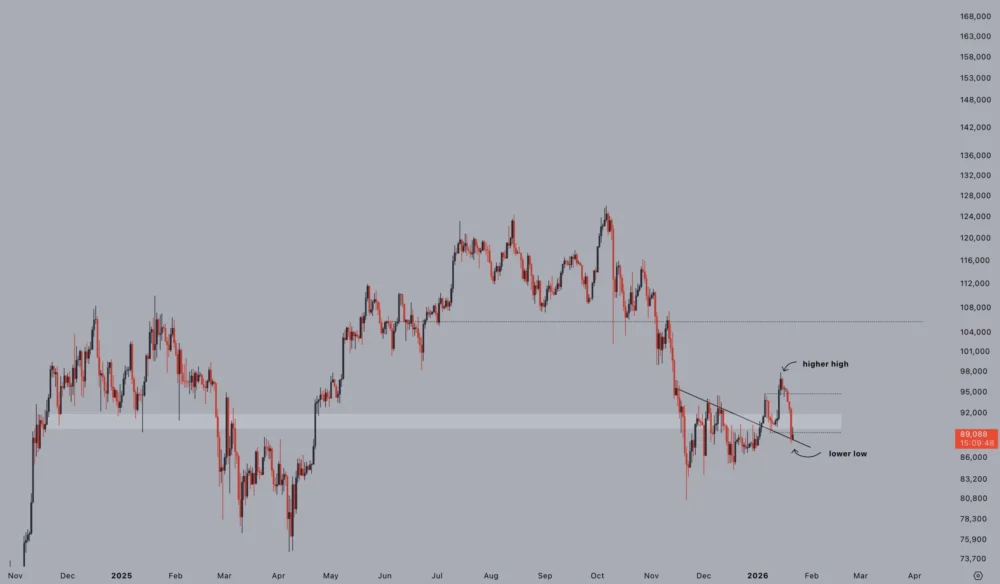
Bitcoin (BTC) found itself at a critical juncture near the $90,000 mark on Wednesday, as its price action decisively hit a significant technical target, triggering both relief and apprehension across the cryptocurrency market. The digital asset’s recent descent not only fulfilled a long-standing "gap" in the CME Group’s Bitcoin futures market but also effectively erased the entirety of its gains accumulated since the dawn of 2026, forcing a re-evaluation of its immediate trajectory and the broader market sentiment.
The $88,000 CME Gap: A Magnet for Price Action
Data meticulously tracked from TradingView revealed Bitcoin registering a modest 1.1% rebound on the day, clawing back slightly after a sharp decline saw it touch $87,800. This particular move carried substantial weight, marking the lowest price levels Bitcoin had experienced since the very beginning of January. In doing so, BTC/USD had not merely corrected; it had systematically unwound more than $10,000 from its month-to-date highs, a stark reversal for investors who had celebrated a promising start to the year.
The pivotal event, however, was the closure of an open "gap" in CME Group’s Bitcoin futures market, specifically the one formed at the yearly open. For those unfamiliar with the intricacies of futures trading, a CME gap emerges when Bitcoin’s price on the regulated CME futures market opens significantly higher or lower than where it closed the previous trading session, often over a weekend when spot crypto markets remain active. This discrepancy creates a "gap" on the chart, which many traders, especially those focused on technical analysis, believe acts as a magnet for future price action. The prevailing wisdom suggests that these gaps are eventually "filled," meaning the price tends to return to that level to close the void. As Cointelegraph had previously highlighted, such gaps frequently function as short-term price targets, with the market often gravitating back to them within a matter of days or even hours, driven by a combination of algorithmic trading and psychological self-fulfilling prophecies. The fulfillment of the $88,000 gap therefore represented a significant technical milestone, satisfying a condition many analysts had been eyeing for a potential "reset" or consolidation.

BTC Price "Not Looking Strong" After Gap-Fill: Mixed Trader Sentiment
Despite the technical objective being met, the mood among market participants remained decidedly mixed, with many analysts expressing growing skepticism about Bitcoin’s immediate strength. With other, higher gaps still open above the current spot price, some saw potential for a quick reversal, while others anticipated further downside.
Prominent trader CW, for instance, articulated a nuanced perspective to his X followers. He posited that the gap-fill was a necessary precursor to ensure a "stable rally." In his view, a genuine and sustainable upward movement required the market to address these technical imbalances first. "A rapid rise is expected," he optimistically stated, suggesting that with the technical hurdle cleared, Bitcoin was now better positioned for a robust ascent rather than a volatile, short-lived pump. This perspective suggests that while the decline was painful, it served a corrective purpose, clearing the path for healthier growth.
However, an increasingly bearish sentiment was championed by trader Jelle, who meticulously analyzed the daily chart. Jelle pointed to a worrying technical pattern: "Higher high immediately followed by a lower low." This sequence, particularly after an initial breakout from a downward-sloping trendline, is often interpreted by technical analysts as a bearish divergence, indicating a loss of momentum and a potential trap for bullish traders. His summary painted a clear picture of concern: "CME Gap filled and price retesting the trendline once again – but we can all agree that this ain’t looking strong anymore." The retest of the trendline, especially if it fails to hold as support, could signal a deeper retracement. The combination of the gap-fill, which might have exhausted immediate buying pressure, and the deteriorating technical structure, led Jelle and others to conclude that Bitcoin’s immediate prospects were grim, or at best, uncertain. The market seemed to be wrestling with the question of whether the gap-fill was a launching pad for recovery or merely a temporary pause before a further decline. The absence of strong buying volume at these levels further exacerbated bearish concerns, suggesting a lack of conviction among buyers.
Bitcoin Investors in "Capital Preservation" Mode Amid Macro Headwinds

Beyond the technical charts, the broader macroeconomic landscape continued to exert a profound influence on crypto market analysis, particularly ahead of the Wall Street open. The prevailing global economic conditions were dictating investor behavior, pushing many into a "capital preservation" mindset rather than a speculative one.
In its latest "Asia Color" market update, trading company QCP Capital offered a sobering assessment of Bitcoin’s current role within the financial ecosystem. The report characterized Bitcoin as "trading like a high-beta risk asset, highly sensitive to rates, geopolitics, and cross-market volatility." This description underscores a fundamental shift in how institutional investors perceive Bitcoin. Instead of a purely uncorrelated, decentralized hedge, it is increasingly seen as an asset that amplifies broader market movements, particularly those driven by macroeconomic factors.
- Sensitivity to Rates: Rising interest rates, often implemented by central banks to combat inflation, make traditional fixed-income investments more attractive. This draws capital away from riskier assets like cryptocurrencies, as the opportunity cost of holding volatile assets increases. Higher rates also tighten liquidity, making it more expensive for investors to borrow and speculate.
- Geopolitical Factors: Global instability, conflicts, and political uncertainties typically drive investors towards traditional safe havens. In times of crisis, the perceived risks of digital assets, despite their decentralized nature, can outweigh their potential benefits, leading to outflows.
- Cross-Market Volatility: When volatility spikes in traditional markets—equities, bonds, or commodities—it often cascades into the crypto space. Bitcoin, being a relatively nascent and less liquid asset class compared to traditional markets, tends to experience amplified price swings during periods of heightened global market turbulence.
QCP Capital concluded that "Until clearer policy signals emerge, crypto is likely to stay reactive rather than directional." This implies that Bitcoin’s price movements are currently more a reflection of external forces and less driven by its intrinsic developments or specific crypto-native catalysts. The market is effectively in a holding pattern, waiting for clearer guidance from central banks regarding monetary policy and for a reduction in global geopolitical tensions.
The report further emphasized the overarching theme: "For now, this is a market focused on capital preservation over conviction, watching closely whether policy missteps turn today’s tremors into something more systemic." This sentiment highlights a cautious approach among institutional investors, who are prioritizing the protection of capital over aggressive bets on market direction. The fear is that any missteps in economic policy—be it from central banks or governments—could exacerbate current market jitters, potentially triggering a more widespread financial crisis that would undoubtedly impact all asset classes, including cryptocurrencies. Such systemic risk would force a deeper flight to safety, further challenging Bitcoin’s recovery.
Gold’s Historic Rally: A Traditional Hedge Outperforms

In stark contrast to Bitcoin’s struggles, the traditional safe-haven asset, gold, continued its relentless ascent, reaching yet another all-time high of $4,888 per ounce on the day. This historic rally in gold serves as a powerful indicator of the prevailing market anxieties and the "capital preservation" theme.
Gold has historically been a store of value, particularly during periods of economic uncertainty, high inflation, or geopolitical instability. Its physical nature and long-standing reputation as a hedge against fiat currency debasement make it a preferred asset when confidence in financial systems wavers. The Kobeissi Letter, a trading resource, aptly captured the significance of gold’s performance, reacting with awe: "We are all witnessing history right now."
The divergence between gold’s robust performance and Bitcoin’s struggle underscores the current market narrative. While Bitcoin has often been touted as "digital gold" and a hedge against inflation, its recent behavior as a "high-beta risk asset" means it is currently correlating more with equities and other risk-on assets rather than acting as an uncorrelated safe haven. In an environment where investors are seeking genuine safety and stability, physical gold, with its centuries-long track record, is proving to be the asset of choice. This suggests that for now, Bitcoin’s journey to becoming a universally accepted safe haven is still a work in progress, particularly when confronted with profound macroeconomic and geopolitical uncertainties that compel investors towards time-tested sanctuaries of wealth. The question remains whether Bitcoin can eventually shed its high-beta correlation and assert its role as a true independent store of value in the face of future global tremors, or if it will continue to dance to the tune of broader market sentiment.
This article does not contain investment advice or recommendations. Every investment and trading move involves risk, and readers should conduct their own research when making a decision. While we strive to provide accurate and timely information, Cointelegraph does not guarantee the accuracy, completeness, or reliability of any information in this article. This article may contain forward-looking statements that are subject to risks and uncertainties. Cointelegraph will not be liable for any loss or damage arising from your reliance on this information.